Artisan crafts in Venice: what to make, watch, and buy
Venice: Carnival mask workshop
What artisan crafts can you experience in Venice?
Venice's main artisan traditions include Murano glassblowing, Carnival mask-making, Burano lacemaking, marbled paper (carta marmorizzata), gondola and rowing equipment (fórcole and rèmi), and traditional bookbinding. Hands-on workshops exist for all of these except lacemaking. Most shops near San Marco sell mass-produced imports — genuine artisan work requires knowing where to look.
Venice’s artisan heritage: what survives and why it matters
At its medieval and Renaissance peak, Venice was one of the most densely specialised manufacturing centres in Europe. The city’s guilds covered not just the well-known industries — glass, lace, textiles — but hundreds of trades: spice merchants, comb-makers, mirror-polishers, booksellers, bellmakers, silk dyers. The Rialto market was not just a fish market but the commercial clearing house for half of Europe’s long-distance trade.
Most of those specialised crafts are gone. But Venice’s remaining artisan traditions — glassblowing on Murano, Carnival mask-making, Burano needle-lace, marbled paper, the construction and maintenance of gondolas and their equipment — survive in working form. They are not museum exhibits. They are living practices carried on by people who learned from their predecessors, who learned from theirs.
Understanding what is genuinely handmade, where to find it, and what hands-on workshop experiences are available turns what could be another souvenir-shopping afternoon into something with actual depth.
| Where | Murano (glass), Burano (lace), San Marco/San Polo/Santa Croce/Dorsoduro (paper, textiles, bookbinding) |
| Cost | Around €25–60 for a Murano glass souvenir; €50–100+ for a guided hands-on workshop |
| Time needed | 1–2 hours for most workshops; a half-day if combining Murano travel with a session |
| Getting there | Vaporetto (ACTV) to Murano; on foot within the historic centre for the rest |
| Best time | Weekday mornings, when workshops are less booked and shops are quieter |
Murano glassblowing
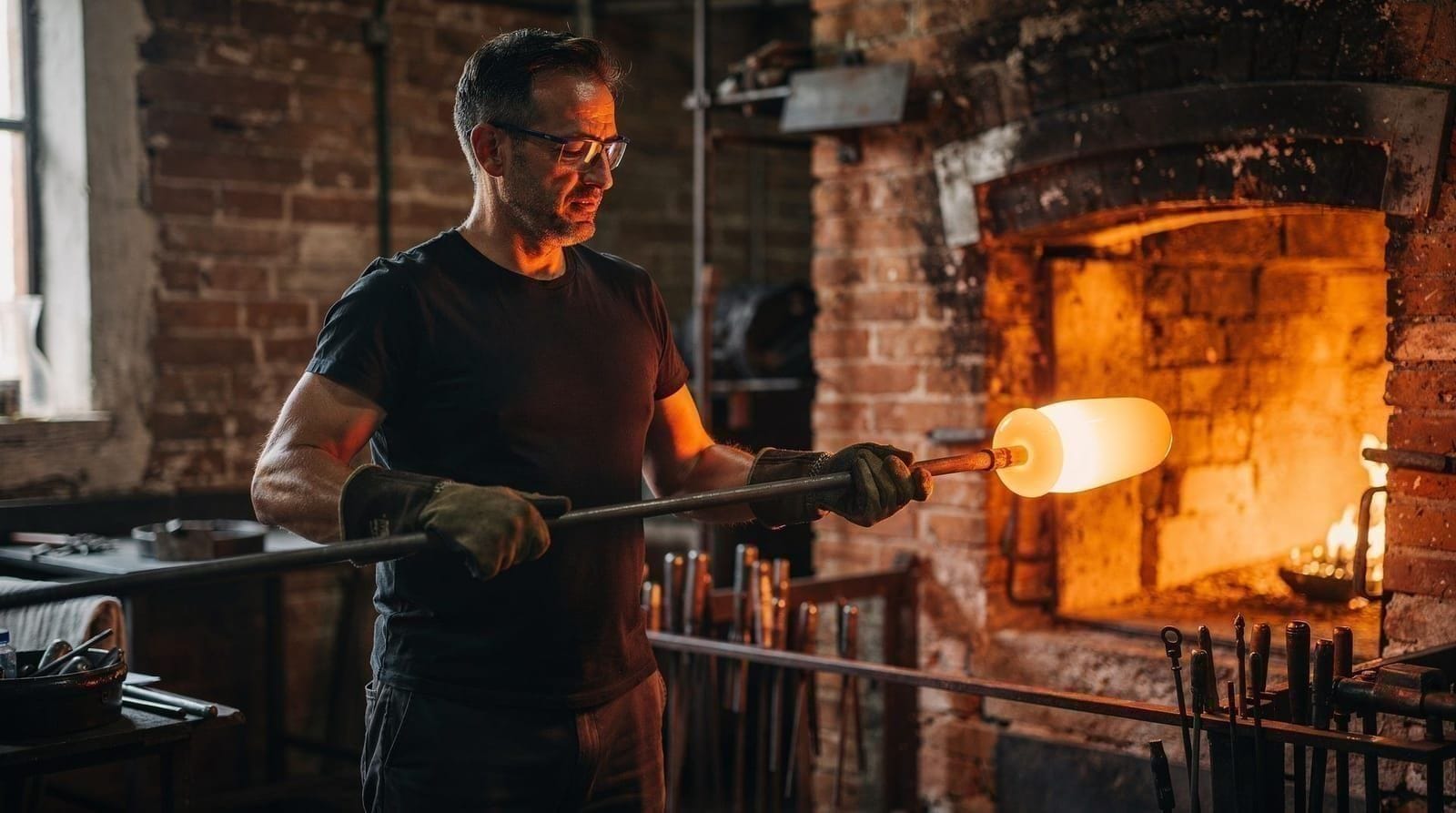
The most internationally famous of Venice’s artisan traditions, and the one with the most hands-on workshop opportunities. Glassmakers were relocated from Venice proper to Murano in 1291, officially to reduce fire risk — but also to contain the valuable trade secrets. Maestros were granted noble privileges but forbidden to leave the Republic. The techniques they developed over subsequent centuries — millefiori (a mosaic of glass rods fused into a single piece), filigrana (twisting coloured glass threads through clear glass), and the extraordinary sommerso (overlaid layers of different-coloured glass) — remain the defining standards of the craft.
Today, approximately 35–40 working furnaces remain on Murano. A handful offer genuine hands-on workshops where visitors can blow a piece under a maestro’s guidance. Read the full Murano glassblowing workshop guide for how to choose between them.
The Murano glassblowing demo and workshop combines watching a maestro work with a hands-on session for participants. It is the most widely available format and a good introduction.
Carnival mask-making
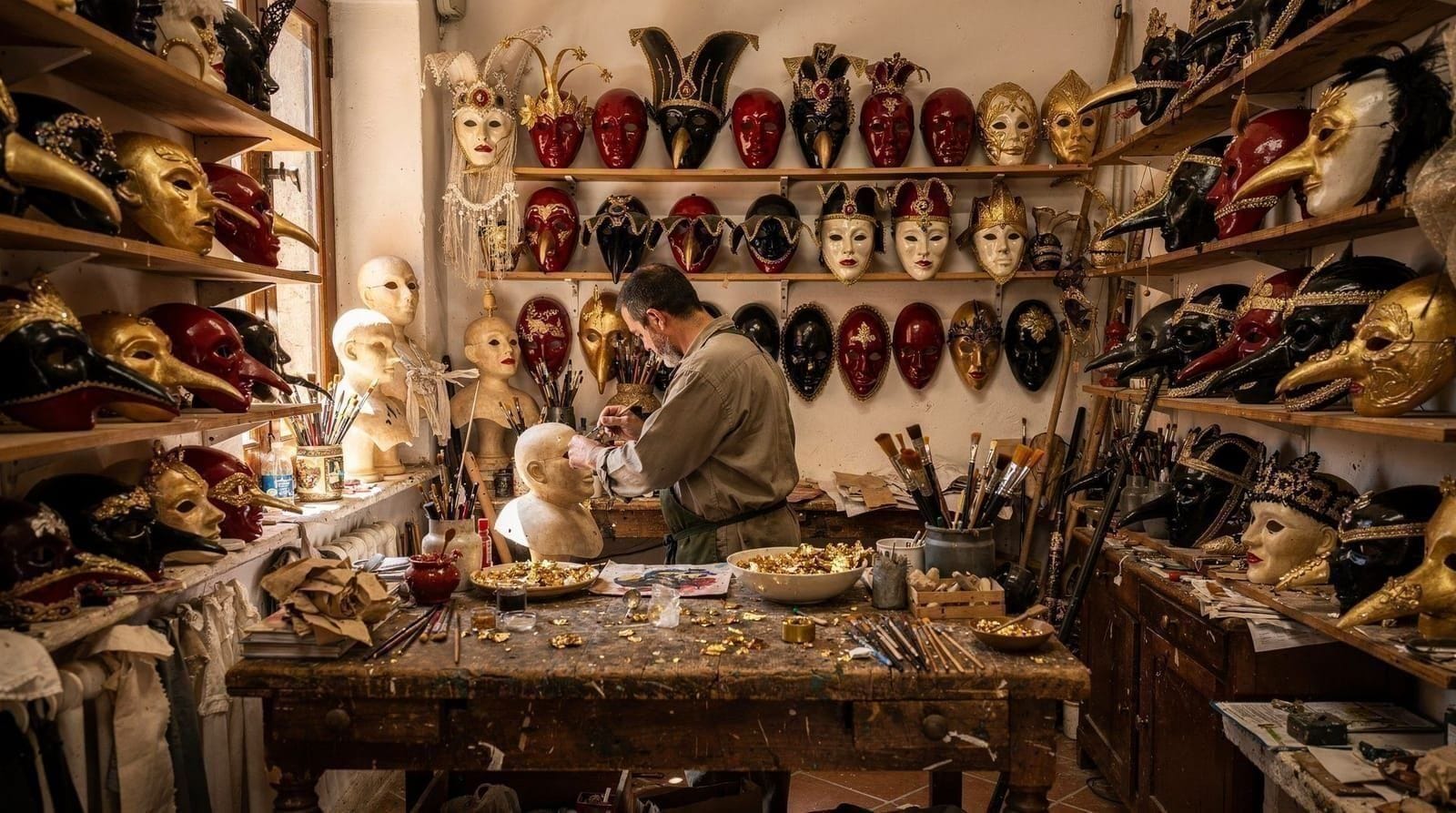
Venetian mask-making (mascherari) has been a recognised guild trade since the 13th century. The masks that defined Venice’s Carnival — the bauta, the moretta, the medico della peste, the colombina — each have specific histories tied to Venetian social and theatrical life. Read the full Venetian mask history guide for that context.
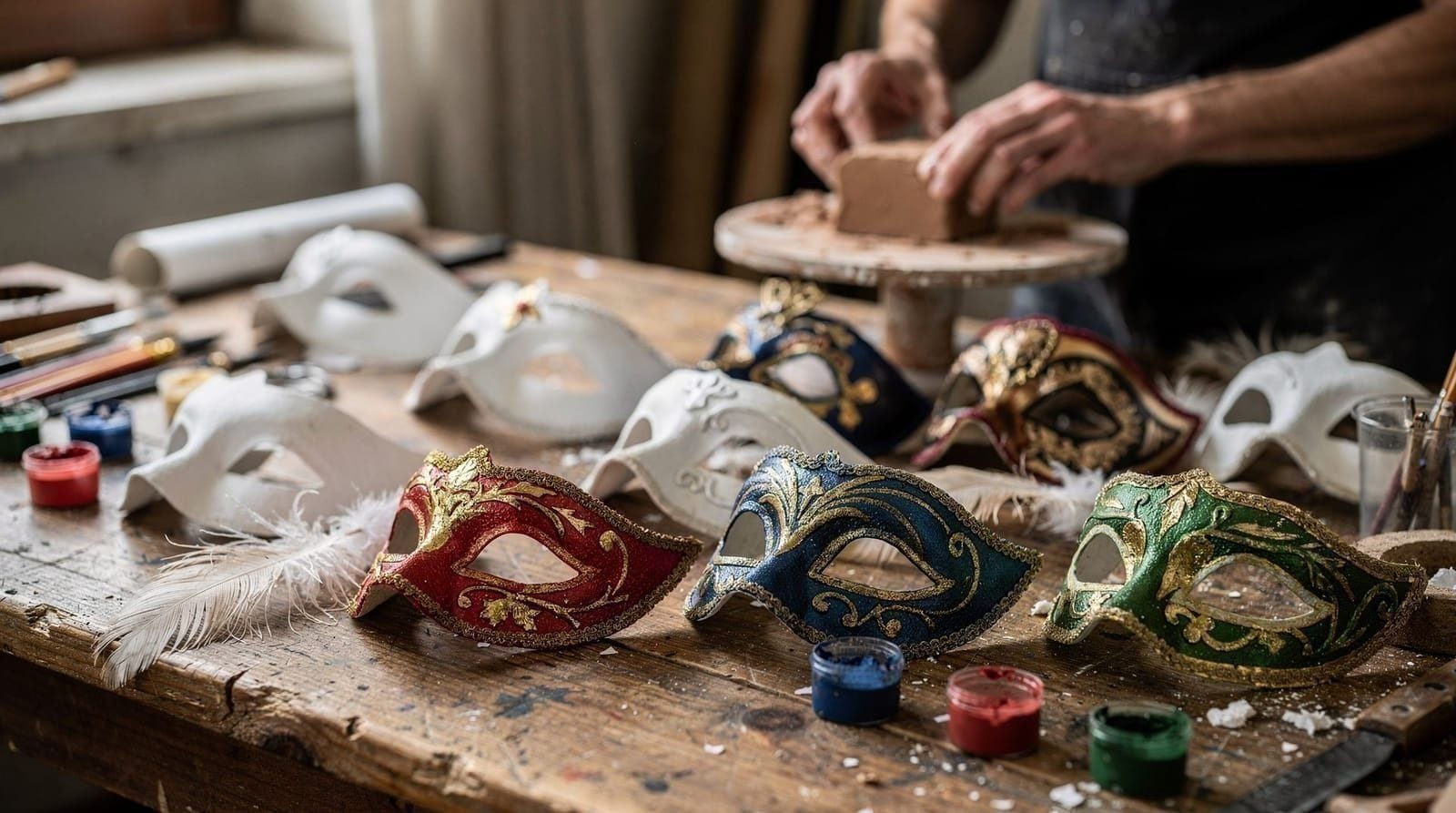
Today’s workshops typically focus on the decorating stage rather than the underlying construction (which involves layering papier-mâché over a clay form over several days). You paint and decorate a pre-formed base mask using traditional pigments, gold leaf, feathers, and ribbons. The best workshops pair the practical work with genuine historical explanation.
The Venice Carnival mask workshop is one of the most established options, with instructors who teach both the technique and the history. See the mask-making workshop guide for a full comparison of what is available.
Marbled paper (carta marmorizzata)
Marbled paper arrived in Venice from Persia via Turkey, carried along the same trade routes that brought spices and textiles. By the 18th century, Venetian marbled paper was the standard material for bookbinding endpapers across Europe. The technique uses a shallow tray of water with a carrageenan thickener; oil-based pigments are floated on the surface and combed or swirled into patterns, then a sheet of paper is laid on the surface to pick up the image.
The craft nearly disappeared in the 20th century but was revived by a small number of dedicated practitioners from the 1970s onward. Legatoria Piazzesi (Campiello della Feltrina, near Piazza San Marco) is the oldest continuously operating paper craft shop in Venice, with roots in the 18th century. Alberto Valese (Campiello Santo Stefano, San Marco) produces marbled paper and handmade books; he is considered one of the key figures in the revival. Both shops sell finished paper and bound books, and some offer short demonstrations.
If you are interested in learning the technique, a few specialist workshops offer half-day paper marbling sessions, though these are harder to find than glass or mask workshops. Ask at the shops directly.
The fórcola and the remèr’s craft
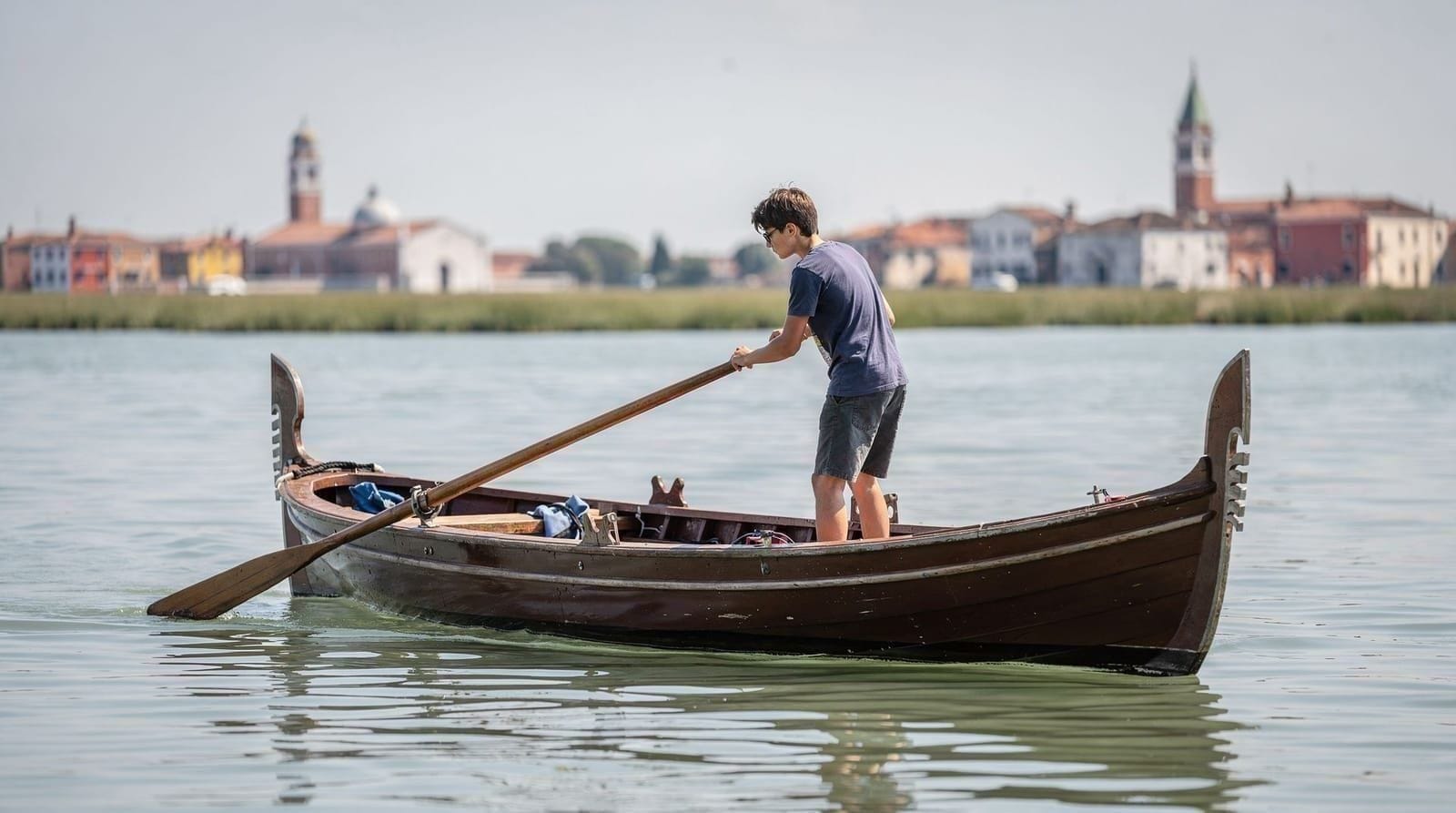
The fórcola — the S-shaped carved wooden rowlock at the stern of a gondola — is one of Venice’s most overlooked artisan objects. Each fórcola is made by hand to fit a specific rower: height, arm length, and rowing style all affect the shape. The carver, called a remèr, works from walnut root using chisels and gouges, gradually revealing the complex form that allows the multiple rowing positions essential to voga alla veneta.
There are fewer than six working remèr workshops remaining in Venice. Saverio Pastor on Fondamenta Soranzo della Fornace in Dorsoduro is the best-known; his workshop is visible from the street and occasionally open to visits. The fórcole he produces range from functional pieces for working gondoliers to decorative wall objects sold as art.
For a working understanding of why the fórcola’s design matters, join a rowing lesson first. The voga alla veneta lesson guide explains the technique and how the equipment enables it.
Gondola construction: the squeri
A squero is a boatyard. Venice once had dozens; today there are only two or three functioning squeri capable of building and repairing traditional wooden boats. The most visible is the Squero di San Trovaso in Dorsoduro, which can be viewed from the bridge on Fondamenta Nani. The yard operates openly, and if you stand on the bridge for even 10 minutes on a working day, you may see a gondola being repaired, caulked, or painted.
A gondola is an asymmetric hull — the left side is wider than the right, compensating for the gondolier’s weight and the single-oar rowing position. It is made of eight different types of wood (typically mahogany, oak, cherry, walnut, fir, and others) and requires months of skilled work to build. A new gondola costs approximately €35,000–€45,000. Most are refurbished rather than replaced; a well-maintained gondola can last 20–25 years.
Burano needle-lace
The most precarious of Venice’s surviving crafts. Burano’s punto in aria (literally “stitch in the air”) is a form of needle-lace built entirely on thread without a fabric foundation — each loop is created and secured individually with a needle. A skilled lacemaker working full-time takes weeks to produce a piece of moderate complexity. The resulting fabric is extraordinarily fine and expensive.
The honest reality: nearly all of the lace sold in Burano’s shops today is machine-made and imported. The island’s genuine lacemaking community has dwindled to a small number of elderly women. The Museo del Merletto on Burano displays historical examples and explains the technique, and a few demonstrators still work there. But buying a piece of genuine handmade Burano needle-lace requires a specific conversation with a craftsperson — not a purchase from a market stall.
If Burano interests you beyond the lace, the Burano colours and photography guide covers the island’s other considerable appeal.
Traditional bookbinding
Venice’s publishing industry was one of the first in Europe — Aldus Manutius established the Aldine Press here in 1494 and invented the italic typeface and the portable octavo book format. The bookbinding tradition that supported it survives in a handful of workshops producing handmade books using historical techniques.
Legatoria Polliero (Campo dei Frari, San Polo) is a small workshop near the Frari church that produces handmade notebooks, journals, and bound books. The work is done on-site, and the owner occasionally discusses technique with interested visitors.
The glass from Murano vs. glass sold in Venice: how to tell the difference
An estimated 70–80% of glass sold as “Murano glass” in Venice’s tourist shops is not made on Murano. It is manufactured in China or Eastern Europe using machine processes, then sold in Venice with labelling that implies but does not guarantee Murano origin.
The tell-tale signs of non-Murano production:
- Perfectly uniform surface texture: Hand-blown glass has slight variations in thickness, surface texture, and colour distribution. Machine-made glass is perfectly consistent. Under direct light, the difference is visible.
- Unusually low prices: A handmade Murano glass paperweight made by a skilled artisan costs approximately €25–€60 depending on complexity. A piece sold for €8 has not been made by hand in a Venetian furnace.
- Plastic rather than glass: Some items sold as Murano glass are actually acrylic — lighter, warmer to the touch, and without the slight ring of glass when tapped.
- No visible production link: Genuine Murano studios will typically direct you to the furnace or display photographs of their production. Shops that simply buy and resell cannot do this.
The Vetro Artistico Murano trademark — a distinctive blue sticker — is the official certification for genuine Murano glass, administered by the Veneto region. It is not universally applied by all genuine Murano producers, but its presence is a reliable positive indicator. Workshops that conduct genuine production will always have it available if asked.
Venetian textiles: what to look for
Venice’s textile tradition was as significant as its glass and lace industries. The city was the primary European trading post for silk, velvet, and brocade from the East, and it developed its own weaving industry over the medieval and Renaissance periods. The term damask derives from Damascus via Venice — Venetian merchants brought Syrian silk-weaving techniques back along the trade routes and adapted them.
Today, genuine hand-woven Venetian fabrics are made by a small number of workshops, primarily using restored historical looms. Luigi Bevilacqua (Santa Croce) operates the most famous of these workshops, weaving velvet and lampas on 18th-century hand looms. Their fabric sells at prices that reflect the skill involved — several hundred euros per metre — and is used for costume productions, interior furnishings, and museum conservation. Visitors can watch the weavers working.
Rubelli (Palazzo Corner Spinelli, San Marco) is one of the oldest Venetian textile firms, producing high-quality furnishing fabrics with historical designs. Their showroom is accessible to visitors.
For more affordable Venetian-style textiles, the market stalls in Campo Santa Margherita and the shops in Cannaregio and San Polo carry scarves, table linens, and small decorative items in distinctive Venetian patterns — bauta masks, moretti figures, geometric designs derived from historical brocade patterns.
Goldbeating and metalwork
Less well-known than glass or lace, Venice’s tradition of decorative metalwork survives in a handful of workshops. The battiloro (goldbeaters) who supplied the gold leaf used in glass-making, gilding, and icon-painting were a recognised guild in the medieval Republic. Today, gold leaf production is rare, but several workshops in Venice still produce decorative metalwork using historical techniques.
Gilding — the application of gold leaf to picture frames, furniture, and decorative objects — is practised by a small number of specialist restorers who also work commercially. If you see a workshop with a gilder’s tools visible (burnishing tools, gilder’s knife, cushion, loose gold leaf in books), it is worth pausing. The craft is genuinely old and the practitioners are rare.
Practical advice: how to find genuine artisan work
The most reliable filter is location and observation. Shops in the immediate vicinity of Piazza San Marco and the Rialto Bridge are overwhelmingly selling tourist goods with no connection to Venetian craft production. Move one or two streets away from the main tourist corridors and the quality improves noticeably.
Look for:
- A visible workshop space — if you can see production happening, the goods are more likely to be genuinely local.
- The Artigiano a Venezia certification — a municipal scheme verifying local craft production.
- Prices consistent with skilled labour — a handmade Murano glass piece that costs €8 is not handmade.
- A maker who can explain their technique — genuine artisans welcome questions about their process.
The Dorsoduro guide and San Polo and Rialto guide include notes on which streets in each sestiere have the highest concentration of working craft studios.
Which workshop should you choose
If you only have time for one hands-on experience, this comparison helps narrow it down:
| Workshop | Time | Cost (approx.) | Best for |
|---|---|---|---|
| Murano glassblowing demo + workshop | 1–1.5 hours | €50–90 | Anyone wanting to see and try the most famous Venetian craft |
| Carnival mask decorating | 1–1.5 hours | €40–70 | Families, children old enough to paint carefully |
| Voga alla veneta (Venetian rowing) | 1.5–2 hours | €60–90 | Active travellers wanting a physical, on-the-water experience |
None of these requires prior skill. The glassblowing workshop is the most photogenic and the most closely tied to Venice’s global craft reputation; the mask workshop is the easiest to slot into a family day; the rowing lesson is the most unusual and gives real insight into how the fórcola and gondola actually work together.
Combining a craft workshop with the rest of your day
A Murano glassblowing session pairs naturally with a wider Murano and Burano day — see the Murano vs Burano guide and the Murano glass guide for how to structure the islands portion around a workshop. Mask workshops sit comfortably within a San Marco or Cannaregio day, and are a reliable option on a Venice with kids itinerary when museum fatigue sets in. If you are building a full itinerary and want to know where a craft activity best slots in, the 2-day Venice itinerary and 3-day itinerary both leave natural gaps for exactly this kind of hands-on afternoon.
What a genuine workshop actually feels like
The honest expectation-setting: a one-hour glassblowing “workshop” rarely means you personally blow a full finished piece unsupervised — safety and the realities of a 900°C furnace mean the maestro does the technically dangerous parts while you shape, blow into a tube under close guidance, or finish a simpler piece such as a small paperweight or bead. This is not a letdown; watching a maestro work at close range, with narration, is itself the highlight for most visitors, and the hands-on portion is a genuine, if guided, participation rather than a token gesture. Mask and rowing workshops are more directly hands-on throughout, since neither involves molten material at extreme temperature.
Frequently asked questions about artisan crafts in Venice
Is it possible to buy genuinely handmade Venetian crafts?
Yes, but you need to look beyond the San Marco tourist strip. Certified artisan workshops produce glass, masks, paper, and leather goods on-site. The Dorsoduro, San Polo, and Cannaregio sestieri have higher concentrations of working artisans.
What is marbled paper and where can I buy it in Venice?
Carta marmorizzata is handmade paper decorated with swirling pigment patterns using a technique that originated in Persia and reached Venice via trade routes. Legatoria Piazzesi and Alberto Valese are among the most established producers.
What is a fórcola, and where are they made?
A fórcola is the carved wooden rowlock used in Venetian gondolas. Each is individually carved from walnut root to fit a specific rower. The craftsmen who make them are called remèri. Only a handful of working workshops remain, primarily in Dorsoduro.
Is Burano lace still made by hand?
Genuine needle-lace from Burano is extremely rare and expensive. Most lace sold in Burano shops is machine-made and imported. The Museo del Merletto on Burano explains the history and displays genuine historical examples.
What craft workshops are best for families with children?
Mask-painting workshops are ideal — the paints are non-toxic and the result is immediate. Glassblowing workshops have minimum age requirements. Paper marbling is also suitable for older children.
Do I need to book artisan workshops in advance?
Yes, for glassblowing and mask workshops it is strongly recommended, especially in peak season (April–October) and during Carnival, when demand is highest. Walk-in availability exists but is unreliable, and popular time slots fill days ahead.
Can I take my finished piece home the same day?
Mask-painting pieces are usually ready to take immediately once the paint has set. Glass pieces from a workshop session are typically small (a paperweight or bead) and can travel home in hand luggage if carefully wrapped, though anything larger or more fragile is generally better shipped by the studio.
Top experiences
Bookable activities with verified prices and instant confirmation on GetYourGuide.