Voga alla veneta: learning Venetian rowing in Venice
Venice: 2-hour Venetian rowing lesson
Can tourists learn Venetian rowing in Venice?
Yes. Several operators offer 2–2.5 hour lessons in voga alla veneta, the traditional technique of rowing standing up and facing forward, using a single oar in a pivoting lock called a fórcola. Lessons cost €50–€80 per person and take place on the canals or the lagoon. No prior experience needed.
Standing on water: what voga alla veneta actually feels like
The first thing that strikes you, climbing into a batèla or a sandolo (the traditional flat-bottomed boats used for lessons), is that standing upright in the stern feels much less precarious than it looks from the shore. The hull is wide and stable. The fórcola — the carved wooden rowlock — is positioned exactly where your hip naturally sits. The oar, which a gondolier calls a rèmo, is longer and heavier than most people expect: typically 4–5 metres.
| Where | Mostly Dorsoduro (near Squero di San Trovaso) or the northern lagoon off Fondamente Nove |
| Cost | Around €50–80 per person for a 2–2.5 hour lesson |
| Time needed | 2–2.5 hours |
| Best for | Couples, pairs, anyone wanting an active alternative to a passive gondola ride |
| Booking | Advance booking recommended, especially April–October |
Your instructor, almost certainly someone who has been rowing since childhood, will spend the first few minutes showing you the basic stroke. The oar moves through the water in a figure-eight pattern — forward, through the water, back, and then a twist at the end that provides the crucial steering correction. Watch a gondolier from a bridge for ten minutes and you will see this pattern thousands of times. It looks effortless. It is not.
The hardest part in the first lesson is not the rowing motion itself but the coordination of standing balance with the rowing movement. You are on a moving platform, moving a long lever through water, trying to maintain your footing as the boat shifts under you. Within 30 minutes, most people find a rough equilibrium. By the end of a two-hour session, the movement starts to feel natural — not easy, but natural.
The history of voga alla veneta
Venice built its empire on water, and the men who rowed its boats — gondoliers, ferrymen, sailors — were essential to its functioning for centuries. The specific technique of voga alla veneta evolved over hundreds of years to meet the demands of the Venetian environment: narrow canals requiring precise steering, shallow lagoon waters requiring a flat-bottomed hull, and traffic conditions requiring the ability to manoeuvre quickly.
The fórcola is perhaps the most ingenious element. Unlike a simple rowlock, the fórcola’s complex S-shaped profile provides multiple contact points for the oar. A gondolier can move the oar to different positions on the fórcola to achieve different strokes — the standard forward propulsion stroke, the braking stroke, the tight-turn stroke — without repositioning the hands. The fórcola is custom-carved for each gondolier by a specialist craftsman called a remèr, and a good fórcola represents weeks of skilled work.
The remèr’s craft is itself worth exploring. There are only a handful of traditional rèmer workshops remaining in Venice, and several are open to visitors. See the artisan crafts guide for more on these surviving workshops.
The gondolier’s training
To become a licensed gondolier in Venice today requires passing a competitive exam that is notoriously difficult. There are approximately 430 licensed gondoliers in Venice, down from over 10,000 in the city’s heyday. The exam tests practical rowing skills, knowledge of Venice’s waterways, history, and foreign language ability. Only recently, after centuries of exclusion, have women been permitted to take the exam; in 2010, Giorgia Boscolo became the first female gondolier.
Most of the gondoliers working today are Venetians born to families with generational connections to the water. Some learned voga alla veneta as children. The competitive exam is currently held approximately every two years, and the waiting list for a licence is long.
What a standard rowing lesson includes
A typical 2-hour voga alla veneta lesson begins with a brief introduction on shore: the instructor explains the equipment, the basic stroke mechanics, and the safety rules. You then board the boat at a canal-side or lagoon-edge location.
The 2-hour Venetian rowing lesson is the standard format — you spend the full session actively rowing, with the instructor beside or behind you correcting your technique. You cover a short stretch of canal or lagoon that varies depending on conditions. By the end, most participants can maintain forward motion and execute basic turns.
For a more narrative approach — where the rowing lesson is paired with the story of Venetian maritime culture — the discover the secret craft of Venetian rowing session adds historical and cultural context to the practical instruction. The instructor explains the history of the fórcola, the gondola’s construction, and the social role of the gondoliers. It runs slightly longer and costs a little more, but is particularly suited to travellers who want to understand the craft rather than just experience it.
If you specifically want to row on the Grand Canal — and the spectacle of doing so is undeniable — the rowing class and waterways tour on the Grand Canal runs 2.5 hours and covers more water than the standard lesson, with the Grand Canal as the centrepiece route.
Where lessons take place
Most rowing lessons take place in the Dorsoduro area, near the Squero di San Trovaso (one of the last working gondola boatyards in Venice) or along the Giudecca Canal. Some operate from the northern shore of the island, near Fondamente Nove, with access to the open lagoon.
The lagoon is preferable for longer lessons — there is more space and fewer navigation obstacles than the inner canals. Canal-based lessons are slightly more atmospheric (you are rowing through the city) but require more precise steering.
The fórcola as an art object
If voga alla veneta captivates you — and it does many people more than they expected — the fórcola deserves more attention. The best examples are carved from walnut root, a dense and close-grained material that machines cannot easily replicate. The carver (remèr) works by hand with chisels and gouges, gradually revealing the S-shape that allows the multiple rowing positions.
Several Venice museums hold antique fórcole as museum objects. Contemporary remèr workshops also sell decorative pieces — fórcole made as wall objects or as stand-alone sculptures. The Squero di San Trovaso, which can be viewed from the bridge on Fondamenta Nani in Dorsoduro, sometimes opens for visits that include a view of boatbuilding and rowing equipment.
Combining a rowing lesson with canal exploration
A morning rowing lesson pairs naturally with an afternoon on the water as a passenger. After experiencing how much effort goes into moving a boat through Venice’s canals, even a brief vaporetto ride or water taxi feels different — you watch the engines with new respect, and you understand why the gondoliers’ technique is as refined as it is.
For a different water perspective, the hidden canals tour takes you through the smaller waterways by boat, while the Grand Canal by boat guide covers the main artery at length. The gondola ride guide explains the standard tourist gondola experience and how it compares to the rowing lesson.
The sounds and feel of voga alla veneta
There is something specific to the sensory experience of voga alla veneta that no description quite captures: the sound the oar makes in the fórcola as it rotates between strokes — a slight wooden click — and the way the boat responds not to your hands but to your entire body. Standing rowing requires the engagement of the whole posture: legs slightly bent, weight shifting from foot to foot, torso rotating with each stroke. It is closer to dance than to the seated rowing most people associate with the word.
When it goes wrong — and in the first lesson it frequently does — the most common error is pulling the oar too far back on the power stroke, causing the boat to yaw to one side. The correction requires a quick twist of the wrist at the end of the stroke — the steering correction that keeps the boat tracking straight. This is the fundamental skill of voga alla veneta and it takes most people the better part of an hour to make it automatic.
When it goes right — when the stroke is clean, the boat tracks true, and the canal slides past in silence — there is a quality of absorption that experienced rowers describe as meditative. You are not thinking about anything except the next stroke, the next correction, the next moment of contact between the oar blade and the water.
The sandolo and the batèla: boats for learning
The boats used for voga alla veneta lessons are not gondolas. The gondola is a specialist vessel requiring specialist skill developed over years; it is not the boat you learn on. The two boats most commonly used for beginner lessons are the sandolo and the batèla.
The sandolo is a flat-bottomed boat, narrower and lighter than a gondola, used throughout the lagoon for fishing, transport, and leisure. It is responsive to small weight shifts and to the oar, which makes it a good teaching vessel — mistakes in technique produce immediate and obvious consequences. The sandolo is the traditional boat of the Venetian lagoon and has been built in the same basic form for centuries.
The batèla is slightly larger and more stable, often used for lessons where the instructor stands with the student and provides more hands-on guidance. For complete beginners, the added stability of the batèla is reassuring, though the sandolo’s responsiveness teaches the technique faster once basic balance is achieved.
Neither boat is as fast or as manoeuvrable as a gondola in the hands of an expert, but both require the same fundamental voga alla veneta technique and the same fórcola-based oar management. The skill you acquire is the same; the platform is more forgiving.
After the lesson: watching gondoliers with new eyes
The experience that most rowing-lesson participants describe as the lasting effect is not the rowing itself but what happens afterward: looking at gondoliers from bridges and canal banks, you now understand what they are doing with their body, how the fórcola functions in the strokes you can now recognise, why a specific piece of canal requires a particular sequence of movements.
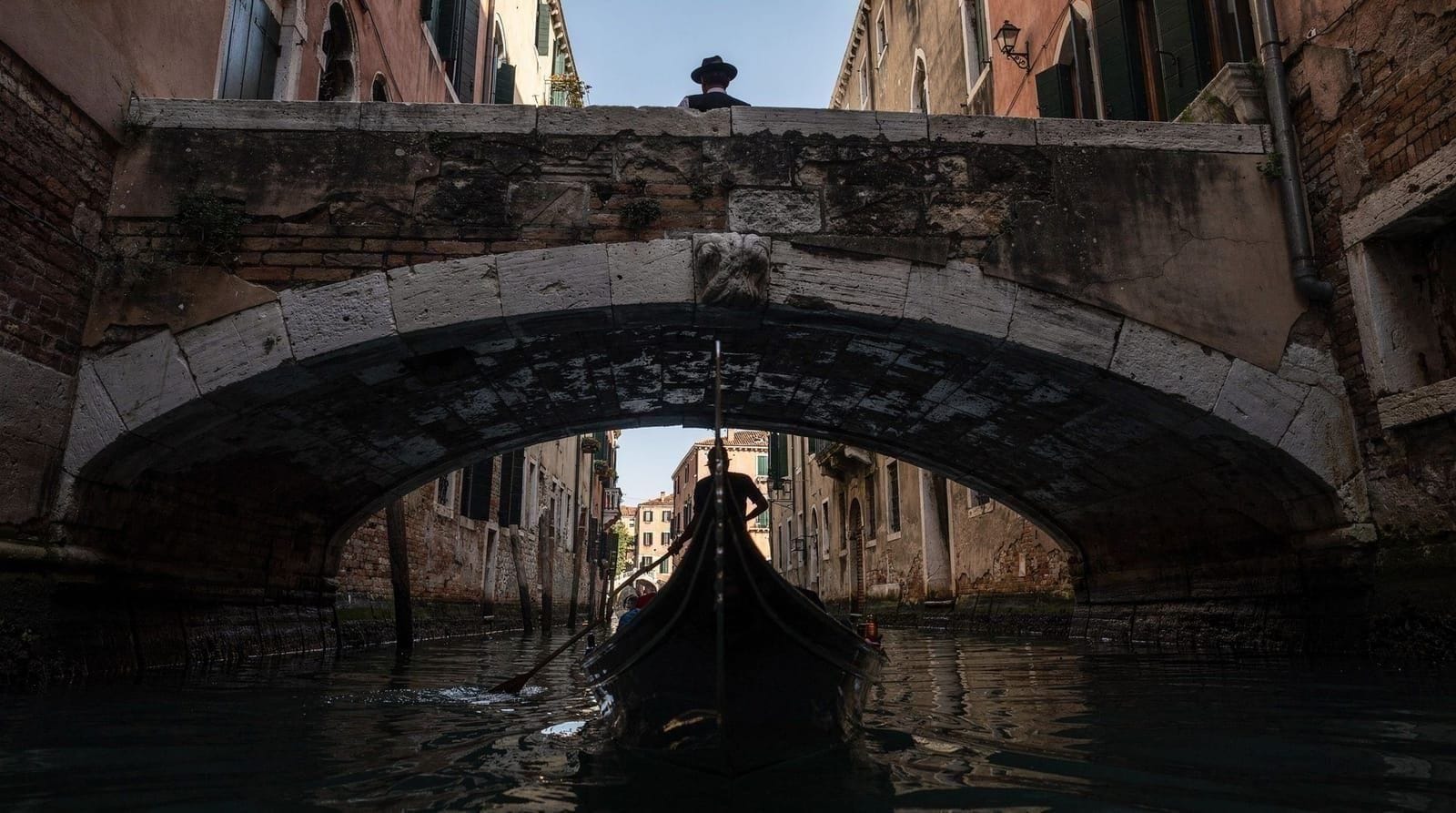
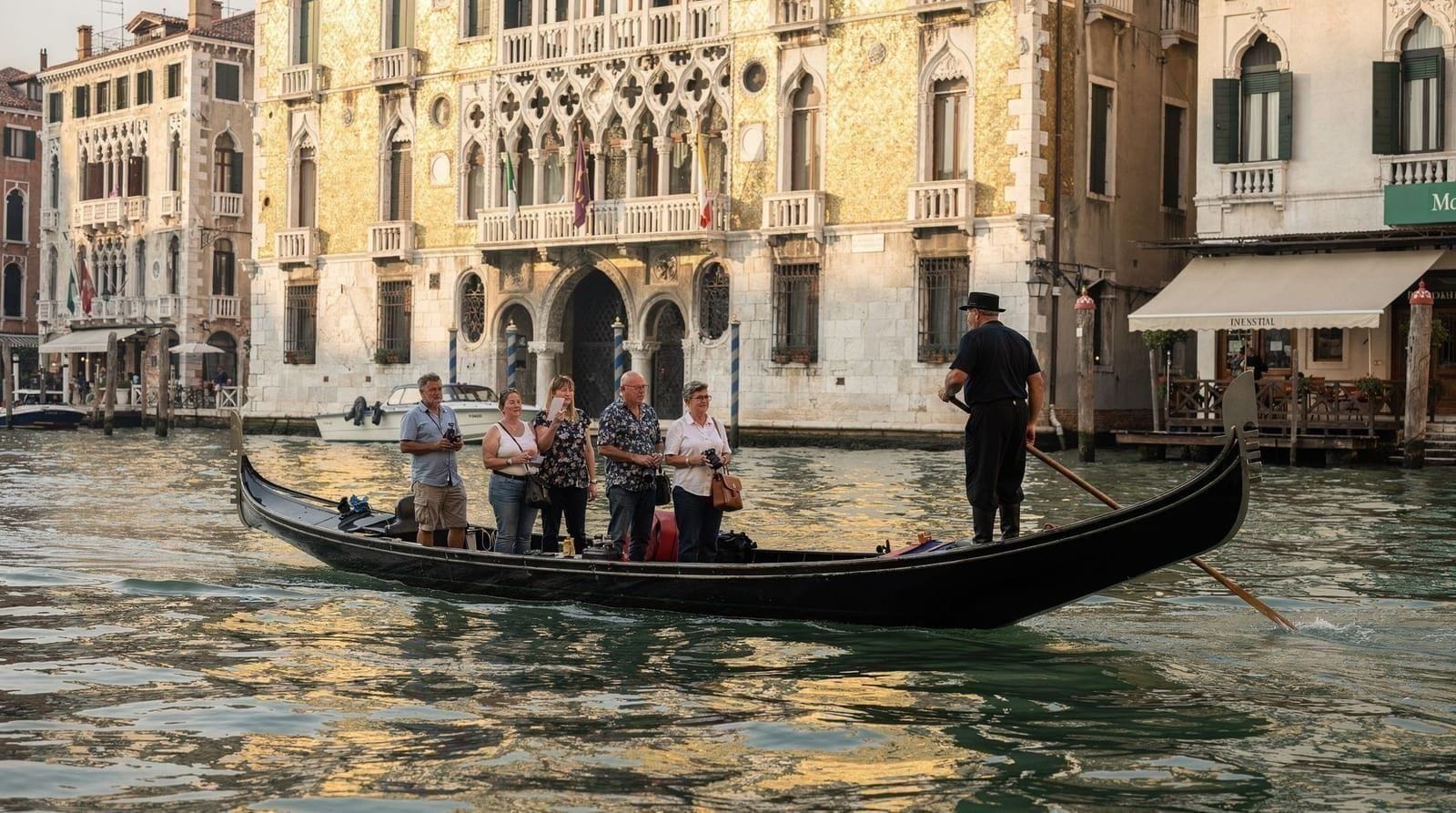
Venice is full of gondoliers at work, and they are worth watching carefully for a few minutes from a bridge above a canal. The efficiency of the motion is the product of years of practice, but the principles are the same ones you encountered in your lesson. Twenty minutes spent watching a gondolier work at a busy canal junction is one of Venice’s underused free experiences.
Practical notes for the lesson
- Wear comfortable, flat-soled shoes. You are standing on a curved hull throughout.
- Bring a light jacket even in summer — it can be cooler on the water than on land.
- Most operators can accommodate two people on the same boat, making this a natural activity for couples or pairs.
- Minimum age is usually 12–14; children younger than this typically cannot manage the oar weight safely.
- No swimming ability required — life jackets are available and the water in Venice’s canals is shallow.
Frequently asked questions about Venetian rowing lessons
What is voga alla veneta?
Voga alla veneta is the traditional Venetian rowing technique, performed standing up and facing forward using a single oar in a pivoting lock called a fórcola. It is the technique used by gondoliers and all traditional Venetian boatmen.
How difficult is it to learn voga alla veneta?
The basics can be learned in 30–45 minutes. Getting a feel for actual propulsion and steering takes most of the 2-hour lesson. You will not be rowing competitively by the end, but you will have the fundamental technique.
What is a fórcola?
The fórcola is the S-shaped wooden rowlock carved from walnut root into which the oar pivots. Each fórcola is made specifically for an individual rower’s height and arm reach. Traditional fórcola-making is itself an artisan craft, and fine examples are sold as art objects in Venice.
How does a voga lesson compare to a gondola ride?
A gondola ride is passive — you sit while the gondolier rows. A voga lesson is active — you are the one rowing. Most people who take a lesson report that they look at gondoliers very differently afterward.
Are rowing lessons available year-round in Venice?
Yes, though conditions in the lagoon are most comfortable April–October. Winter lessons happen but cold and wind add difficulty.
What is the Vogalonga?
The Vogalonga is a non-competitive rowing event held annually in Venice, typically in late May or early June. It covers approximately 32 km through the canals and the lagoon and is open to any human-powered boat.
What to expect if you’ve never rowed anything before
Complete beginners often worry the lesson requires some baseline fitness or balance they don’t have. In practice, the physical bar is low: you do not need upper-body strength (the technique relies on hip rotation and the fórcola doing the leverage work, not arm muscle) and you do not need prior boating experience. What helps most is simply relaxing the legs and letting the knees absorb small movements of the hull, the same instinct that makes standing on a moving bus or train easier once you stop bracing rigidly. Most instructors teach in English or manage with a mix of demonstration and a handful of shared words, so a language barrier rarely gets in the way of the actual learning.
Comparing the three lesson formats
| Format | Duration | Focus | Best for |
|---|---|---|---|
| Standard 2-hour lesson | 2 hours | Pure technique, maximum rowing time | First-timers who just want to try it |
| Secret craft session | Slightly longer | Technique plus history and cultural context | Travellers who want to understand, not just do |
| Grand Canal rowing class | 2.5 hours | Technique on the city’s most scenic and demanding water | Confident beginners wanting the spectacle |
Book the standard 2-hour Venetian rowing lesson if you are unsure which to choose — it is the easiest entry point and covers the same fundamental technique the other formats build on.
Combining a rowing lesson with the rest of your trip
A rowing lesson works well as a mid-trip activity rather than a first-day one — arriving with at least a passing familiarity with Venice’s canals and gondolas from watching them for a day or two makes the lesson click faster, because you already have a mental picture of what you are trying to replicate. It also pairs naturally with a broader look at Venice’s traditional crafts: the artisan crafts guide covers the mask-makers, glassblowers, and fórcola carvers who keep these skills alive, and a rowing lesson is one of the few of these traditions you can actually participate in rather than just watch. For getting between the lesson location and the rest of the city, see the getting around Venice guide and the vaporetto guide.
Top experiences
Bookable activities with verified prices and instant confirmation on GetYourGuide.