San Marco
Venice's iconic heart — St Mark's Basilica, Doge's Palace, La Fenice, and the most beautiful square in the world, with honest advice on crowds and costs.
Venice St. Mark's pass: basilica, Doge palace & bell tower
Quick facts
- Best for
- Iconic monuments, Byzantine art, opera, grand-canal views
- Vaporetto stop
- San Marco Vallaresso (line 1/2) or San Zaccaria (east side)
- Time needed
- Half a day minimum; full day if doing Doge's Palace + Basilica
- Don't miss
- Doge's Palace secret itineraries, Basilica terrace at dawn
- Watch out for
- Coperto charges at restaurants near the square (€3–6 per person)
The most visited square kilometre in Italy
Piazza San Marco is often described as “the drawing room of Europe” — and it earns that reputation. The Byzantine mosaic domes of St Mark’s Basilica, the Gothic and Renaissance columns of the Doge’s Palace, the two tall granite pillars framing the lagoon, the Campanile soaring 98 metres above it all: seen together at the right moment — early morning in spring mist, or late evening when the crowds have thinned — it is genuinely overwhelming.
But San Marco is also Venice’s most expensive and most crowded neighbourhood, and it requires strategy. Restaurants within two minutes of the Piazza routinely charge €4–6 coperto per person before the meal starts, and the tourist-density means everything costs more. This guide tells you what is genuinely worth your time and money here, and what to skip.
| Where | Central Venice, around Piazza San Marco |
| Cost | Basilica nave free; terrace/Treasury €5–7; Doge’s Palace ~€30; Campanile ~€10 |
| Time needed | Half a day minimum; a full day for the Basilica and Doge’s Palace together |
| Getting there | Vaporetto lines 1 or 2 to San Marco Vallaresso or San Zaccaria |
| Best time | Before 9am or after 6pm to avoid the worst of the crowds |
St Mark’s Basilica
The Basilica di San Marco is Venice’s cathedral and one of the finest surviving examples of Byzantine architecture in the Western world. Built over three centuries from 832 AD, it was expanded and decorated over time with spoils from Constantinople and the Eastern Empire — most famously the four bronze horses on the facade (originals are inside; those outside are replicas).
Entry to the main basilica is free but requires timed booking during peak months. The queue for free entry can be 45–90 minutes in summer. The terrace (€7 supplement, views over the Piazza) and Pala d’Oro (€5 supplement, the extraordinary jewelled altarpiece) require separate tickets, but both are worth it. The Treasury (€5) holds Byzantine relics and goldsmithing from Constantinople.
The best light inside the basilica falls in the morning. Go before 10am if at all possible.
St Mark’s Basilica skip-the-line ticket with audio appRead the full St Mark’s Basilica guide.
Doge’s Palace
The Palazzo Ducale was for over 500 years the centre of Venetian political power. It is one of the finest Gothic buildings in the world, and its interior — the Council of Ten’s chamber, the armoury, the Sala del Maggior Consiglio with Tintoretto’s massive Paradise (the world’s largest oil painting on canvas), the Bridge of Sighs, and Casanova’s prison — is extraordinary.
Standard ticket: around €30 in advance (includes audio guide option). Book ahead in summer; queues without a ticket can be 60–90 minutes. The Secret Itineraries tour (€30–35 supplement, small groups, separate booking required) takes you through the hidden administrative rooms above the main palace — including the actual torture chambers and the lead-roof prison where Casanova was held. It is genuinely excellent and sells out well in advance.
Doge’s Palace — prison and secret passageways tourRead the full Doge’s Palace guide.
The Campanile
The free-standing bell tower at 98 metres is the tallest structure in Venice and offers panoramic views of the lagoon, the sestieri, and on clear days the Dolomites. It is not the most crowded of Venice’s viewpoints, but still expect queues of 20–40 minutes in summer. Tickets cost around €10; combined passes with the Basilica and Museo Correr are available. The current tower is a 1912 reconstruction — the original collapsed in 1902.
Read the full St Mark’s Campanile guide.
Piazza San Marco: the honest picture
The Piazza itself is free to walk and looks best without crowds — meaning before 9am and after 6pm. The two outdoor cafés, Caffè Florian (founded 1720, Venice’s oldest) and Gran Caffè Quadri across the square, charge around €12–18 for a coffee when the orchestras play. That is an experience worth paying for once; it is not where you should have lunch.
The Museo Correr on the far end of the Piazza is often overlooked — it covers Venice’s political and cultural history through maps, paintings, armour, and the Biblioteca Nazionale Marciana (the stunning library on its piano nobile). A Museum Pass covering Correr, the Archeological Museum, and the Library costs around €15–20 and is good value.
Teatro La Fenice
Venice’s famous opera house, destroyed by fire twice (1836 and 1996) and rebuilt each time, is worth visiting even if you are not attending a performance. Guided tours of the theatre itself run daily (€15–18), taking you through the gilded auditorium, the royal boxes, and the backstage areas. Book ahead in peak season. Actual opera and concert performances run year-round; prices vary from €30 for standing gallery to €300+ for premium stalls.
The majestic Teatro La Fenice: guided tour in VeniceRead the full La Fenice guide.
The Scala Contarini del Bovolo
A few minutes’ walk from Piazza San Marco, this Gothic spiral external staircase (bovolo means snail in Venetian dialect) on the courtyard of Palazzo Contarini is one of Venice’s most beautiful hidden architectural details. Entrance costs around €8; it includes access to the upper loggia with rooftop views over the surrounding palaces and gardens. Rarely crowded.
Read the Scala Contarini del Bovolo guide.
Where to eat and drink in San Marco without getting ripped off
San Marco’s restaurant scene is the most tourist-facing in Venice. The rule of thumb: the closer to the Piazza, the higher the coperto and the lower the quality-to-price ratio. That said, the sestiere is not entirely a trap.
Al Bacareto (Calle delle Botteghe, near Campo Santo Stefano) is a reliable mid-range trattoria with cicchetti at the bar and proper pasta dishes from around €14. Osteria alle Botteghe nearby is similarly honest. For coffee, Torrefazione Cannaregio has a branch in San Marco; Caffè del Doge on Calle dei Cinque near the Rialto side is another serious option.
The Bacino Orseolo gondola basin just behind the Piazza fills with gondoliers waiting for fares — nice for photographs, not for sitting down to eat.
Read where to eat in San Marco — avoiding the traps.
Campo Santo Stefano and the Grand Canal approach from the west
Just west of Piazza San Marco, Campo Santo Stefano (also called Campo Francesco Morosini) is one of Venice’s largest and most pleasant open spaces — a local contrast to the tourist-dense Piazza. The church of Santo Stefano has a ship’s-keel ceiling and works by Tintoretto. The campo itself has a handful of good cafés and restaurants, including Bacaro Lounge and the reliable Trattoria San Trovaso nearby (technically in Dorsoduro but 5 minutes away).
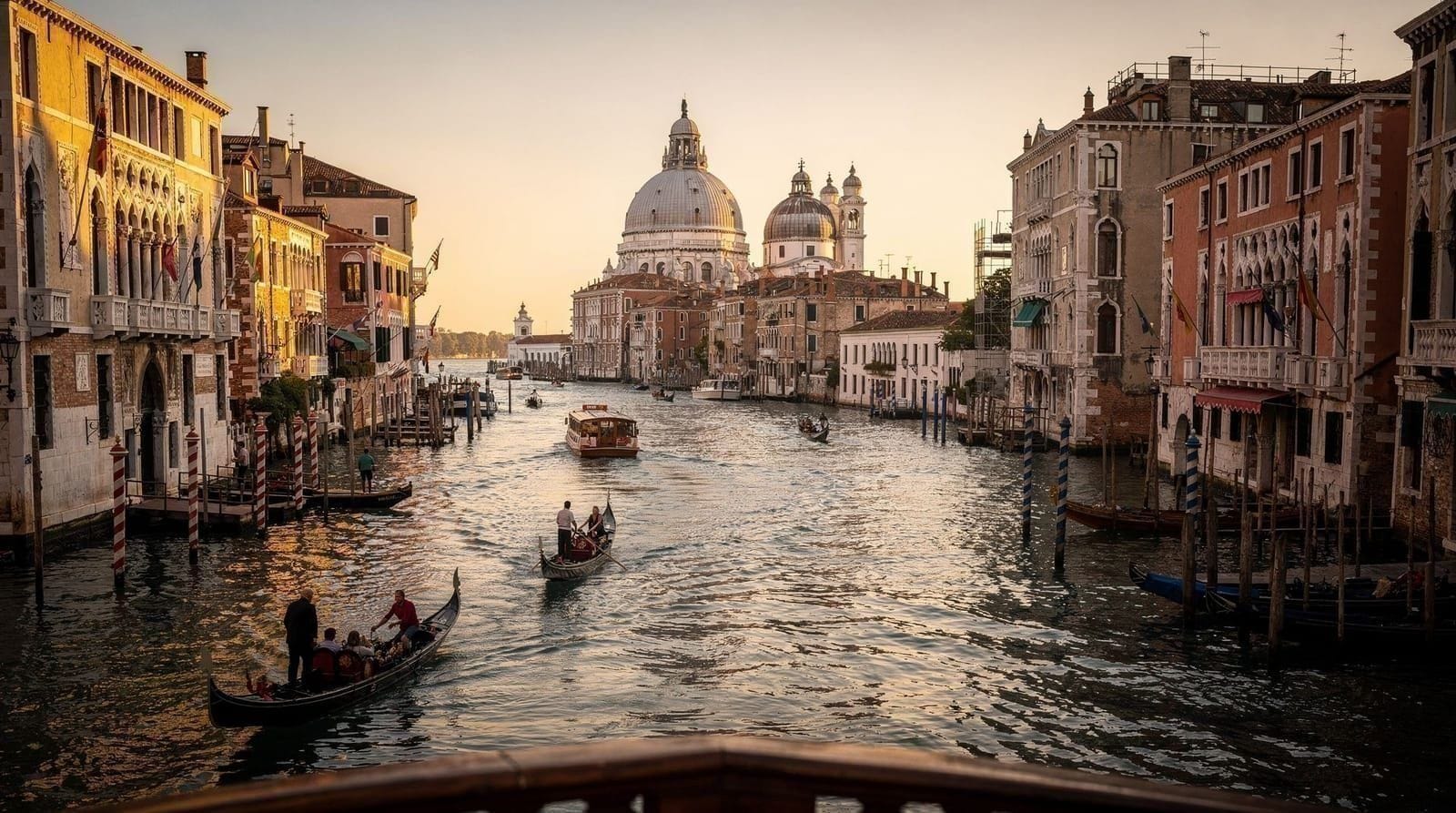
The Accademia bridge — a steep wooden arch just west of the campo — is the fourth of Venice’s four Grand Canal crossings and one of the most photographed. The view east from the top of the bridge (toward San Marco and the Campanile) is a classic Venice photograph and consistently excellent at golden hour. See the golden hour Venice guide.
Palazzo Grassi and Punta della Dogana context from San Marco
Palazzo Grassi is technically in San Marco sestiere, on the Grand Canal opposite Ca’ Rezzonico. It is the other Pinault contemporary art venue in Venice (alongside the Punta della Dogana in Dorsoduro). The Palazzo was renovated by Tadao Ando and hosts large-scale temporary exhibitions. Combined tickets with Punta della Dogana are available (around €20). Worth noting if you are visiting Dorsoduro for the Peggy Guggenheim — these two Pinault spaces cover the most ambitious contemporary art collection in Venice.
Planning around acqua alta in San Marco
San Marco sits at the lowest elevation in Venice. During acqua alta events — high water periods that occur most commonly from October through February — the Piazza is typically the first and worst-affected part of the city. Even a modest high-water event (around 80–90 cm above sea level) puts 5–15 cm of water on the Piazza. The Basilica interior has flooded repeatedly over the centuries, contributing to the deterioration of the mosaic floors.
Practical tips: keep an eye on the Città di Venezia tide forecast app (CiMAS) for warnings, which are issued the evening before. Acqua alta events are typically 2–4 hours at peak, not all-day floods. Temporary raised walkways (passerelle) are installed on the main tourist routes. Boots are sold everywhere for €5–8. The Basilica’s entrance is elevated and usually accessible even during modest flooding.
Read the full acqua alta guide and Venice in winter guide for seasonal planning.
Getting to San Marco
From the train station (Ferrovia) or Piazzale Roma, take vaporetto line 1 the full length of the Grand Canal — the journey takes about 40 minutes but gives you the best water-level view of the palaces. Line 2 is faster (15 min) but less scenic, stopping only at Rialto. From the east side of the island, line 1 and 2 stop at San Zaccaria, a 5-minute walk from the Basilica.
See the full getting around Venice guide and the vaporetto guide.
The Grand Canal palaces from San Marco
San Marco’s Grand Canal frontage includes some of the most celebrated palaces in Venice. The Ca’ Farsetti and Ca’ Loredan opposite the Rialto were originally Byzantine-era merchant houses, now forming Venice’s town hall. The Ca’ Corner della Ca’ Granda (designed by Jacopo Sansovino, 1533) is one of the earliest High Renaissance palaces in Venice. The Palazzo Grimani near San Marco is now a museum of Roman sculpture collections — entry around €5, worth it for the extraordinary cortile and the arrangement of antiquities.
From the water on vaporetto line 1, the approach to San Marco from the Rialto direction is one of the great urban sequences in the world: the canal widening, the Ca’ Rezzonico dome on the Dorsoduro bank, then La Salute emerging from the left, then the Bacino opening up with the two granite columns and the Campanile visible from several hundred metres away.
The Piazzetta and the two columns
The Piazzetta di San Marco — the smaller square connecting Piazza San Marco to the lagoon — is framed by Doge’s Palace on the east and the Biblioteca Marciana (Sansovino’s masterpiece of 16th-century civic architecture) on the west. The two tall granite columns at the water’s edge, topped by the winged lion of St Mark and the figure of St Theodore, were brought from the eastern Mediterranean in the 12th century. Between them, criminals were once executed. Superstitious Venetians traditionally avoid walking between the columns — not that visitors ever observe this.
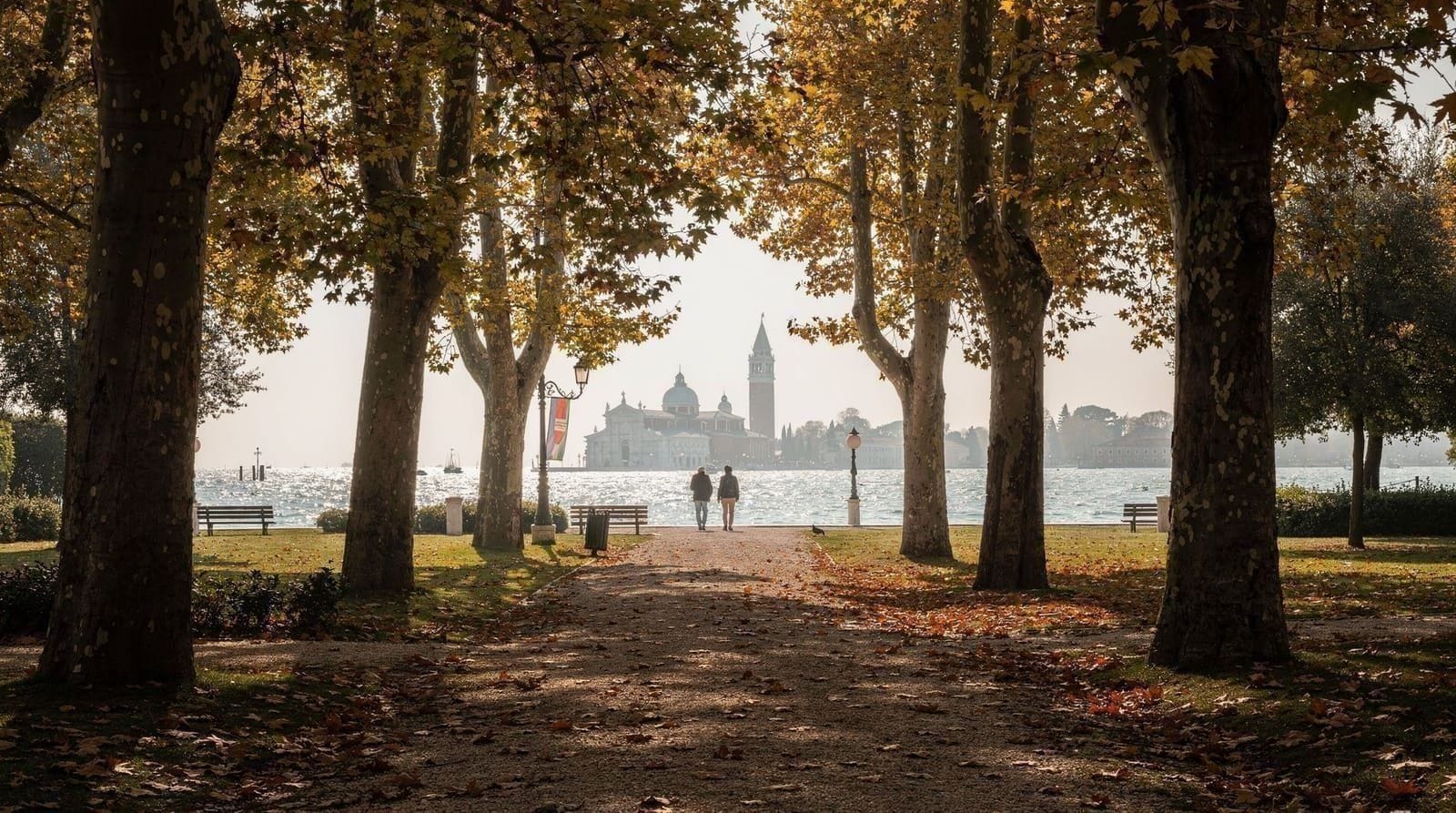
The view from the Piazzetta toward San Giorgio Maggiore across the Bacino is one of the defining Venice views. At dawn, with the light hitting the facade of San Giorgio and the lagoon flat and still, it is exceptional. The sunrise photography guide and the best photo spots guide both feature this location.
Honest assessment: what makes San Marco worth it
For all the crowds and traps, San Marco deserves its reputation. The Basilica and Doge’s Palace are two of the world’s great buildings, not merely famous ones. The Piazza on a cold November morning, when the fog comes off the lagoon, when a few pigeons and one early walker are all that move — those are the moments that stay. The key is managing the visit: arrive very early, pre-book tickets, eat elsewhere, and treat the crowds as a background condition rather than a reason to rush.
What San Marco’s sights actually cost
Budgeting for San Marco means adding up several separate tickets rather than one entrance fee.
| Sight | Cost | Booking |
|---|---|---|
| St Mark’s Basilica (nave) | Free | Timed booking required in peak months |
| Basilica terrace | ~€7 | On-site, separate ticket |
| Pala d’Oro | ~€5 | On-site, separate ticket |
| Doge’s Palace | ~€30 | Advance booking recommended |
| Secret Itineraries tour | €30–35 supplement | Advance booking essential |
| Campanile di San Marco | ~€10 | On-site or pre-booked |
| Scala Contarini del Bovolo | ~€8 | On-site |
| Museo Correr | Included in Museum Pass (€15–20) | On-site or advance |
A realistic full day covering the Basilica, terrace, Doge’s Palace and Campanile runs to around €50–55 per person before food.
Comparing San Marco’s two free-standing viewpoints
Two towers dominate San Marco’s skyline for visitors deciding where to get their panoramic photo: the Campanile di San Marco itself, and — a two-minute vaporetto ride away — the free bell tower of San Giorgio Maggiore. The San Marco Campanile gives a bird’s-eye view over the whole city and costs around €10 with queues of 20–40 minutes in summer; San Giorgio’s tower is free, rarely has a queue, and instead frames San Marco and the Doge’s Palace from across the water. Doing both on a longer visit is worthwhile; on a single tight day, San Giorgio is the better value use of the same 20 minutes.
Evening San Marco
After the day-trip coach groups clear out around 6–7pm, San Marco changes character. The Piazza empties enough to hear your own footsteps on the stone, the orchestras at Caffè Florian and Gran Caffè Quadri continue playing into the evening, and the floodlit Basilica facade is one of the most photographed night scenes in Italy. Dinner in the sestiere works better after dark than at midday — the same restaurants that are jammed with day-trippers at 1pm often have tables free by 9pm, though the coperto charges apply regardless of the hour. The Venice after dark guide covers evening San Marco alongside the rest of the city’s night-time character.
San Marco with an itinerary
For your first morning in Venice, the Venice 1-day itinerary begins here: arrive at San Marco before 9am for the Basilica, Doge’s Palace mid-morning (ticket booked in advance), Campanile before lunch, then west through the Frari toward Rialto for the afternoon. The Venice 2-day itinerary devotes the full first day to San Marco and San Polo, leaving Cannaregio, Dorsoduro, and the islands for day two.
Frequently asked questions about San Marco
How long should you spend in San Marco?
Budget at least a half day for the Basilica alone (1.5–2 hours with terrace and Treasury), and a full morning for Doge’s Palace. Add La Fenice tour or the Campanile and you have a full day. Most visitors try to squeeze too much into too short a time — the queues alone can absorb 2 hours if you haven’t pre-booked tickets.
Is it free to enter St Mark’s Basilica?
Entry to the main nave is free, but requires booking a time slot during peak months (April–October). The terrace, Treasury, and Pala d’Oro each require separate paid tickets. The after-hours private tours of the Basilica (around €30–40 per person) include areas and experiences not available during regular opening.
What is the Bridge of Sighs?
The Ponte dei Sospiri connects Doge’s Palace to the Prigioni Nuove (New Prisons) and was used to transfer prisoners from the interrogation rooms to their cells. The name (attributed to Lord Byron in the 19th century) refers to the sighs of condemned prisoners seeing Venice one last time through the small windows. The best view of it is from the Ponte della Paglia below.
When is the best time to visit Piazza San Marco?
Early morning (before 9am) and late evening (after 7pm). Between roughly 10am and 6pm in summer, the square is extremely crowded. Acqua alta (high water) floods the lowest parts of the Piazza first in autumn and winter — check the CMSV tide forecast app if visiting November–February.
Are there any good restaurants near Piazza San Marco?
Yes, but not within the first 200 metres. The restaurants immediately facing or adjacent to the Piazza are generally overpriced tourist traps with coperto charges. Walk 5–10 minutes toward Campo Santo Stefano or toward the Rialto and the quality improves markedly. Always check for the coperto line on any menu.
Can you visit Doge’s Palace without a tour guide?
Yes — the standard ticket includes an audioguide app and the rooms are well-labelled. However, the Secret Itineraries tour is significantly better if you want to understand the building’s history. A guided group tour covers the highlights more efficiently than self-guiding for first-time visitors.
How much should I budget for a full day in San Marco?
Around €50–55 per person for the Basilica terrace and Treasury, Doge’s Palace, and the Campanile combined, before meals. Adding La Fenice’s guided tour or the Secret Itineraries supplement pushes this toward €80–100. Skipping the Campanile in favour of San Giorgio Maggiore’s free bell tower is the easiest way to cut costs without losing the panoramic view.
Is San Marco safe from pickpockets given the crowds?
Like any dense tourist area, San Marco sees more pickpocketing than quieter sestieri — keep bags zipped and in front of you, especially on crowded vaporetti and in the queue areas outside the Basilica and Doge’s Palace. Venice overall is a low-violent-crime city; the concern here is opportunistic theft, not personal safety.
Top experiences
Bookable activities with verified prices and instant confirmation on GetYourGuide.