Sunrise photography in Venice: where to go and what to expect
Venice: 2.5-hour private photo-walk with photographer guide
Is it worth getting up early for photography in Venice?
Yes — genuinely and emphatically. Venice in the hour around sunrise is a different city from the one 20 million tourists visit. The main piazzas are empty, the water is still, the light is warm and directional, and the Rialto, San Marco, and the Grand Canal are available to photograph without a single other person in frame. Summer sunrise is around 5:15 am; winter sunrise around 7:10 am.
The city that exists only before 8 am
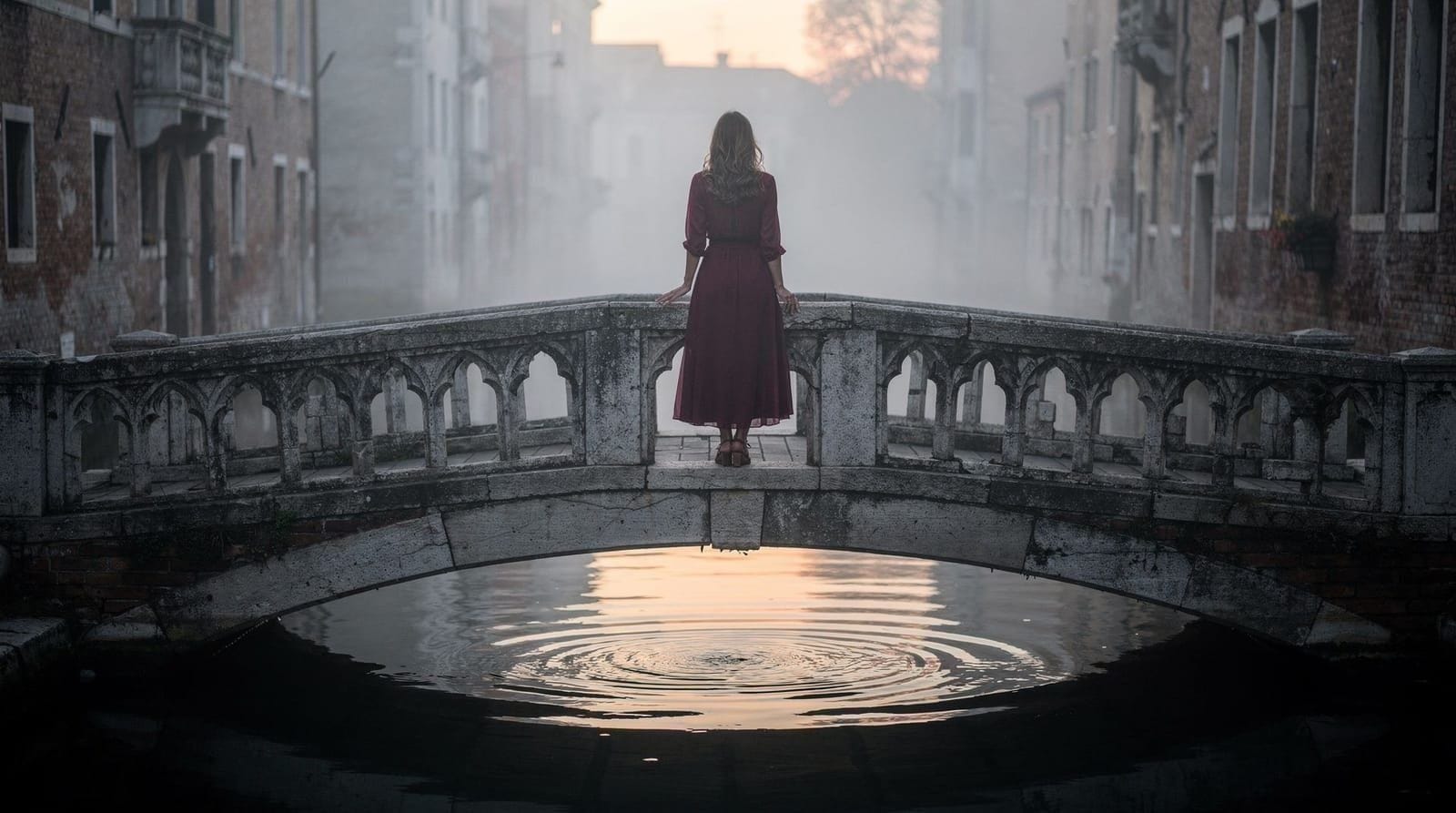
No photograph taken in Venice at noon looks like what Venice actually is. The noon photographs — which constitute the majority of what appears on travel platforms — show a city drowning in visitors, its beauty still present but competing with thousands of competing bodies and bags. The Venice that photographers talk about when they describe the city as extraordinary is a different version: the pre-dawn city, quiet as a held breath, with mist on the water and the light doing things it cannot do at midday.
This guide is about accessing that version of Venice. It requires an early alarm, appropriate preparation, and the willingness to be standing in Piazza San Marco when the sky turns from navy blue to the first pale gold. What you find there will justify every interruption to your sleep. See the best photo spots guide for the wider list of locations beyond sunrise-specific ones.
| Where | Rialto Bridge, Piazza San Marco, Grand Canal, Fondamenta Nove |
| Cost | Free — no ticket needed for outdoor locations at this hour |
| Time needed | 1–3 hours depending on how many locations you cover |
| Getting there | Walking (most sights are central); first vaporetto ~5:30am for the lagoon |
| Best time | 20 minutes before published sunrise; October–February for mist and acqua alta reflections |
When to arrive and how early is early enough
The optimal window for sunrise photography in Venice is the 30 minutes before the sun clears the horizon and the 30 minutes after. During this hour, the light is soft, the sky transitions through colours that are not reproducible at other times, and the canal water picks up the colour of the sky.
The practical rule: be at your chosen location 20 minutes before the published sunrise time. That means:
- Summer (June): leave your accommodation at 4:45 am to be in position by 5:00 am
- Autumn/Spring: leave around 6:30 am for a 7:00 am arrival
- Winter (December/January): a more civilised departure around 7:10 am for 7:30 am arrival
The later in the year, the more mist is possible, which changes the character of the light entirely. October and November mornings with light fog are among the most atmospheric photography conditions Venice produces.
Rialto Bridge at sunrise: the primary target
The Rialto Bridge faces roughly east–southeast. As the sun rises, its light catches the bridge’s Istrian stone face-on, turning it orange and warm against a still-dark sky. The Grand Canal at this hour has little traffic — perhaps a single delivery barge, the reflection of lights in the water.
The best positions:
From Fondamenta del Vin (San Polo bank, south side): You are looking northeast at the bridge with the canal in front. This is the most classic composition. At sunrise in late spring/early summer, the sun appears roughly behind and to the right of the bridge, backlighting the structure slightly.
From Fondamenta Carbon (opposite bank): Slightly less used, looking southwest at the bridge. The sun hits the bridge differently here — more front-lit in the early morning.
From the bridge itself (looking south toward the Salute): Stand on the bridge at sunrise and look south — the canal curves away with the Salute visible in the distance, the early light catching the building facades. The bridge’s own parapet is in your foreground.
Arrive at least 20 minutes before sunrise. The bridge fills with other photographers rapidly once the light is obviously working. The Rialto Bridge guide has the fuller history and daytime context for the same landmark.
Piazza San Marco: the empty piazza
San Marco at dawn is Venice’s most transformative experience for photography. The piazza, which holds 10,000 people on a summer afternoon, is empty at 5:30 am. The Campanile casts a long shadow across the stones. The basilica’s gold mosaics are lit from within (the artificial lighting of the interior and the facade turns on before sunrise and stays on until mid-morning). The two columns at the Piazzetta’s south end frame a view toward San Giorgio Maggiore across the Bacino.
If acqua alta has occurred recently — even a few centimetres — the piazza may still hold a thin film of water that reflects the basilica’s facade. This is the most sought-after condition in Venice photography and not as rare as people assume: acqua alta at minor levels (flooding below 110 cm) occurs several times each autumn and winter.
The Riva degli Schiavoni — the long promenade east of San Marco — is also excellent at dawn. Looking west from the far end, you have the entire San Marco waterfront, the Campanile, and the Salute visible in the distance across the Bacino.
Grand Canal at dawn: timing and positions
The Grand Canal is most photogenic in the very early morning because:
- The water is at its stillest before boat traffic begins
- The sky light reflects in the canal’s surface
- No vaporetti creating wake for the first 15–20 minutes after dawn
Ponte dell’Accademia faces northeast. At summer sunrise, the light comes from the right (east) and illuminates the canal buildings on the right bank. The Salute dome at the far end of the composition catches the very first light.
Ponte di Calatrava (near Piazzale Roma) faces east and provides a different canal view — the relatively modern bridge over the section of canal closest to the mainland. Less used photographically than the Accademia or Rialto bridges, but interesting for architectural contrast.
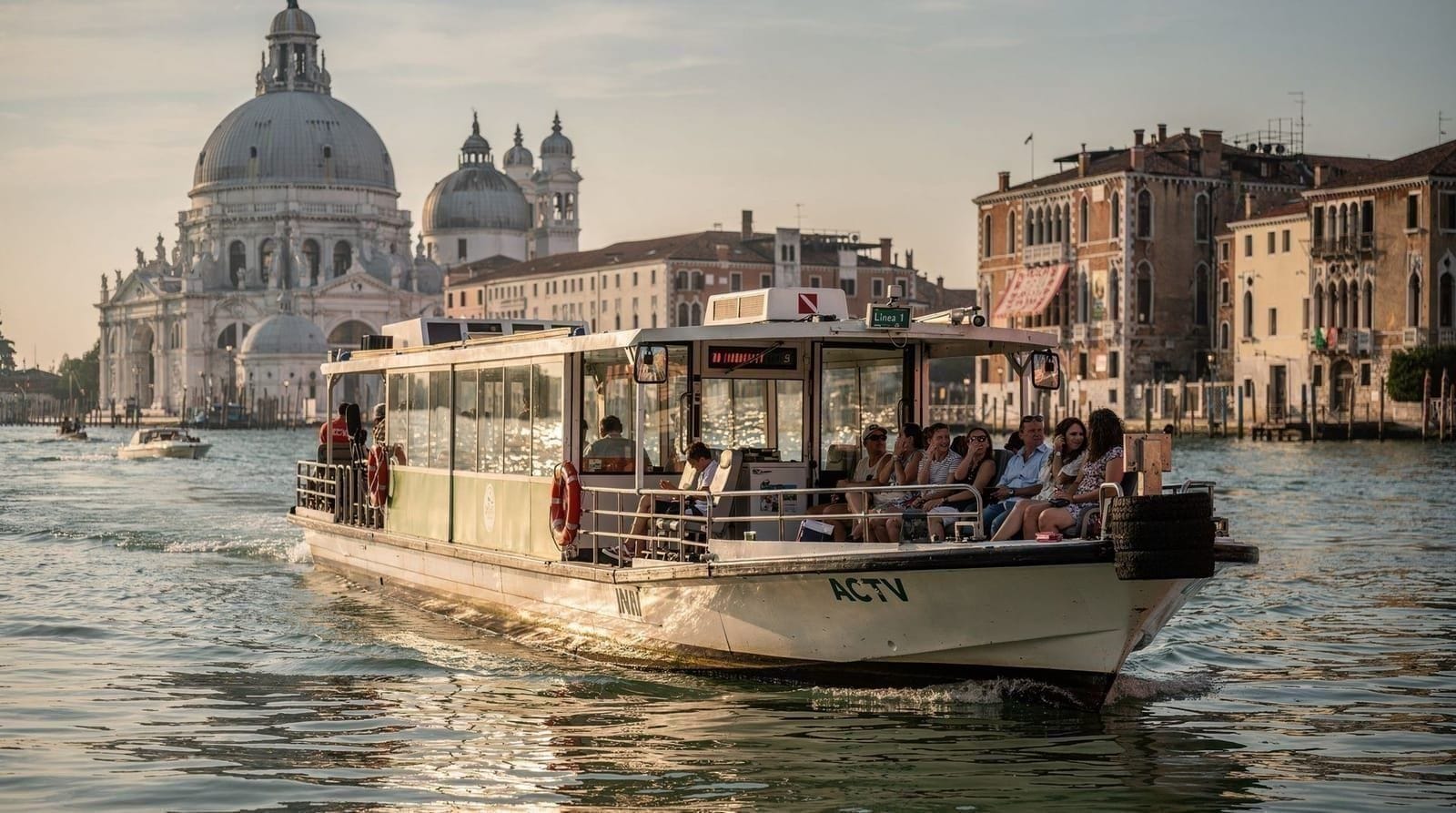
From a vaporetto deck: If you take the line 1 vaporetto at the first service (approximately 5:30 am from one terminus), you travel the full length of the Grand Canal. The slow boat provides changing perspectives from water level that are impossible from bridges. The light quality and almost empty deck at this hour makes for unusual photography.
The lagoon at dawn: different from the city
The open lagoon at sunrise is a completely different photographic subject from the urban canal environment. The scale is horizontal, the sky is the dominant element, and the low perspective across water creates effects — reflections, silhouettes, mist — that the canal environment cannot produce.
Fondamenta Nove (Cannaregio) faces north across the open lagoon toward Murano and the distant Alps (visible in clear conditions). In winter, the snow-capped mountains are visible from here at dawn — one of the most surprising views in Venice, and almost unknown to visitors. The vaporetto pontoons and the distant Murano lighthouse are the foreground elements.
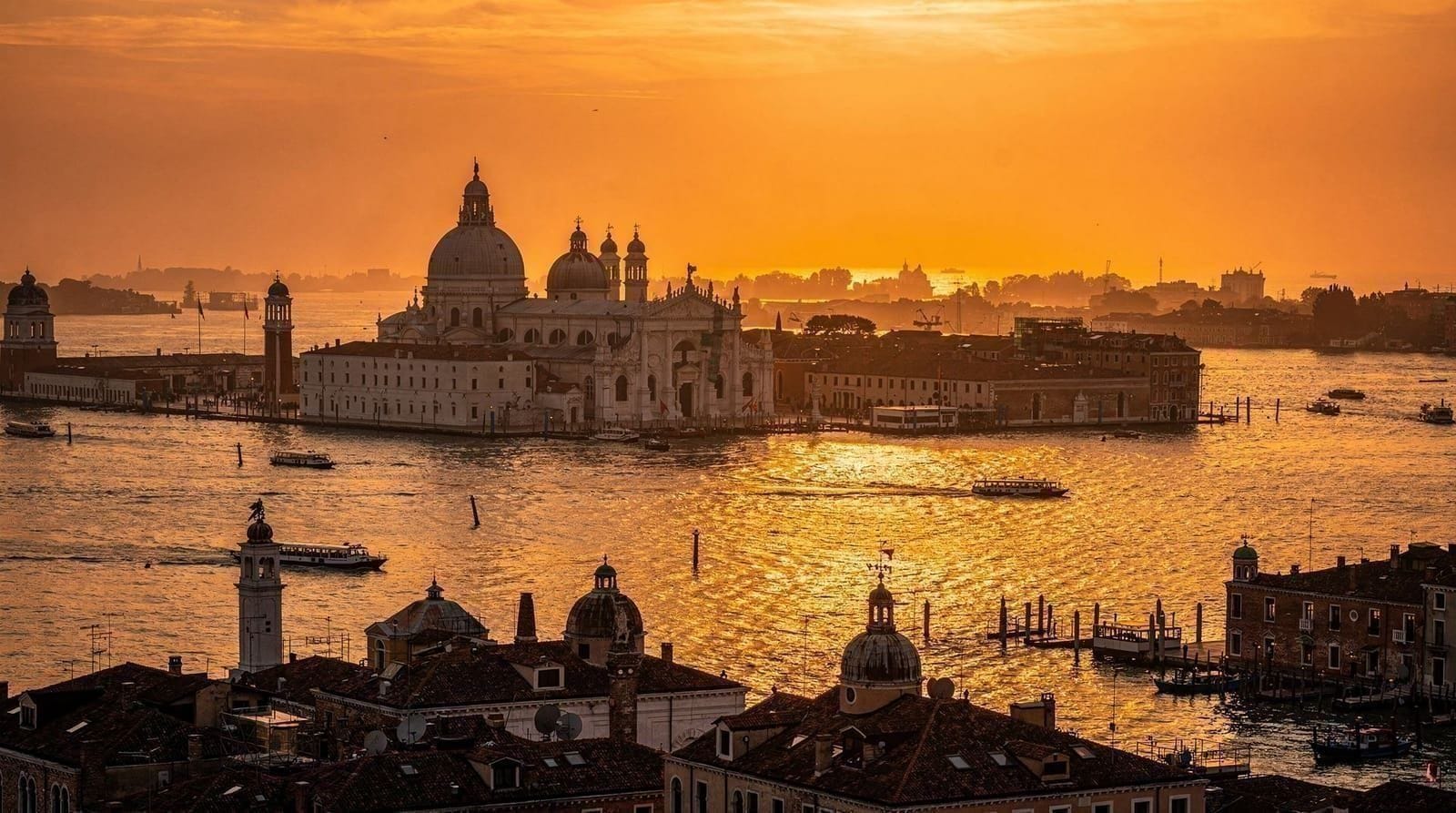
Riva degli Schiavoni eastern section (near the Arsenale stop) faces southeast across the open Bacino toward the islands of the southern lagoon. The water here is wide enough that you have genuine horizon photography — a quality the canal environment does not offer.
San Giorgio Maggiore island (5 minutes by vaporetto): Taking the first morning service and standing on the San Giorgio waterfront looking north, you have Venice’s entire skyline across the water as a sunrise backdrop. This is the reverse of the standard city view and is far less used.
Autumn and winter: the best season for sunrise photography
The autumn and winter months (October–February) offer conditions that summer cannot match:
Acqua alta possibility: High water is most common in autumn and winter, and minor flooding episodes — which do not significantly inconvenience visitors but transform the visual character of Piazza San Marco — are common. A flooded piazza at dawn, with the basilica reflected in a shallow sheet of water, is the single most iconic Venice photograph and is only achievable in this season. See the acqua alta guide for how to anticipate flooding events.
Morning mist: Venice’s lagoon produces ground-level mist on cold, still mornings. This mist — lighter than fog, not opaque — creates a photographic quality of diffused light and mysterious depth that is specific to this season and this landscape.
Later sunrise: Winter sunrise at 7:00–7:45 am is accessible without waking before 6:00 am, making it more practical to maintain across a multi-day trip.
Fewer photographers: Many dedicated photographers plan their Venice visit for autumn specifically for these reasons, but the majority of visitors come in summer. You have the best conditions and fewer competitors.
The vaporetto at first light: an alternative approach
If your accommodation is in Mestre (mainland) or if you want to approach Venice from the water at dawn, taking the first vaporetto from Piazzale Roma or the Ferrovia (Santa Lucia station) into the city is its own experience. Line 1 takes the full length of the Grand Canal from the station to San Marco — 35 minutes of slow travel past the sleeping palazzi with the sky lightening ahead of you and, in good conditions, mist on the water.
The Grand Canal at the first service of the day — typically around 5:30 am — carries almost no passenger traffic. Delivery barges and service boats are beginning their rounds, but the tourist vaporetti are largely empty. Standing on the deck at the bow, you have the water, the silent palaces, and the approaching light all to yourself.
For a full immersive sunrise experience that combines the Grand Canal approach with arrival at the key photography locations, this is the sequence: vaporetto along the Grand Canal → walk from San Marco to Rialto → Fondamenta del Vin at sunrise → walk back via the Piazza. Approximately 3 hours in total.
The blue hour before sunrise
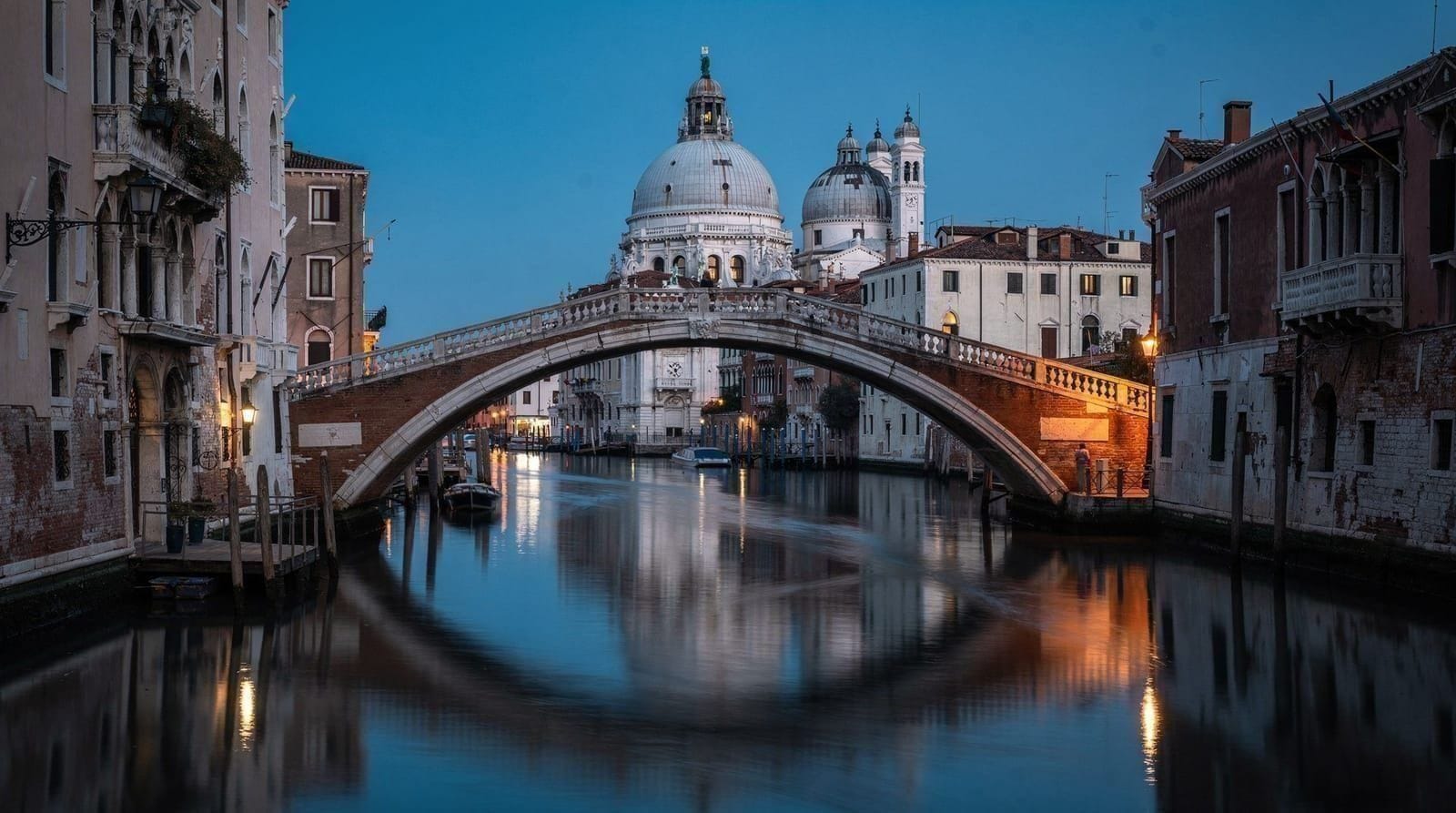
The 30–45 minutes before sunrise is technically the blue hour — the period when the sky lightens from dark to the pale grey-blue that precedes the first orange of the sun. This period is photographically valuable in its own right and somewhat different from the golden minute of sunrise itself.
During the blue hour, Venice’s artificial lighting — the lamp posts along the calli, the windows of early-opening bars, the reflection of street lights in the canal — provides warm points of light against a cool blue background. This contrast produces images that read as magical in a specific way: the human warmth of light against the pre-dawn city. It requires a camera capable of handling the exposure challenge (high ISO without excessive noise), but modern phones can manage it in good hands.
The blue hour is also when Venice’s mist — if present — is most atmospheric. As the sky lightens, the mist becomes backlit, softening the outlines of buildings and bridge arches into something that resembles an 18th-century aquatint more than a digital photograph.
Hiring a guide for sunrise photography
A photography-knowledgeable guide who knows Venice’s light patterns can eliminate the uncertainty from a sunrise session. The private photo-walk with photographer guide can be arranged for early morning departure and takes you through the pre-dawn streets to be in position at the right locations before the light peaks. The guide knows which spots have recently been disrupted by construction or event setup and can adapt the route accordingly.
If you want to photograph sunrise on your own first and then refine your approach for a second morning, the guide session on day two is particularly productive.
Practical preparation for sunrise photography in Venice
Getting there: Most Venice hotels and apartments are within walking distance of the main photography locations. No vaporetto is needed if you are staying in the historic centre — walking the empty streets at 5 am is part of the experience.
What to carry: Camera (or phone), spare battery (cold reduces battery life significantly), a jacket (the canal wind at dawn is cold even in summer), and a small amount of cash for the first coffee at a bar that opens at 6 am.
Weather assessment: A clear sky the previous evening is the best predictor of a clean sunrise. Partial cloud can produce spectacular coloured light but also blocks the sun entirely. Check the forecast the night before and adjust your alarm time accordingly — if it is going to rain, a 5 am start is not justified.
A note on tripods: Venice streets are public but narrow. A full-size tripod can block a bridge or canal path entirely. A small travel tripod or a gorilla-pod that wraps around a railing is more practical and less antisocial. For phone photography, a small phone mount and a compact tripod is adequate.
Planning sunrise around the rest of your trip
Sunrise photography works best as the first activity of a day rather than a standalone excursion — you’re back at your accommodation or a bar for coffee by 7:30–8am with the rest of the day still ahead. See the getting around Venice guide for how vaporetto schedules and walking times factor into planning an early start, especially if your accommodation is on the mainland or a further-out island. If you’re deciding when in the year to visit primarily for photography, the best time to visit Venice guide weighs the light-and-crowds trade-off across the seasons in more depth than this guide’s autumn/winter section above.
For a more posed or styled outcome rather than documentary street photography, a dedicated early-morning shoot is a different product from a self-guided walk. The Instagram Venice guide and the Venice photoshoot guide cover locations and styling specifically for portrait-led photography, which overlaps with but isn’t identical to the landscape-focused approach in this guide.
Private Instagram-style photographer session in Venice is worth considering if you want polished portraits from the same early hours rather than (or alongside) your own landscape shots.
Frequently asked questions about sunrise photography in Venice
What time does the sun rise in Venice?
Approximate sunrise times: June 5:15 am, July 5:27 am, August 5:55 am, September 6:22 am, October 6:47 am, November 6:16 am, December/January 7:37–7:42 am, March 6:28 am, May 5:44 am.
Which is the best sunrise spot in Venice?
The Rialto Bridge and Fondamenta del Vin are the most rewarding — the light hits the bridge stone directly, the canal is calm, and the location is otherwise impossible to photograph empty. Piazza San Marco and the Grand Canal from Ponte dell’Accademia are also excellent.
Are there boats on the canals at sunrise?
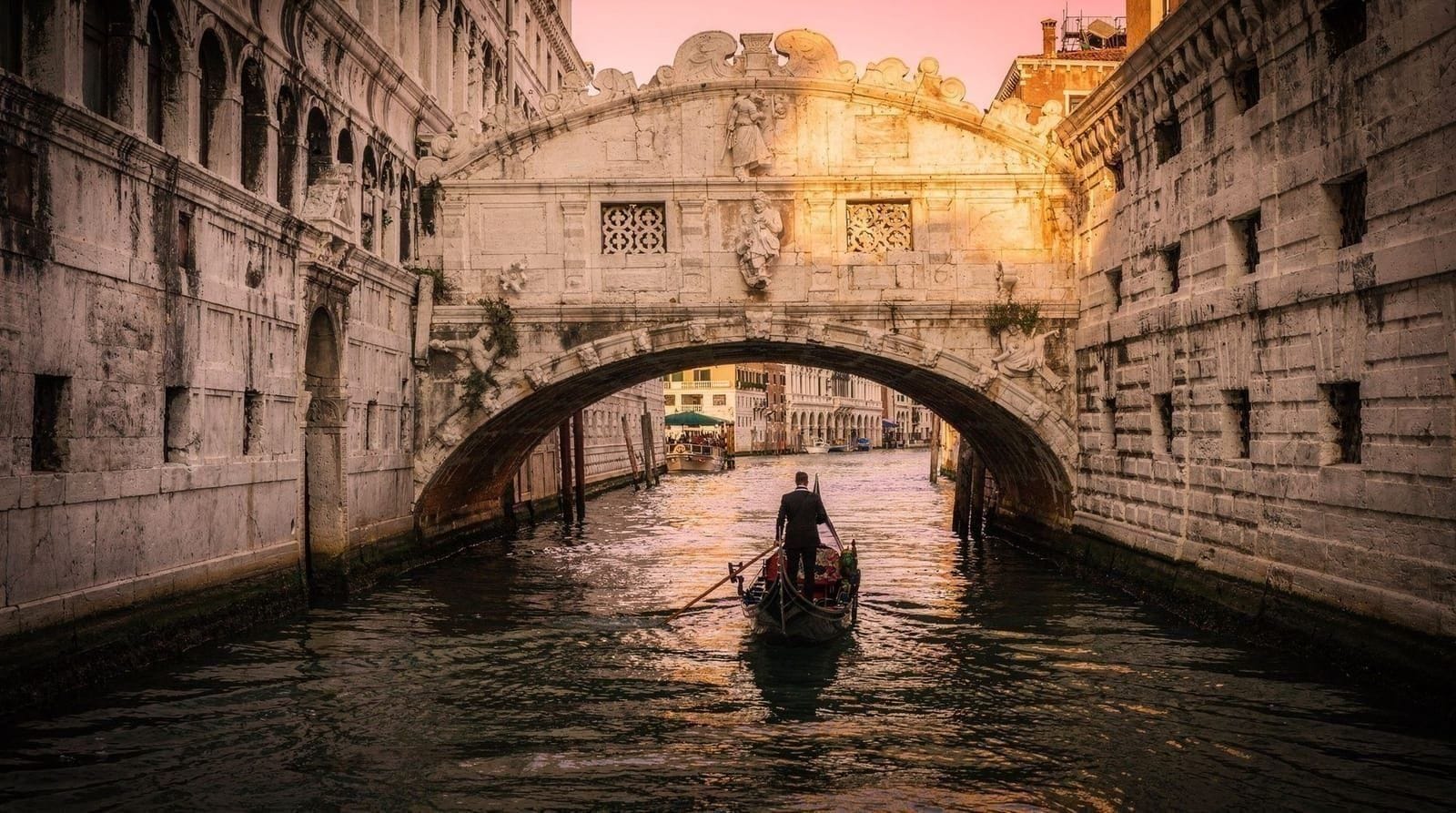
Delivery boats begin from about 6 am. Vaporetti run from approximately 5:30 am. Gondoliers typically start at 9 am. Occasional delivery boats in frame add life and scale.
Is it safe to walk around Venice at dawn?
Yes. Venice has very low crime rates. Pre-dawn Venice is populated by delivery workers and early-shift staff. Navigation with a phone map is the main practical consideration.
Can I take a vaporetto to Burano for sunrise?
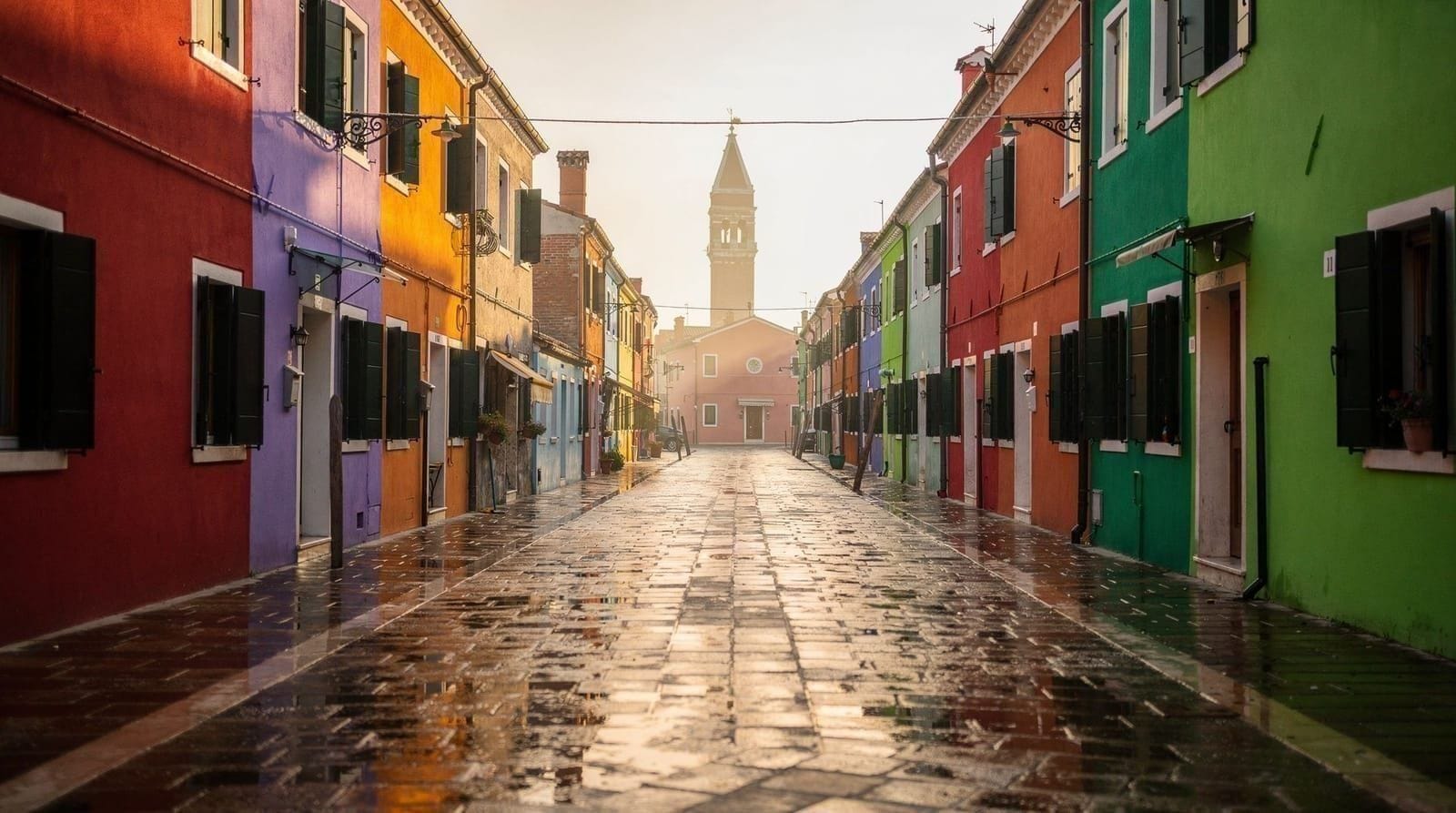
Yes. The first vaporetto to Burano (line 12 from Fondamente Nove) typically departs around 5:20–5:40 am. Check the ACTV website for current first-service times before planning. See the Burano photography guide for what to shoot once you arrive — the coloured houses reward a different approach from the stone-and-water compositions in the historic centre.
How does sunrise compare to golden hour for Venice photography?
They are different tools for different results. Sunrise gives you empty streets and piazzas — the crowd-free version of the city is the main prize, with the light itself a bonus. Golden hour (the hour before sunset) gives comparable warm light but with the crowds still present, since it happens at the end of the day rather than before it starts. See the golden hour Venice guide for the evening equivalent, useful if an early start genuinely isn’t feasible on your trip.
Do I need a full multi-day trip to make sunrise photography worthwhile?
No — even a single sunrise session is worth the alarm on any Venice trip. But if photography is your main purpose for visiting, dedicating a full itinerary around the light makes a real difference; see the Venice photography 3-day itinerary for a structured plan that sequences sunrise, midday interiors, and golden hour across three mornings.
Top experiences
Bookable activities with verified prices and instant confirmation on GetYourGuide.