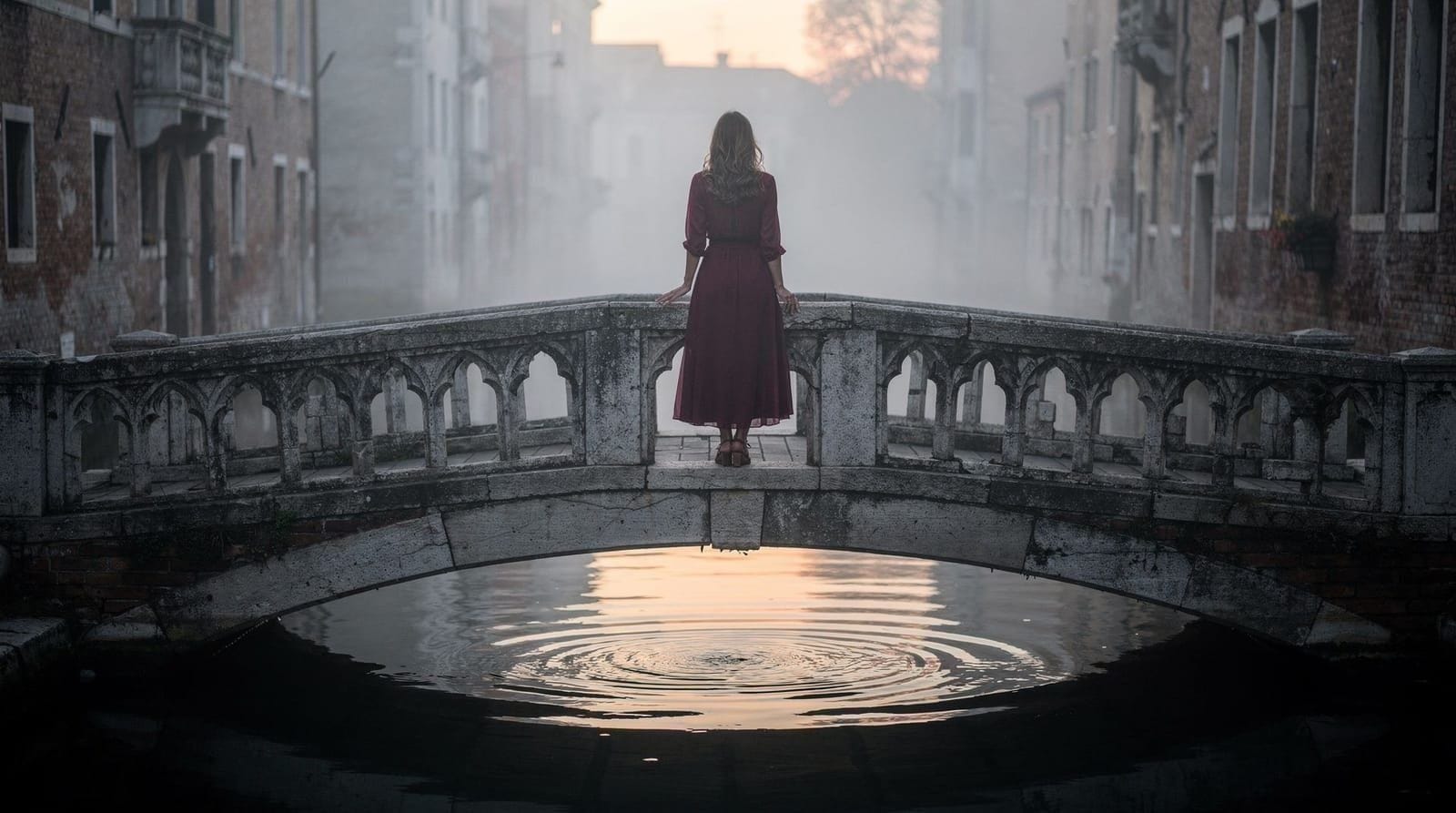
Best photo spots in Venice: 15 locations worth waking up early for
Venice: 2.5-hour private photo-walk with photographer guide
Where are the best photo spots in Venice?
The most rewarding photography spots in Venice are: Rialto Bridge at sunrise, Punta della Dogana at golden hour, Burano's coloured houses, the Libreria Acqua Alta courtyard, Fondamenta della Misericordia in Cannaregio, the Bridge of Sighs from the Riva degli Schiavoni, the Gondola yard at San Trovaso, and the Grand Canal from Ponte dell'Accademia. Early morning (before 8 am) is when Venice is most photogenic and least crowded.
The challenge and the reward of photographing Venice
Venice is both the most photographed city in Europe and one of the most difficult to photograph well. The challenge is not finding beautiful subjects — they are everywhere — but finding them without ten thousand other visitors also photographing them at the same moment.
The solution is almost always the same: arrive earlier. The city transforms before 7 am. The traghetti are not yet running. The gondoliers are still having their coffee. The pigeons have Piazza San Marco to themselves. The light is warmer, softer, and more directional than the flat noon sky that most tourism photographs are taken in.
This guide covers the 15 most photographically rewarding locations in Venice, with honest advice on timing, what to look for, and what the experience is actually like.
| Where | Rialto, Punta della Dogana, Castello, Cannaregio, Burano |
| Cost | Mostly free; church interiors ~€3, San Giorgio campanile ~€8 |
| Time needed | A dedicated morning (2–3 hours) covers 3–4 spots well |
| Getting there | On foot for the historic centre; vaporetto for Burano and San Giorgio Maggiore |
| Best time | Before 8am for empty frames, golden hour for warm light |
The Rialto Bridge at sunrise
The Rialto Bridge is the most photographed structure in Venice, which means getting an empty-bridge shot during the day is effectively impossible from April through October. At sunrise — roughly 5:15 am in June, 7:00 am in December — it is frequently empty.
The classic composition is from the boats moored along Fondamenta del Vin on the San Polo side, looking east toward the bridge. At sunrise, the light hits the bridge’s white Istrian stone directly; in fog or mist (common in October–November), the bridge appears to float in grey light. The Grand Canal at this hour has fishing boats and delivery craft on it, which give scale and life.
From the opposite direction — standing on the bridge and looking down the Grand Canal toward the Rialto’s curves — the light falls differently at different times of year. The south-facing view (toward Dorsoduro) catches morning light well; the north-facing view (toward Cannaregio) is better in the afternoon.
Pair with the Rialto market guide — the fish market (pescheria) opens at 7 am and the stalls are at their most photogenic before 9 am.
Punta della Dogana: the finest waterfront position
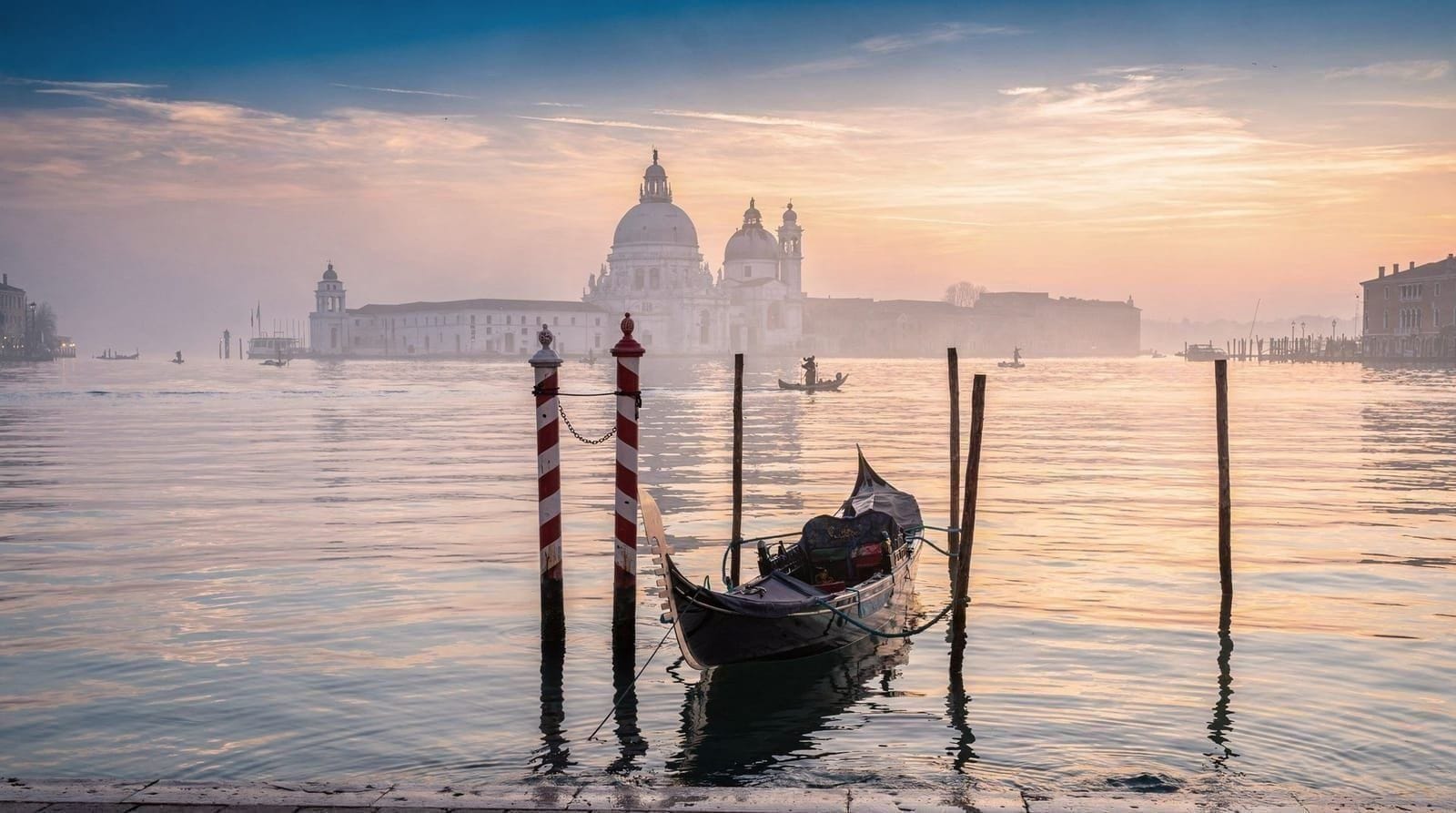
The point where the Grand Canal meets the Giudecca Canal — the tip of Dorsoduro — is the most strategically important viewpoint in Venice. From here, you can photograph:
- The Basilica della Salute from water level, with its dome and scrolled buttresses reflected in the canal
- The entire Bacino di San Marco, with San Giorgio Maggiore across the water and the Giudecca Canal opening to the right
- The Riva degli Schiavoni and the Doge’s Palace in the middle distance
- Gondolas and vaporetti crossing the water in front of you
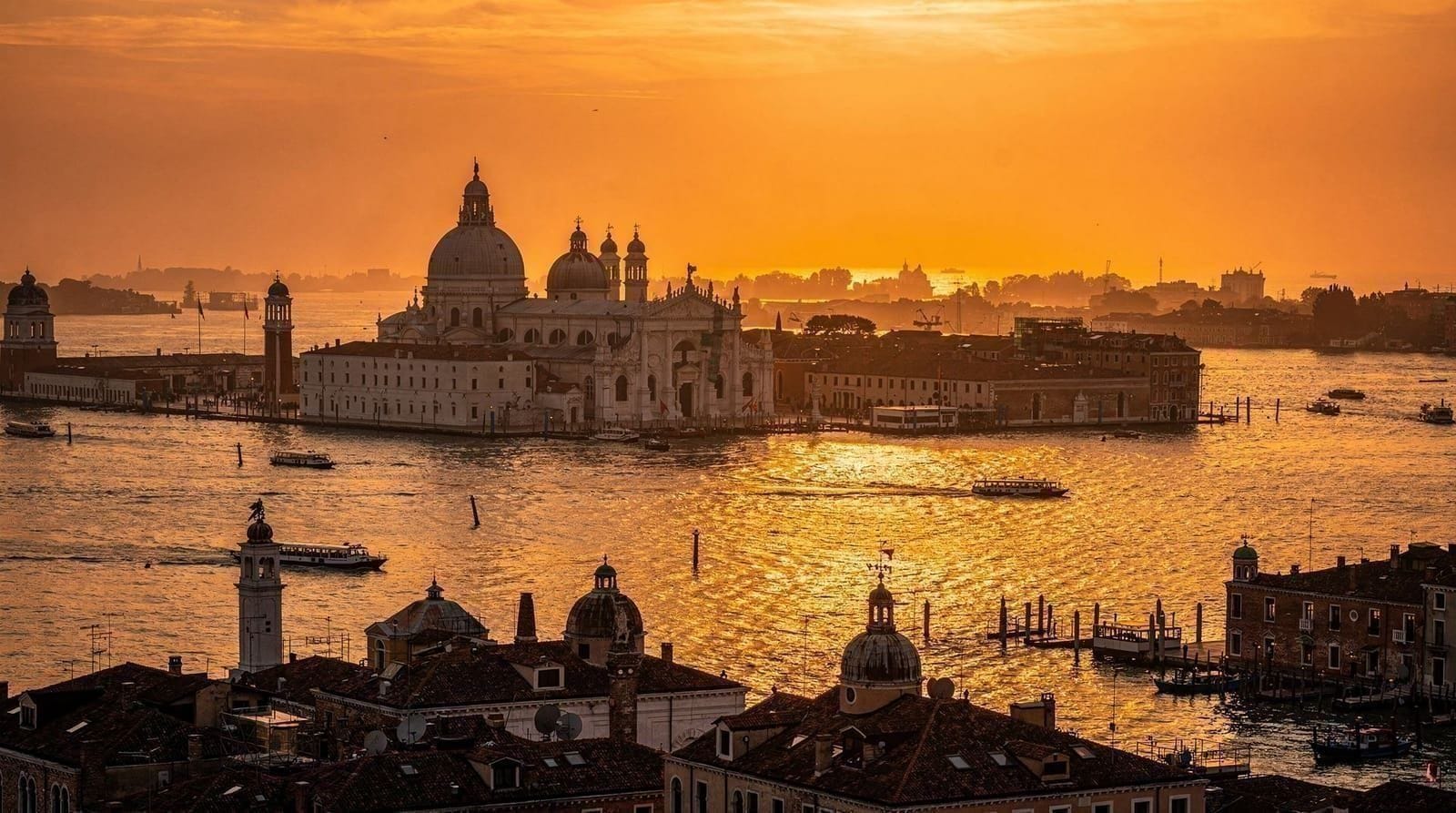
At golden hour — 45 minutes before sunset — the light turns orange on the Salute and the San Giorgio Maggiore campanile across the water. In clear weather in autumn, this is among the finest urban photography situations in the world.
The former Dogana da Mar (Customs House) building at the point is now the Punta della Dogana contemporary art museum, managed by François Pinault. The museum’s exterior terrace does not require a ticket and provides elevated views over the water. The Punta della Dogana guide covers what is inside.
Libreria Acqua Alta: the most shared interior
The Libreria Acqua Alta (Calle Lunga Santa Maria Formosa, Castello) is a famously eccentric bookshop where books are stored in gondolas, bathtubs, and large baskets to protect them from high water flooding. A staircase at the back of the shop is constructed from stacked encyclopaedia volumes. The shop opens onto a small canal through a rear window.
The interior photographs exceptionally well: warm tungsten lighting, rich textures of old paper and wood, and the surreal juxtaposition of a gondola as a book display. The staircase of encyclopaedias is the most widely shared image. Visiting early (the shop opens at 9 am; arrive as it opens on a weekday) gives you the shop with few or no other visitors.
Fondamenta della Misericordia: the real Venice canal
For the canal photograph that looks like Venice without looking like a tourist brochure, Fondamenta della Misericordia in Cannaregio is one of the best streets in the city. It is a long, straight canal-side path with residential buildings, local bars, restaurants popular with Venetians, and a working boat culture. In the evening it is busy with locals having aperitivo; in the morning it is quiet.
The light on the buildings here — mid-morning on a clear day — produces the kind of golden reflected-canal light that makes Venice’s photography so distinctive. There are no specific landmarks; the subject is the neighbourhood itself.
Bridge of Sighs from Riva degli Schiavoni
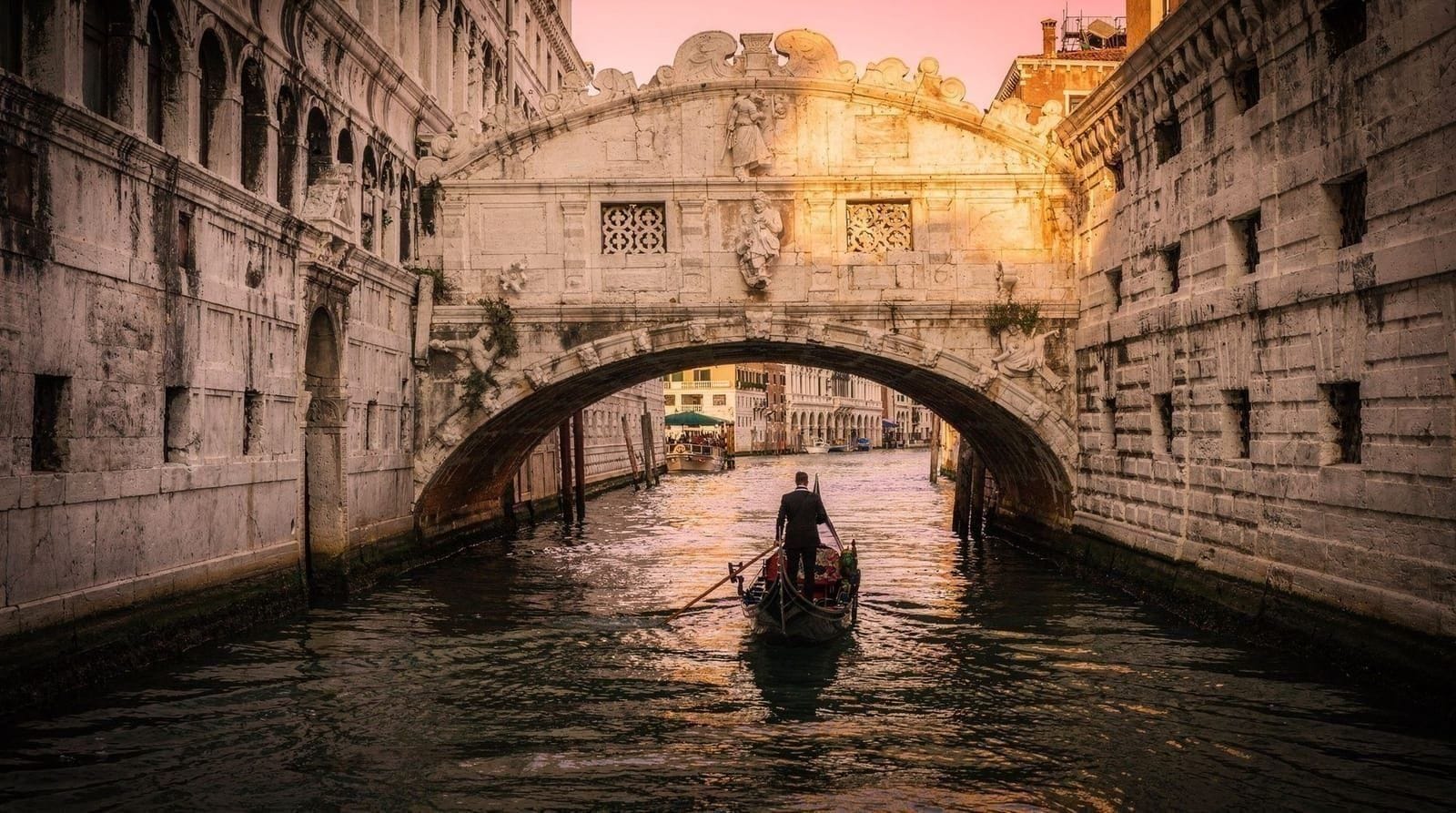
The Ponte dei Sospiri is best photographed from the Ponte della Paglia on the Riva degli Schiavoni, which provides the head-on view that appears in most depictions. The bridge is small, white, and enclosed, spanning between the Doge’s Palace and the old prison. The light on it is best in the morning (east-facing position) and most photogenic when there is a slight haze on the water behind.
The location is inevitably crowded from mid-morning onward. At 6–7 am it is quiet. Gondolas passing through the bridge from the underlying canal are a reliable compositional addition.
San Trovaso squero: the working boatyard
The Squero di San Trovaso in Dorsoduro is one of the last functioning gondola boatyards in Venice. It is visible from the bridge at the end of Fondamenta Nani — a free vantage point requiring no permission. From here you can watch and photograph the boatbuilding and maintenance operations, with the typical wooden Alpine-style structure of the squero (which resembles a mountain chalet, brought to Venice by Alpine craftsmen) as the backdrop.
The working activity is most reliable Tuesday through Saturday morning.
Ponte dell’Accademia: the Grand Canal composition
The wooden Ponte dell’Accademia in Dorsoduro gives the most widely used view of the southern Grand Canal: looking northeast toward the Salute and San Giorgio Maggiore beyond. The bridge is most useful at golden hour (evening), when the light enters from the west and illuminates the canal directly. The Salute dome in warm orange light, with gondolas in the foreground, is the canonical composition.
Early morning is also excellent here, with mist possible in the colder months. The bridge crowds from 9 am onward in summer.
San Giorgio Maggiore campanile: the highest accessible viewpoint
The campanile of San Giorgio Maggiore (on the island across the Bacino from San Marco) can be reached by lift for €8. The views from the top are 360 degrees: San Marco and the Doge’s Palace directly north, the full length of the Giudecca Canal to the west, the lagoon spreading in every direction. This is the best elevated photography point in Venice — better than the Campanile di San Marco (which gives you a higher elevation but directly down into the piazza) because the slightly lower height and external position give more usable perspective.
The island is reached by vaporetto line 2 from San Zaccaria (5 minutes). Combine with the church interior (free entry; two late Tintorettos on the choir walls).
Fondamenta degli Ormesini: Cannaregio at its most local
Running through northern Cannaregio parallel to the Fondamenta della Misericordia, the Fondamenta degli Ormesini offers a long canal-side perspective with laundry strung between windows, resident cats, and the working rhythms of a neighbourhood that still functions primarily for its inhabitants rather than its visitors. Early morning and late evening are the best times.
Burano: colour at any hour
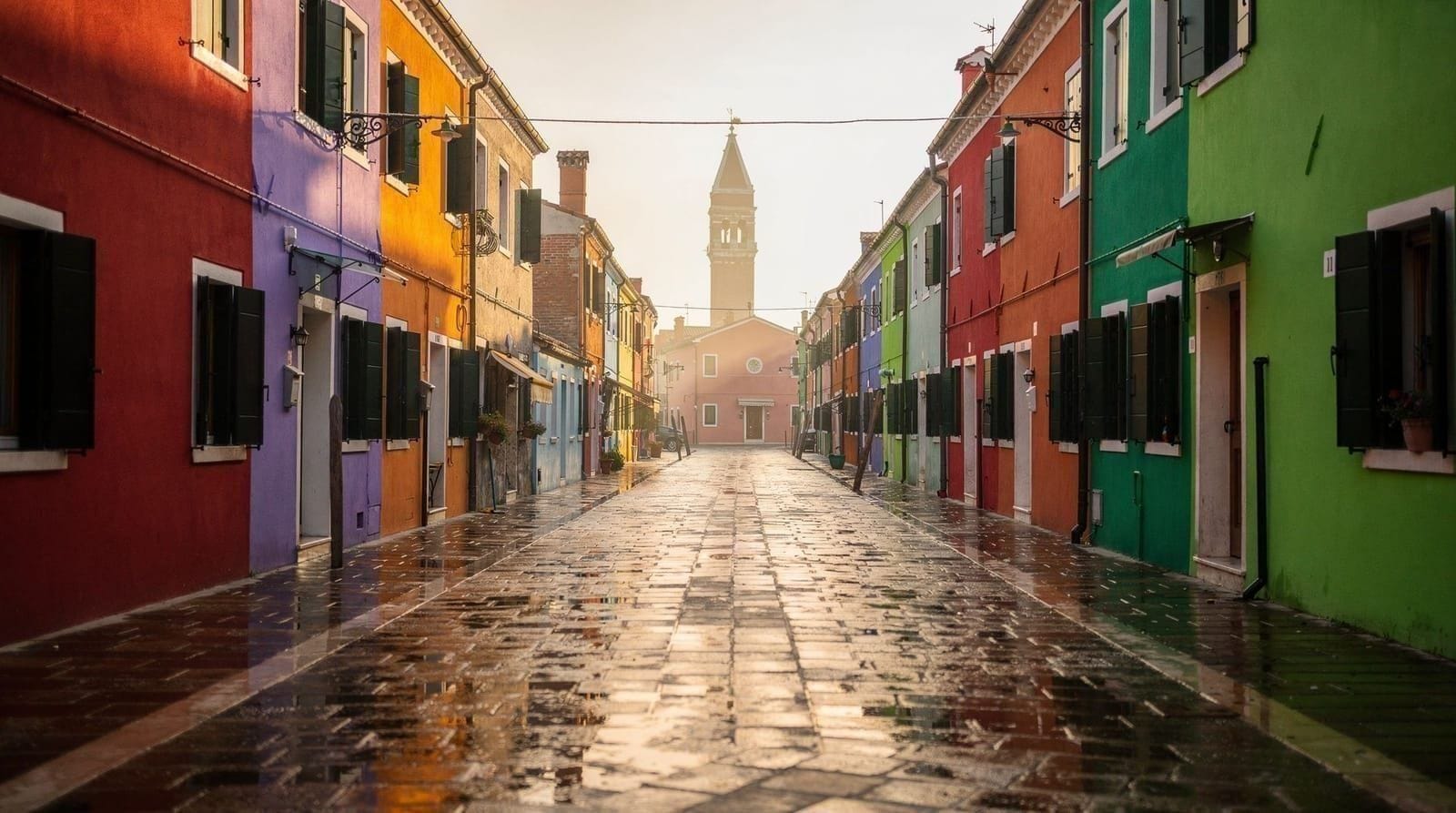
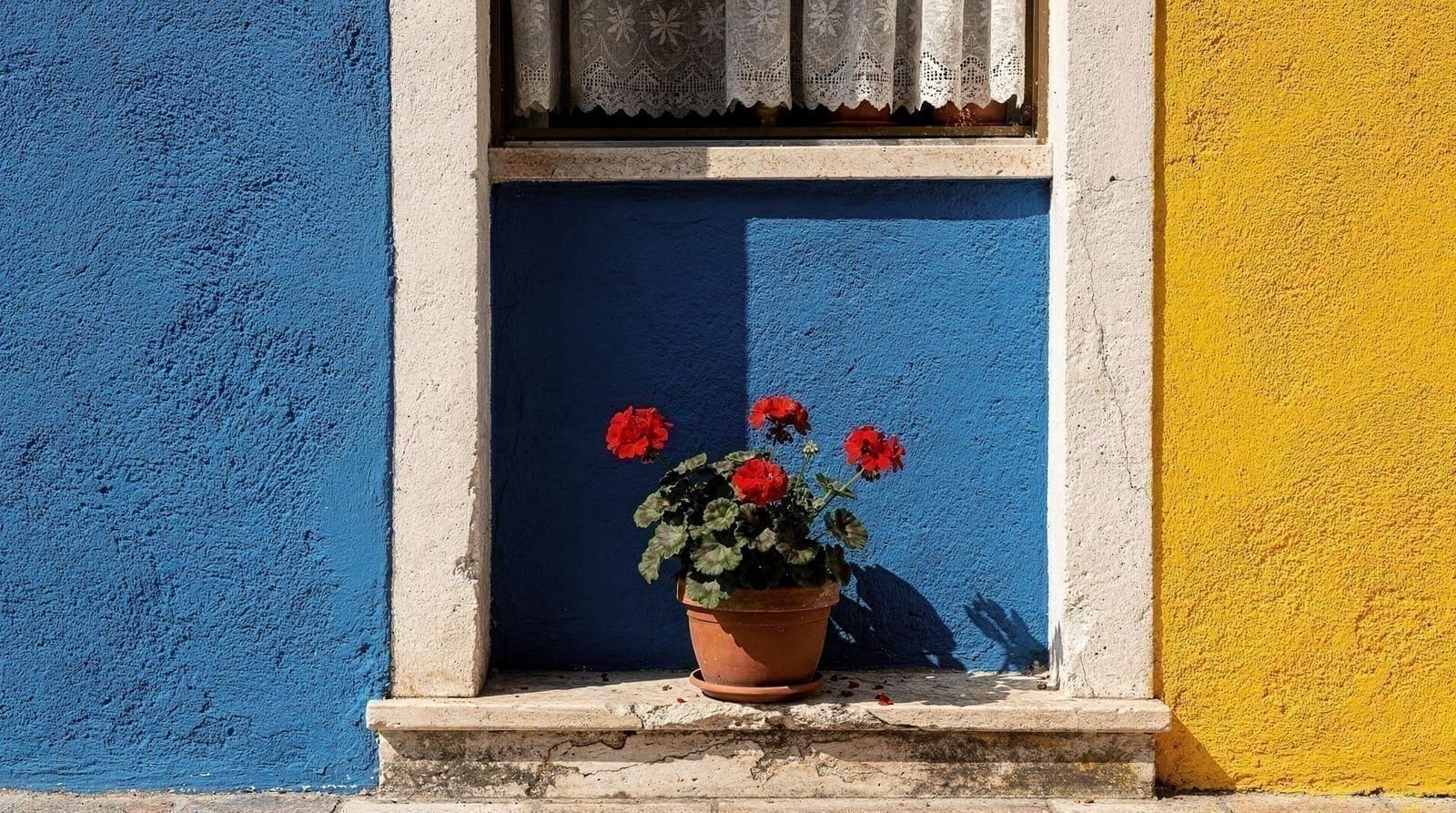
Burano’s coloured houses are discussed in detail in the dedicated Burano photography guide. In summary: the saturation of colour on the island’s buildings is genuinely extraordinary and photographs well at any time of day. The empty-streets opportunities are best before 9 am or after 5 pm, when the day-trippers have returned to Venice. See the full guide for route suggestions and specific streets.
Fondaco dei Tedeschi terrace: free elevated viewpoint
The Fondaco dei Tedeschi, a former trading post for German merchants near the Rialto and now a luxury department store, has a free public terrace on its roof that provides a view over the Grand Canal’s northern bend. Booking is required (free, at dfs.com/en/venice), and time slots are 15 minutes. The view is useful for wide-angle photography of the Grand Canal and the Rialto Bridge from above. Most useful in the hour before the terrace opens when you can plan your position, then execute quickly during your slot.
Church interiors: the underused photography resource
Several Venice church interiors are extraordinary photography subjects that most visitors underuse. The best for interior photography:
- San Zaccaria: the crypt partially flooded, creating reflections of the Gothic arches
- Santa Maria dei Miracoli: a perfect Renaissance jewel box in marble and gilded wood (Cannaregio)
- Madonna dell’Orto: large Tintorettos in a relatively quiet Gothic space (Cannaregio)
- Gesuati: Tiepolo ceiling frescoes, mid-morning light through tall windows
All permit photography without flash. Most cost €3 (Chorus Pass accepted).
Hiring a photography guide or professional photographer
If you want to maximise your photography in Venice — particularly if you have specific goals (couple portraits, architectural photography, early-morning canal access) — a guided photo walk is worth considering.
The 2.5-hour private photo-walk with photographer guide gives you a photography-knowledgeable companion who knows the light, the timing, and the access points for the best spots. This is particularly valuable for morning light, when having someone who has already done the route prevents wasted time during the brief window of ideal conditions.
For a professional portrait or couple’s photoshoot, the Venice photoshoot at the Grand Canal and Rialto pairs you with a professional photographer at one of the most visually compelling locations. The result is documented images rather than just memories.
The Instagram tour with private photographer is designed specifically for social-media-oriented content, visiting a curated set of locations with a photographer who handles both composition and post-processing of the day’s images.
Fondamente Nove and the Alps: the unexpected panorama
Standing on Fondamente Nove in Cannaregio — the long quay facing north across the open lagoon — on a clear winter morning, you may see something that surprises you. Behind Murano, in the far distance, the snow-capped Alps. On exceptionally clear days (most reliably after rain and wind has cleared the atmosphere, October–January), the range is distinctly visible from Venice: the mountain backdrop to the lagoon city is one of the most unexpected and photographically powerful views in the region.
This combination — the flat blue lagoon, the flat silhouette of Murano, and then the white mountains above — requires specific conditions and is not reliably available. But when it is there, it is the kind of photograph that makes Venice look like somewhere other than Venice in the best possible way. The best position is Fondamente Nove between the Gesuiti church and the Cimitero stop, looking north-northwest.
The question of photography etiquette in Venice
Venice’s canals, streets, and piazzas are public spaces, but they are also home to approximately 50,000 permanent residents. The tension between photography and daily life is real and occasionally tense — Venetians have been photographed by tourists in their own neighbourhood for decades, and not all of them welcome it.
The basic courtesies: do not photograph people in their homes or through windows, even if the window is open and the interior is visible from the street. Do not point cameras at children without permission. If you are photographing in a residential area and a resident indicates discomfort, move on. Venice is a living city, not an open-air museum, and the people who live there deserve the same privacy considerations you would expect at home.
In public spaces — Piazza San Marco, the Rialto, the vaporetto — normal street photography practice applies. People in public spaces have reduced expectations of privacy, and Venice’s tradition as one of the most photographed cities in the world means that most residents have made a certain peace with cameras.
What camera equipment to bring
Venice is walkable and the terrain involves narrow streets and bridges — bulky camera bags are awkward. The optimal setup for most visitors:
- A compact mirrorless camera (Sony ZV-E10, Fujifilm X100 series) or a capable phone with manual mode access
- A wide to standard zoom (24–85mm equivalent) covers 90% of what Venice requires
- A small lightweight tripod or gorilla-pod for interior shots and dawn/dusk work without relying on high ISO
- Extra batteries — Venice’s cold winter mornings drain batteries rapidly
The biggest improvement most photographers can make to their Venice photography is not equipment but timing: arriving at sunrise, returning at golden hour, and being patient when the light is working.
Matching spots to your available time
| If you have | Prioritise |
|---|---|
| One early morning (2 hours) | Rialto Bridge sunrise, then Fondamenta della Misericordia |
| A golden-hour evening | Punta della Dogana, then Ponte dell’Accademia |
| A full day | Add Burano (via vaporetto) and the San Giorgio Maggiore campanile |
| A rainy or foggy day | Church interiors (San Zaccaria, Santa Maria dei Miracoli) and Libreria Acqua Alta |
Trying to hit all 15 locations in a single visit is unrealistic and will leave you rushing through each one at the worst possible light. Pick a cluster geographically close together — Rialto and the Fondamenta della Misericordia are a natural morning pair; Punta della Dogana and the Accademia bridge work well together at golden hour — and let the rest wait for a return trip or a different day.
Weather changes the calculus too. A clear, still morning favours the Grand Canal reflections at the Accademia bridge and Punta della Dogana; a foggy or overcast morning is often better for the Rialto Bridge and the narrower Cannaregio canals, where mist adds atmosphere rather than flattening the shot. Rain, counterintuitively, is one of Venice’s most underrated photography conditions — wet stone reflects lamplight and building facades in a way dry pavement does not, and the crowds thin dramatically. Do not automatically write off a grey-sky forecast; adjust your target list to interiors and reflective surfaces instead of open piazzas.
Building a photography morning around Dorsoduro and Cannaregio
For a single well-paced session, a Dorsoduro-to-Cannaregio route works particularly well: start at the San Trovaso squero as the light comes up, walk to Punta della Dogana for the wide lagoon view, cross toward San Marco for the Bridge of Sighs before the crowds build, then loop back through Cannaregio for the Fondamenta della Misericordia and Fondamenta degli Ormesini once the morning has fully opened up. This sequence follows the light rather than fighting it, and keeps walking distances reasonable — see the Venice orientation map guide if the geography is still unfamiliar.
If you are planning a dedicated multi-day photography trip rather than fitting shots around general sightseeing, the 3-day Venice photography itinerary sequences all of this guide’s best locations against realistic light conditions across three mornings and evenings.
Frequently asked questions about photo spots in Venice
What time is best for photography in Venice?
The 45–60 minutes around sunrise are the best time. By 9 am in summer, the main sites are densely crowded. Golden hour (45 minutes before sunset) is excellent for the waterfront.
Can I photograph inside St Mark’s Basilica?
Yes, photography without flash is permitted. Tripods are not allowed. Use high ISO and stabilise the camera against a pillar if possible.
What is the best spot to photograph the Grand Canal?
Ponte dell’Accademia provides the most celebrated view looking toward the Salute. The Rialto Bridge frames the canal’s busiest section. The Fondaco dei Tedeschi rooftop (free, booking required) gives the best elevated perspective.
Is Burano worth visiting just for photography?
Yes. The coloured houses are unlike anywhere else, and the light on the island is distinctive. Early morning on a weekday is the optimal time.
Are professional photography sessions with a guide available in Venice?
Yes. Guided photo walks and professional photoshoot sessions are available. A guided photo walk is particularly valuable for morning light timing and access to less-known spots.
How many photo spots can I realistically cover in one morning?
Three to four, done properly with time to wait for the right light and composition. Trying to rush through more than that turns photography into a checklist exercise and usually produces worse results than lingering at fewer locations.
Is drone photography allowed in Venice?
No. Venice’s historic centre is a no-fly zone for drones under Italian aviation and local regulations, with fines for violations. Elevated views instead come from paid viewpoints like church campanili or the free Fondaco dei Tedeschi terrace.
Top experiences
Bookable activities with verified prices and instant confirmation on GetYourGuide.