Burano photography guide: coloured houses, timing, and the best streets
Instagram tour of Venice with a private photographer
When is the best time to photograph Burano?
The best time to photograph Burano is early morning on a weekday, before the day-trip boats from Venice arrive. In summer, aim to be on the island by 9 am. The side streets parallel to the main Via Galuppi offer the same colour intensity with significantly fewer people. Overcast light reduces glare and is often better than direct sun for the saturated house colours.
| Where | Burano, northern Venetian Lagoon |
| Cost | Vaporetto around €9.50 single |
| Time needed | 1.5–2 hours for a focused photography visit |
| Getting there | Vaporetto line 12 from Fondamente Nove |
| Best light | Early morning (6:00–7:30am) or late afternoon before sunset |
Why Burano photographs the way it does
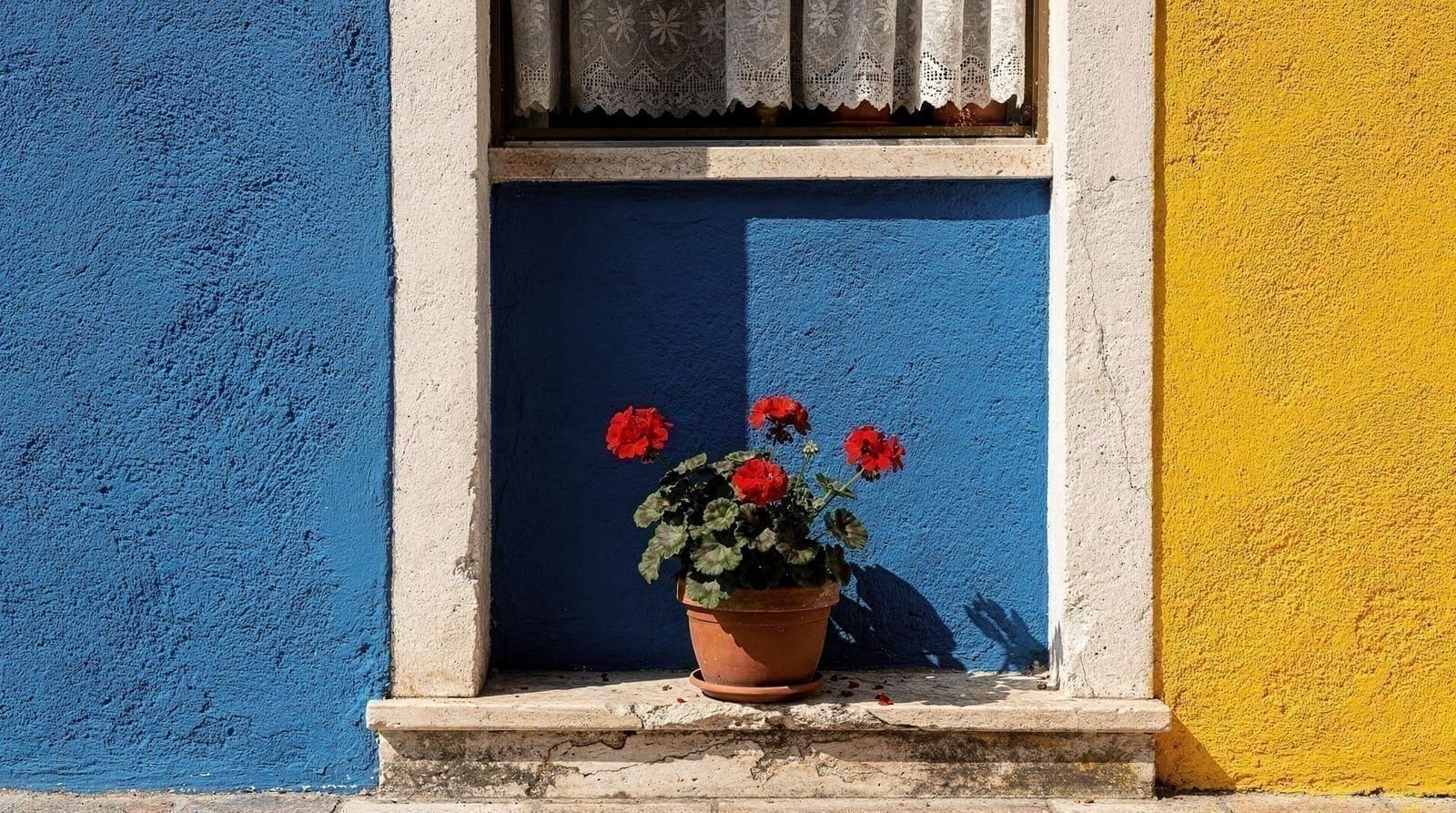
Burano’s colour is not an accident or a decoration — it is a system. Each house on the island requires municipal approval for its exterior colour, and the approval process specifies not just a general hue but a precise shade. No two adjacent houses can be painted the same colour. The result, applied across an island of several hundred houses over decades, is a deliberate mosaic of saturated pigment that catches light differently at different hours and seasons.
The colour intensity is real. Unlike many “colourful” destinations where the photographs require heavy processing to achieve the saturation you see on social media, Burano photographs taken in flat overcast light still look extraordinary. The pigment is genuinely that dense.
What makes Burano work photographically is the combination of three things: the colour, the reflections (the island’s inner canals double every facade in still water), and the scale. Burano is small enough to walk entirely in 90 minutes, which means you can cover every photographic angle in a single morning visit.
Getting to Burano: the vaporetto
Vaporetto line 12 from Fondamente Nove (Cannaregio) is the standard route. The journey takes approximately 35–45 minutes, stopping at Murano Faro and sometimes Mazzorbo before reaching Burano. Single ticket costs €9.50; the journey is included with any multi-day vaporetto pass.
First service: approximately 5:40–6:00 am from Fondamente Nove in summer, slightly later in winter. Check the ACTV website for current timetables before planning a sunrise or early-morning visit.
Frequency: In peak season (April–October), services run every 20–30 minutes. In winter, the service is less frequent — allow more flexibility in your return timing.
Return: The last service from Burano back to Fondamente Nove is approximately 10:30–11:00 pm. You will not be stranded if you stay for the evening light.
To reach Fondamente Nove from the centre of Venice, take vaporetto line 4.1 or 4.2 from San Marco or walk from Cannaregio (about 15 minutes from the Rialto area).
The best photography streets on Burano
Via Baldassare Galuppi: the main street and its crowds
The main street of Burano runs north to south from the vaporetto dock through the centre of the island. It is flanked by shops, restaurants, and residences in the most concentrated display of Burano’s colour palette. It is also the route every visitor takes, which means it is crowded from about 9:30 am onward on any day when the lagoon is calm.
For photography purposes, it is worth walking once but not staying. The crowds are genuine and the angle is the same one everyone photographs. The colour is there; the scene is not.
Via San Mauro and the northern streets
Turn left (west) off Via Galuppi partway up and walk toward the northern part of the island. The streets here are narrower, more residential, and almost entirely free of tourist traffic before 10 am. The houses are the same colours — sometimes more so, because this is where residents rather than restaurants and shops choose their paint. Long straight streets with the lagoon visible at each end are the most effective compositions.
The inner canals: the classic Burano image
The image most associated with Burano — coloured houses reflected in a canal, a boat tied up alongside — comes from the inner canals that run parallel to Via Galuppi. These fondamente are quieter than the main street. In the morning, the water is calm enough to produce clean reflections; by afternoon, boat traffic disrupts the surface.
Walk the fondamente on both sides of the main inner canal. The west bank (facing east) catches morning light; the east bank catches afternoon light. For reflection photography, morning is more reliable because wind picks up as the day progresses.
Piazza Baldassare Galuppi: the central square
The piazza at the heart of the island has the leaning tower of San Martino (the campanile that tilts noticeably, though not as dramatically as Pisa) as its centrepiece. The square is less photogenic than the streets — it is more open and the colour concentration is lower — but the leaning campanile framed against bright house colours is a distinctive Burano image.
Timing and light conditions
Early morning
Arriving on the first or second morning vaporetto (6:00–7:30 am) gives you an hour or more of nearly empty streets before the day-trip boats bring the first significant visitor groups. In summer, the light is golden and low at this hour, raking across the facades and exaggerating the colour. In autumn, there may be mist over the lagoon during the crossing and gentle diffusion on the island.
The empty street is not a rare occurrence on Burano — it is the standard before 9 am on weekdays. The difference between this and the busy midday island is difficult to overstate.
Overcast versus sunny
Burano photographs differently in different conditions:
Direct sun creates hard shadows and high contrast, which can make the colour combinations look flatter than they are. The saturated reds and yellows bleach slightly in intense direct sunlight. The best direct-sun photography is in the hour after sunrise when the sun is still low and the shadows have direction.
Overcast light is genuinely excellent for Burano. The soft, diffuse light eliminates the shadows that cut across narrow streets and allows the full colour range of the houses to register without bleaching. On overcast days, Burano may look more impressive to a photographer than on a sunny afternoon.
Mist — possible in autumn and winter — adds an atmospheric quality that is unusual for a place this colourful. The combination of vivid colour and soft edges from mist is unusual and striking.
Late afternoon
If you visit in the late afternoon, the light on the island’s western-facing streets turns gold in the hour before sunset. The canal reflections are more dynamic as the sky colour changes. The tourist boats return to Venice from about 4–5 pm, leaving the island progressively quieter. The combination of good light and diminishing crowds makes late afternoon a reasonable alternative to early morning.
The colour regulation system and why the colours are so intense
The question most visitors ask about Burano is: why are the colours so vivid, and who decides them? The answer lies in a municipal regulation that treats the island’s colour palette as civic heritage.
Each property owner who wants to paint their house must apply to the local authority. The municipality assigns a specific colour from an approved palette, taking into account adjacent properties — no two neighbouring houses can be the same colour. The colours on the approved palette are deliberately saturated: pastels would not produce the distinctive character that makes Burano what it is.
This means the colour juxtapositions — cobalt next to terracotta next to lime green — are the result of regulation rather than individual taste, and they produce combinations that no single property owner would choose on their own. The overall effect is coherent in a way that spontaneous colour development rarely achieves.
Different colours respond differently to light. Red and terracotta facades perform best in warm afternoon light; reds can go flat in the blue-cool of early morning. Cobalt and blue facades are most striking in morning or overcast light; they bleach in direct afternoon sun. Yellow and ochre facades work in almost any light and are particularly resonant at golden hour. On overcast days, the full colour range registers equally well — often making Burano more impressive under clouds than in direct sun.
What else to do on Burano
Photography is the primary draw, but Burano has content beyond the colour.
Museo del Merletto (the Lace Museum): Burano’s other traditional industry was punto in aria needle-lace — one of the finest and most technically demanding forms of lacemaking. The museum has historical examples and a small number of demonstrators who still practice the craft. Entry €7.
Ostaria da Romano: One of the oldest restaurants in the lagoon, serving traditional Venetian lagoon fish. Worth a lunch reservation if you are staying through midday. The risotto di gò (a lagoon fish specific to the Venetian lagoon) is genuinely local.
The cemetery island (Isola di San Michele, visible from the vaporetto): Technically a separate stop on the way back, but the cemetery island — with its cypress trees rising from the water — is photogenic in its own right, particularly from the deck of the passing vaporetto.
Equipment considerations for Burano photography
Burano is an outdoor photography subject — unlike Venice’s churches and covered markets, the colour is external. This means weather conditions and time of day are more important than lighting equipment, and the primary technical challenge is managing the colour saturation correctly.
Exposure: The saturated colours of Burano can cause cameras (both phone and dedicated) to underexpose if they read the bright reds and yellows as requiring exposure compensation downward. If your images look correct on the camera screen but come out slightly dark when you view them on a larger display, add +0.5 to +1 stop of exposure compensation.
White balance: Automatic white balance handles Burano reasonably well in most conditions. In the golden-hour and early morning light, a slightly warmer white balance setting (4500–5500K) will make the warm colours more resonant. In overcast conditions, automatic white balance is the easiest approach.
Focal length choices: A wide angle (24–35mm equivalent) captures a full street of houses and conveys the scale of the colour. A standard lens (50mm) is useful for more intimate compositions with a single facade. A moderate telephoto (85–135mm) compresses the perspective and stacks the houses — less common for Burano but useful for showing colour relationships between non-adjacent buildings.
RAW shooting: If you are using a dedicated camera, shooting in RAW format preserves significantly more colour information than JPEG in Burano’s high-saturation conditions. The difference is particularly visible in the transition between adjacent saturated colours, where JPEG compression can produce colour banding that RAW avoids.
Best time of day and season for Burano photography
| Time / season | Light quality | Crowds | Notes |
|---|---|---|---|
| 6:00–7:30am (any season) | Golden, raking light | Minimal | The single best window |
| 9:30am–4pm, summer | Harsh midday, high contrast | Heavy from 10am | Avoid for serious shooting |
| Late afternoon (3–5pm) | Warm, softening | Thinning as boats return | Good second-best option |
| Overcast days (any season) | Soft, saturated colour | Variable | Often outperforms direct sun |
| Autumn/winter mornings | Diffuse, occasional mist | Low | Atmospheric, fewer visitors overall |
Reaching Burano as part of a wider lagoon photography day
Serious photographers often combine Burano with Murano and Torcello in a single early start, since all three sit on the same vaporetto corridor. A typical structure: first boat to Murano for early glass-workshop light, on to Burano by mid-morning before the crowds peak, then Torcello in the early afternoon when its quiet, near-empty streets are least affected by visitor numbers. See the lagoon islands day trip guide for the full logistics, and the Murano vs Burano guide if you are deciding how to split limited time between the two.
Murano, Burano and Torcello panoramic boat tour covers all three islands in one outing if you would rather not manage the vaporetto connections yourself.
Combining Burano with Torcello
Torcello is a 10-minute vaporetto ride from Burano (line 9), and the two islands are almost always combined. Torcello is almost entirely abandoned — once the most populous island in the lagoon, now it has perhaps 15 permanent residents — and it has the oldest Byzantine buildings in the Venetian lagoon: Santa Maria Assunta cathedral (7th century, with extraordinary 12th-century mosaics) and Santa Fosca.
Photographically, Torcello is the opposite of Burano: almost no colour, agricultural land, and empty Byzantine architecture that predates Venice’s own founding. The contrast between the two islands in a single morning makes for an interesting photographic narrative.
See the Torcello guide and the lagoon islands day trip guide for how to structure the full itinerary.
Photography tours that include Burano
The Instagram tour with private photographer can include Burano as part of a customised itinerary. If Burano is your primary photography target, discuss this when booking — the operator can adapt the session to start with the early lagoon crossing and the island’s morning light.
For a private photo walk focused on Venice itself rather than the islands, the private photo-walk with photographer guide is the most flexible option in the city centre.
Frequently asked questions about Burano photography
How do you get to Burano from Venice?
Take vaporetto line 12 from Fondamente Nove. Journey time approximately 35–45 minutes. Cost €9.50 single or included with multi-day passes.
Why are the houses on Burano so colourful?
The tradition is attributed to fishermen identifying their homes through lagoon fog. Each household applies to the municipality for a specific approved colour. The current intensity dates largely from the 20th century.
What is the best street to photograph in Burano?
Via San Mauro and the northern residential streets have the most colour with fewest crowds. The inner canal fondamente offer the classic reflected-houses image.
Is Burano better for photography than Venice?
Different, not better or worse. Burano offers colour saturation and horizontal openness; Venice offers architectural complexity and historical depth. Visit both.
Can you combine Burano with Murano and Torcello in one day?
Yes. Start early at Murano, continue to Torcello, end at Burano. Allow a full day and use the line 12 and 9 vaporetti.
What camera settings work best for Burano’s colours?
A moderately fast shutter for handheld shooting (1/125s or faster), aperture f/5.6–f/8 for street scenes with reasonable depth of field, and +0.5 to +1 stop of exposure compensation if your images look correct on screen but too dark once viewed larger. Shoot RAW if possible to preserve the colour transitions between adjacent saturated facades.
Is a tripod necessary or allowed on Burano?
Not necessary for daytime photography given the available light, and tripods can be impractical on narrow, busy streets. For blue-hour or long-exposure canal reflection shots in the very early morning, a compact travel tripod is useful and generally uncontroversial on the quieter side streets, though avoid blocking the main canal fondamenta.
Top experiences
Bookable activities with verified prices and instant confirmation on GetYourGuide.