Murano glass guide: what to see, what to buy, and how to avoid the traps
Murano: glass factory experience with tour and demonstration
Is Murano glass worth buying and how do I know if it's genuine?
Genuine Murano glass carries the 'Vetro Artistico Murano' trademark — a sticker with a stylised M and a serial number. It is significantly more expensive than tourist-market glass (imported from China or Eastern Europe) but the craftsmanship is real. A quality piece starts at around €20–30; major decorative works run to hundreds or thousands of euros.
Eight hundred years of glassmaking on a lagoon island
In 1291, the Venetian Republic ordered all glassmakers to move their furnaces from Venice to the island of Murano. The official reason was fire safety — the wooden buildings of Venice were at risk from the furnaces. The real reason was economic control: the Republic wanted to keep the glassmakers’ secrets in one place, under watch, and prevent the techniques from spreading to competitor cities.
The glassmakers of Murano became, effectively, state assets. They were given significant privileges — the right to carry a sword (unusual for artisans), the right for their daughters to marry into the Venetian nobility — in exchange for not leaving the island and not sharing their methods. Glassmakers who escaped and set up abroad were officially considered traitors.
This partly explains why Murano glass techniques — particularly the development of cristallo (clear crystal), filigrana (embedded glass threads), and millefiori (thousand flowers) patterns — remained uniquely advanced for centuries. Today, Murano is still producing high-quality artisanal glass from the same island, using techniques that have evolved over 700 years.
This guide covers how to see genuine glassmaking on Murano, what to buy, and how to navigate the island without being frustrated by the hard sell.
| Where | Murano island, Venetian lagoon |
| Cost | Demo often free; beginners’ workshop around €40–80; Glass Museum around €12 |
| Time needed | 1.5 hours for a quick look; 3.5 hours for demo, museum and basilica |
| Getting there | Vaporetto lines 3, 4.1 or 4.2 from Fondamenta Nuove, around 10 minutes |
| Best time | Morning, before the midday tour-boat rush |
Understanding the Murano glass industry
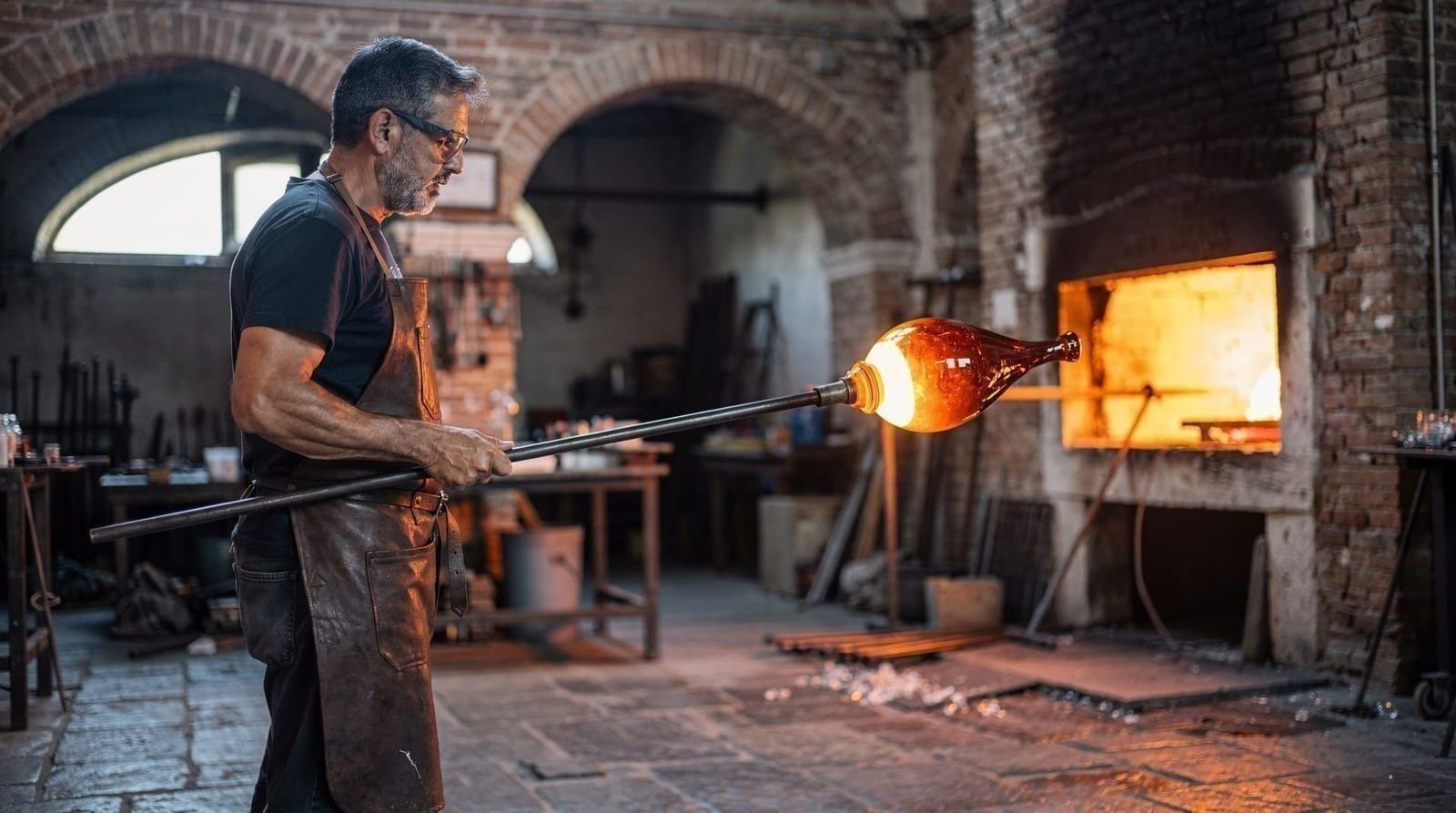
Murano today has around 50 working glass furnaces — a fraction of the hundreds that operated in the Republic era, but still a significant artisanal industry. The furnaces require temperatures of 1400°C and operate continuously (furnaces take weeks to heat up and cool down; they cannot be turned off daily). This means glassblowing demonstrations can run at any time of day, including on weekends.
The factory-showroom model: Most Murano glass factories operate a combined production and retail model. Visitors are shown a glassblowing demonstration, then guided into the showroom where finished pieces are for sale. The demonstration is often free or included in a tour ticket. The showroom is where the commercial transaction happens — and where the hard sell, in some establishments, can be aggressive.
What the hard sell looks like: Men positioned near the Murano vaporetto stops will approach you offering a “free shuttle boat” to their factory. The boat ride is genuinely free. Once in the showroom, you may feel pressured to buy — not physically, but through persistent attention from staff. You are never obligated to purchase anything. Saying “just looking” and leaving is entirely fine. However, some visitors find the atmosphere uncomfortable enough to affect the experience.
Avoiding the hard sell: The most reliable way is to arrive at a factory with a pre-booked ticket or tour — in this case the commercial expectation is different. A paid visit positions you as a customer who has already purchased access; the dynamic is less pressured. See the recommended tours below.
What a glassblowing demonstration actually involves
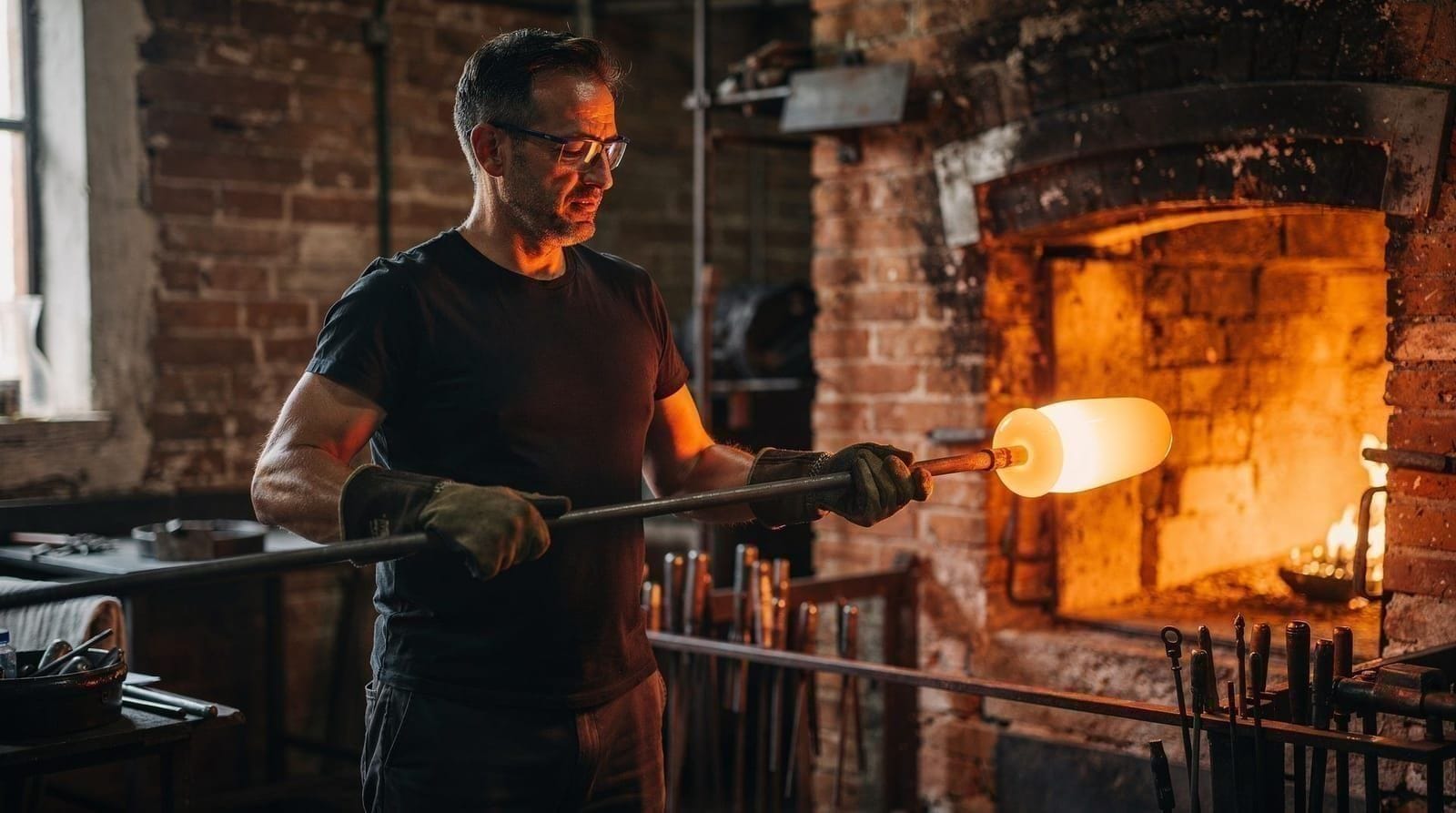
A standard demonstration runs 10–20 minutes. A maestro (master glassblower, typically with 20+ years of training) uses a blowpipe to gather molten glass from the furnace, blow a bubble, shape it with tools and gravity, and produce a finished piece — typically a horse, a vase, or a decorative bowl — in front of the audience.
The techniques that are most visually impressive:
- Filigrana: Fine glass threads are embedded in the molten glass before shaping, producing striped or lace-like patterns inside the finished piece
- Murrina/Millefiori: Cross-sections of layered glass rods fused together to create flower patterns, then incorporated into a finished piece
- Sommerso: Layered glass of different colours, creating a depth effect
A quality demonstration by a skilled maestro is genuinely impressive — the speed, the temperature control, and the transformation from formless molten mass to a finished decorative object in under 10 minutes is remarkable. A perfunctory demo with an inexperienced demonstrator is less so.
For a hands-on experience — where you actually blow a gather yourself — book a beginners’ workshop. These run 1–2 hours, you make a simple piece (usually a bead or small ornament) under the maestro’s supervision, and you take it home. Cost around €40–80 per person.
Murano: glass factory experience with tour and demonstration Murano: glassblowing workshop for beginnersThe Glass Museum (Museo del Vetro)
The Museo del Vetro di Murano (at Fondamenta Giustinian 8, Murano) is the primary museum dedicated to the history and techniques of Murano glassmaking. The collection covers Roman glass, Venetian glass from the 13th century onward, and modern design pieces. Highlights include the Barovier Wedding Cup (1470–80, a masterpiece of Renaissance glass with enamel painted decoration) and the large chandeliers and vases of the 18th-century production.
Entry runs around €12. Open Tuesday–Sunday; check for seasonal variations. Allow 1–1.5 hours. The museum is in a 17th-century palazzo; the building itself is part of the experience.
Buying Murano glass: what to look for
The Vetro Artistico Murano trademark: Genuine Murano glass carries a certification sticker — a stylised M logo with a unique serial number — issued by the Promovetro consortium. Ask to see it. Not all legitimate Murano glass has the sticker (small artisan workshops do not always participate in the certification scheme), but its presence is a reliable indicator of authenticity.
Price as an indicator: Genuine Murano glass is not cheap. A small, simple bead or ornament from a quality maker costs €15–30. A decorative vase runs €80–200. Major decorative pieces (chandeliers, large sculptures) cost thousands. If you are looking at a piece priced at €5–8, it is almost certainly not made in Murano.
The tourist market problem: Venice’s souvenir markets — in the arcades near Piazza San Marco, near the Rialto, and in the airport — sell glass items labelled “Murano” that are not made there. Most is imported from China, Eastern Europe, or other Italian regions. There is no easy way to verify origin unless you have the certification sticker or are buying directly from a verified Murano maker.
Where to buy with confidence: On Murano itself, from a factory with transparent production (you can see the furnaces and the production floor), or from a small artisan workshop where the maker can show you their work in progress. Several small workshops on Murano sell directly without a showroom hard sell — these are generally in the side streets rather than the main fondamenta.
The Basilica di Santa Maria e San Donato
The most underappreciated sight on Murano is the Basilica di Santa Maria e San Donato — a 12th-century Romanesque-Byzantine church at Campo San Donato, about 5 minutes’ walk from the main vaporetto stop.
The exterior apse is one of the finest examples of Venetian Romanesque decoration: blind arcading, geometric brick patterns, and sculptural insets that combine Byzantine and Italian Romanesque elements with unusual sophistication. Inside, the mosaic floor (12th century) depicts animals in a zoomorphic pattern similar to the Basilica of San Marco; the apse holds a 12th-century mosaic of the Virgin Orant — a luminous golden image of considerable power. Behind the altar, the bones of a dragon (actually a large prehistoric reptile) hang on the wall — claimed to be the dragon slain by St Donato.
Entry is free or by small donation. Open daily, morning hours typically 9am–12pm and 3:30–7pm. Almost always quiet. Deeply worth 20 minutes.
Murano’s main canal and neighbourhood
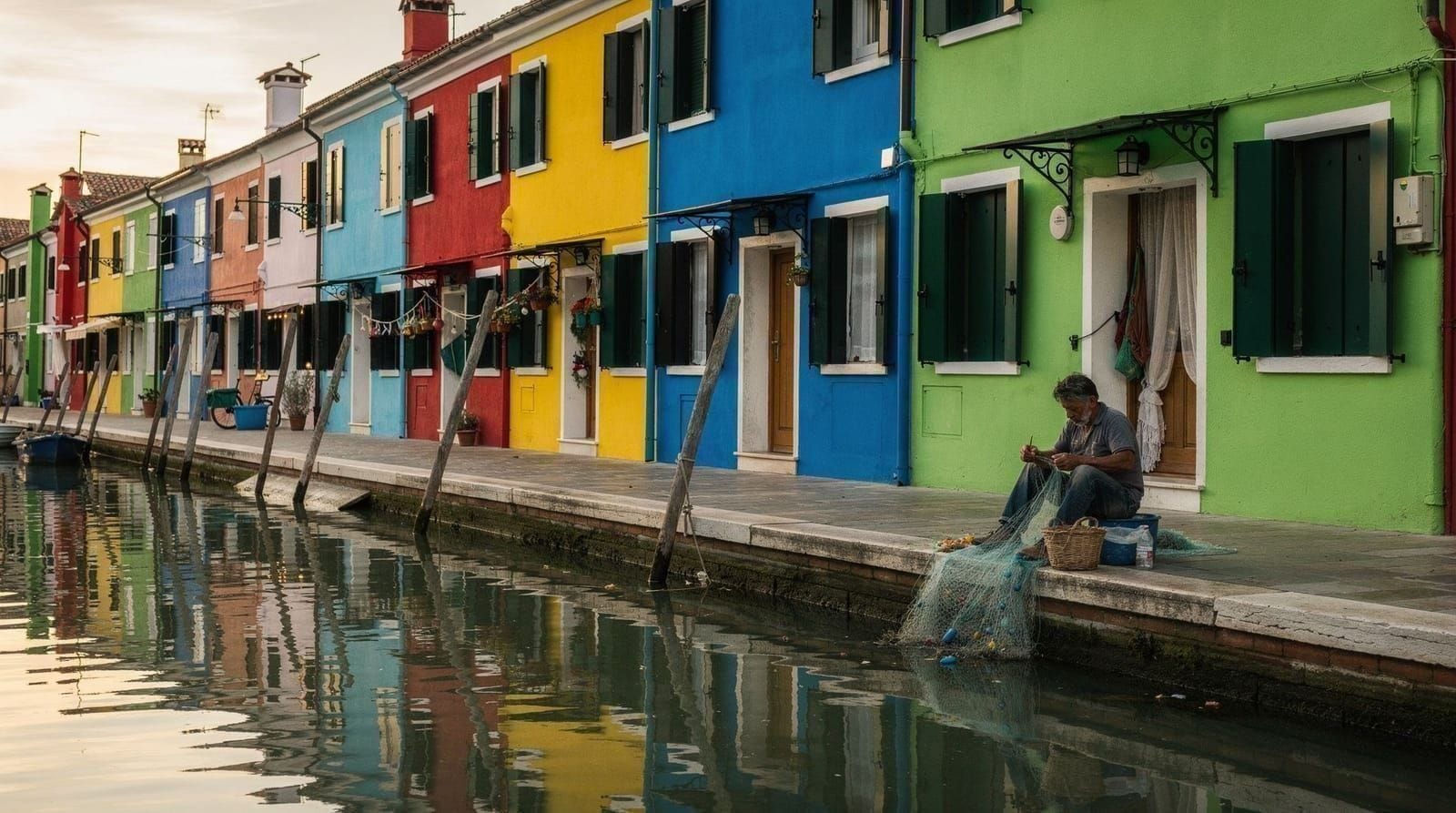
Canal de Mezo is Murano’s main canal, running through the centre of the island. The fondamenta (canal-side paths) on both sides carry the main pedestrian traffic: glass factory showrooms, restaurants, a few souvenir shops. In the morning, delivery boats unload at the fondamenta; the canal carries working boat traffic throughout the day.
The island is small enough to walk entirely in 30–40 minutes. Beyond the main canal and glass-focused area, there are residential streets, a small supermarket, a pharmacy, and the Campo San Donato with the basilica. The working-life side of Murano — locals going about their day in a place that is genuinely inhabited, not just a tourist attraction — is part of what makes a slower visit worthwhile.
Eating on Murano: Several restaurants on the fondamenta serve decent food at prices slightly lower than Venice proper. Seafood is generally good (proximity to the lagoon fisheries). For lunch, ask locally; the most reliable options are usually not on the main tourist strip.
Getting to Murano without the touts
The straightforward route is the public vaporetto, and it works just as well as any private shuttle. From Fondamenta Nuove, lines 4.1 and 4.2 run to Murano roughly every 10–20 minutes and take about 10 minutes; line 3 also serves Murano from the same stop with fewer intermediate stops. Buy a ticket or activate a Venezia Unica travel pass before boarding — full details on fares and validation are in the vaporetto guide and the vaporetto to the islands guide.
Ignore anyone near the vaporetto stop offering a “free” private boat to a factory — it is a sales funnel, not a shortcut, and the public boat is just as fast. If Murano is one stop on a longer lagoon day, see the lagoon islands day trip guide for how it fits alongside Burano and Torcello, and the Murano destination page for an overview of the island beyond the glass trade.
Demo, guided tour or workshop: which to choose
The right way to see Murano glassmaking depends on how much time you have and how hands-on you want to be.
| Option | Time | Typical cost | Best for |
|---|---|---|---|
| Free factory demo (walk-in) | 15–20 min | Free–€10 | A quick, no-commitment look at the craft |
| Guided boat tour with factory visit | Half day | Around €25–45 | First-timers who want transport + demo bundled |
| Beginners’ glassblowing workshop | 1–2 hours | Around €40–80 | Anyone who wants to make a piece, not just watch |
A walk-in demo suits a short visit squeezed between Burano and Torcello. The guided boat tour, such as the option below, removes the need to work out vaporetto timings and pairs the demo with a wider Murano and Burano itinerary — see also the how to visit Murano and Burano guide for a fuller comparison of routes. The workshop is the most memorable but requires booking ahead, especially in high season.
Murano beyond the glass trade
It is easy to treat Murano purely as a glass-shopping stop and miss the rest. The island has its own quiet residential rhythm once you step off the Canal de Mezo fondamenta — for a similarly under-visited lagoon island with a very different character, the Torcello guide and the wider hidden lagoon islands guide are worth reading before you go. If lace rather than glass is the draw, the Burano lace and colours guide covers Murano’s neighbouring island in the same practical detail.
Combining Murano with Burano and Torcello
Murano is most commonly combined with Burano (famous for its lace and coloured houses) and Torcello (the oldest settlement in the Venetian lagoon). The most efficient route on public vaporetto:
- Murano (line 4.1/4.2 from Fondamenta Nuove, 10 minutes)
- Burano (line 12 from Murano-Faro, 35 minutes)
- Torcello (line 9 from Burano, 5 minutes)
- Return to Venice (line 12 or 9 + 12 via Burano and Murano)
Budget a full day if visiting all three. The lagoon islands day trip guide covers the logistics in detail. For a comparison of the two main islands, see the how to visit Murano and Burano guide.
Murano and Burano: boat tour with guide and glass factory visitFrequently asked questions about Murano glass
Is it worth buying Murano glass as a souvenir?
If you want quality Italian glass craftsmanship with genuine artisanal value, yes. If you want a cheap souvenir to remember Venice, the price point of real Murano glass may surprise you — and there are better-value options. The key is being honest with yourself about which category you fall into.
How do I know if a Murano glass piece is authentic?
The Vetro Artistico Murano trademark sticker is the most reliable indicator. Alternatively, buy directly from a factory where you can see the production. Pieces sold in Venice’s tourist markets are almost never from Murano regardless of the label.
Are glassblowing workshops worth doing?
For visitors with an interest in craft or making things, a beginners’ workshop is one of the most memorable experiences available near Venice — creating something with a maestro’s guidance is quite different from watching a demonstration. Budget 2 hours and around €40–80 per person.
How long should I spend on Murano?
For glass factory demo + Glass Museum + basilica + lunch: about 3.5 hours. For demo only + a canal walk: 1.5–2 hours. For a deep dive including a workshop: a full morning.
What is the best glass to buy on a modest budget?
Small individual items — beads, ornaments, small vases — from established workshops rather than tourist-facing showrooms. Prices for genuine small pieces start around €20–30. The glass bead workshops that let you make your own beads are also good value (around €15–20 for a making session including materials).
Can I visit Murano on the same day as Burano and Torcello?
Yes, and it is the most common way to see all three — see the itinerary in the lagoon islands day trip guide. Just budget realistically: rushing the glass demo to catch a connecting boat undercuts the point of watching a maestro work, so treat Murano as the anchor stop rather than an afterthought if glass is your main interest.
Do I need to pre-book a factory visit?
Not for a basic walk-in demo, which factories run continuously through the day. A beginners’ workshop or a guided boat tour that bundles transport and demo does benefit from booking ahead, particularly from spring through autumn when Murano gets busy with day-trippers.
Is Murano worth it, and how to avoid the pitfalls
Top experiences
Bookable activities with verified prices and instant confirmation on GetYourGuide.