Venetian masks: history, types, and why Venice is the city of masks
Carnival mask decoration class at Casanova prisons
Why are masks associated with Venice?
Venetian masks originated as a social tool — anonymous mask-wearing allowed citizens to bypass class hierarchies in gambling houses, theatres, and social gatherings. The tradition peaked in the 18th century and nearly died under Napoleonic rule; the modern Carnival revival from the 1970s onward restored the mask as Venice's defining cultural symbol.
| Documented origins | 1268 (first mask-regulating laws) |
| Peak era | 18th century, worn by all social classes |
| Suppressed | 1797, with the fall of the Republic |
| Genuine artisan mask | From around €50 (simple bauta) to several thousand euros |
| Best places to see genuine masks | Museo Correr, Ca’ Macana, Tragicomica |
Why Venice became a city of masks
No other city in Europe developed such a deep, legally codified relationship with disguise. Venice’s mask culture was not merely decorative; it was a functional social technology deployed at the highest levels of the Republic’s civic life.
The Serenissima — the Most Serene Republic of Venice — was one of the longest-lived political entities in European history, surviving from 697 to 1797. Its stability depended on an elaborate system of checks: the doge’s power was limited, secret ballots were standard, and complex procedures prevented any single family from dominating the government. Into this political culture, the mask fitted naturally. Anonymity was not merely a social pleasure; it was a civic value.
By the 13th century, mask-wearing during Carnival and at certain civic occasions was common enough that Venice passed laws restricting it. The 1268 regulations — some of the earliest documentary evidence of the practice — prohibited mask-wearers from entering convents. Later statutes banned masks near gambling houses (sometimes wearing them was prohibited there, sometimes required), and specified when in the calendar you could and could not appear in disguise in public. The very need for these laws confirms that mask-wearing was already pervasive.
The golden age of Venetian masks: the 18th century
The tradition reached its peak in the 18th century, when the Venetian Republic was in slow political decline but at the height of its cultural and social life. The city was Europe’s most important pleasure destination — the original tourist trap, in a sense, though far more glamorous. Casanova, whose memoirs are set largely in Venice, describes a world saturated with masked encounters: assignations in casinos, political conversations in the corridors of power, theatrical intrigues at La Fenice.
During this period, the legal mask-wearing season officially ran from St Stephen’s Day (December 26) to Shrove Tuesday (Martedì Grasso), and also during certain state occasions, elections, and the visit of foreign dignitaries. In practice, mask-wearing extended throughout the year in certain contexts — the casino being the most notable, where anonymity was a precondition of play and a protection for noble gamblers who needed social cover.
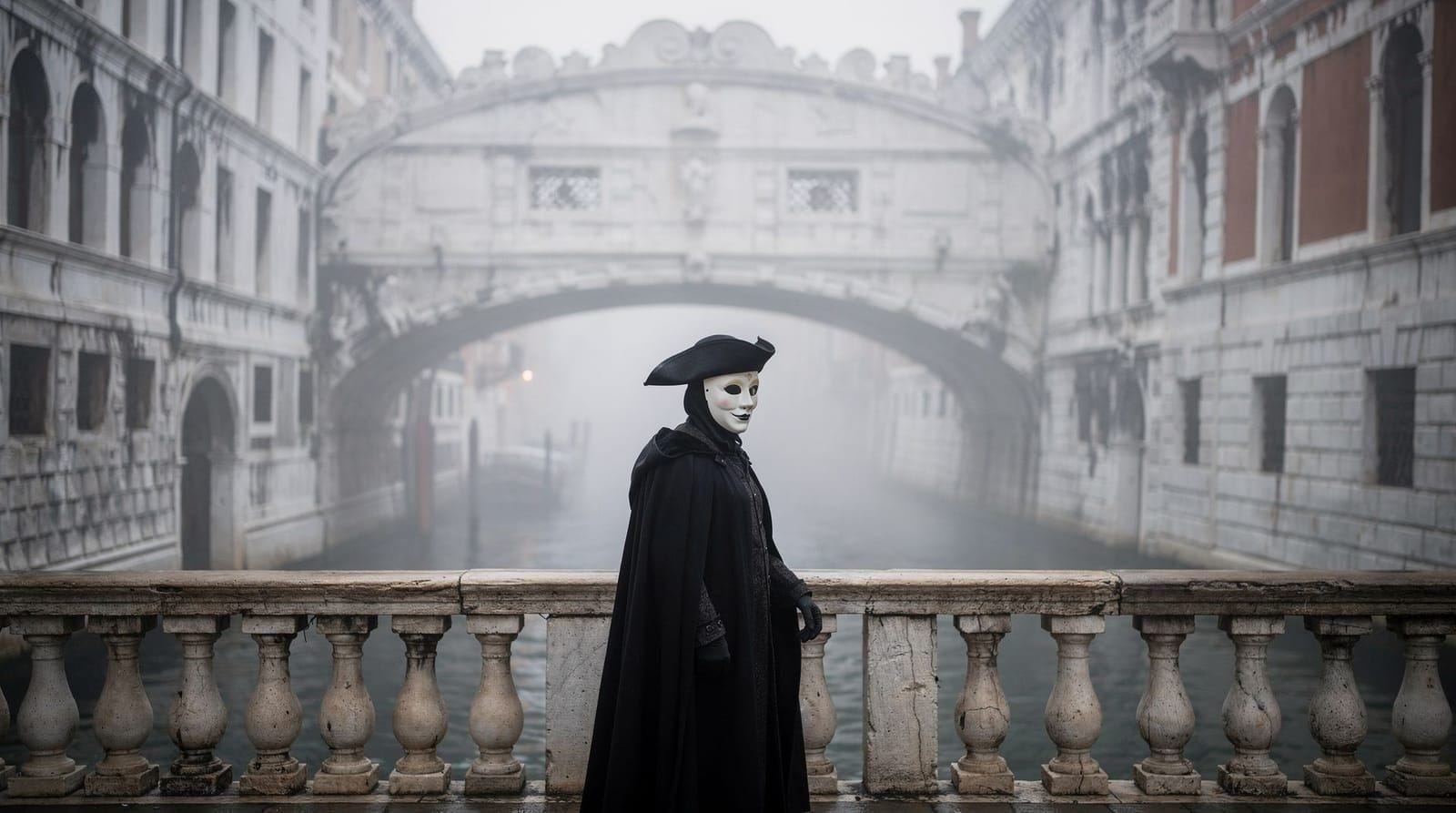
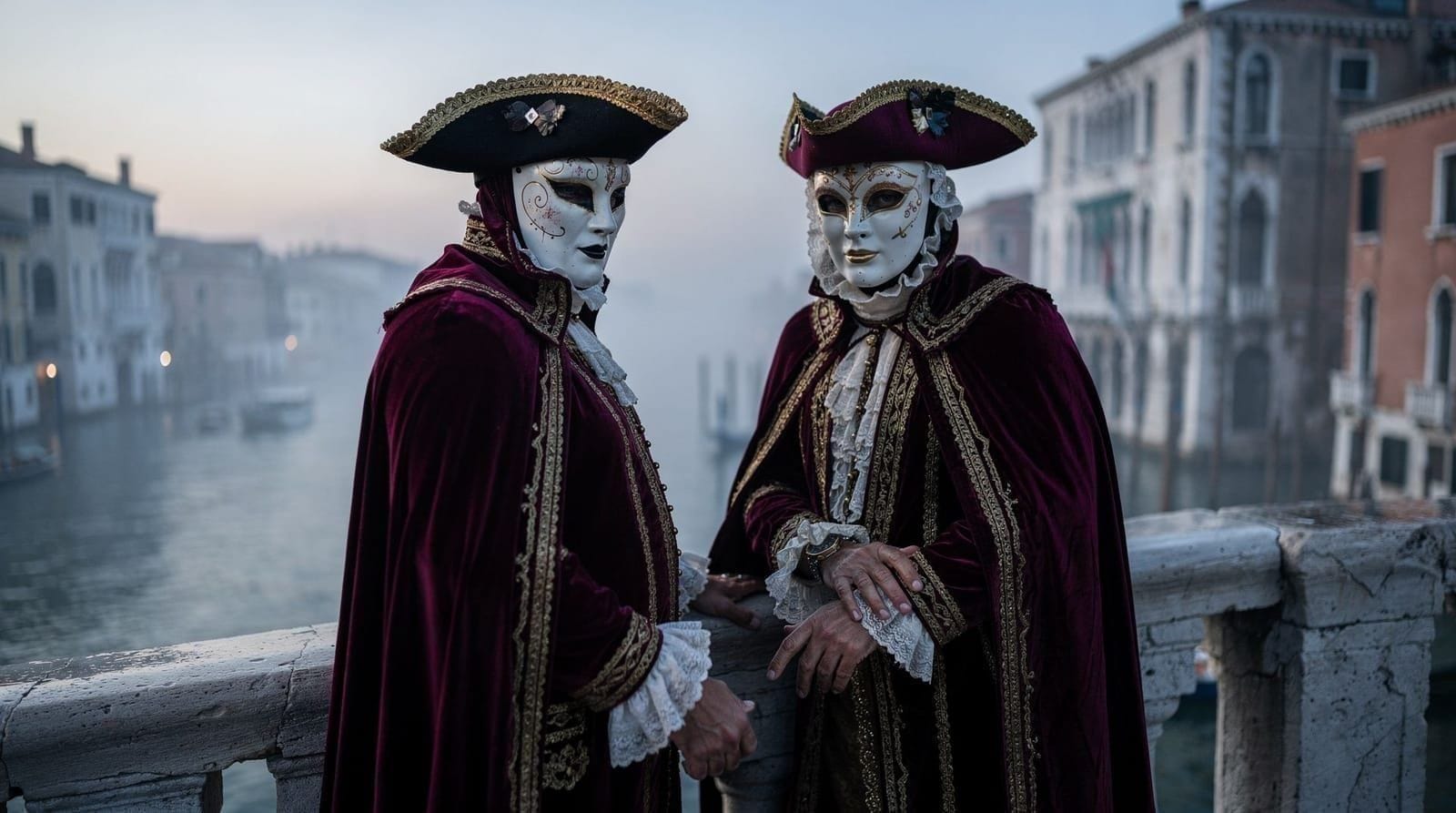
The specific mask most associated with this period is the bauta: a white lacquered face mask with a prominent square chin projection, worn with a black three-cornered hat (tricorno) and a black silk cape (tabarro). The projecting lower section allowed the wearer to eat, drink, and speak without removing the mask — maintaining anonymity throughout an evening. The bauta was worn by both men and women, and by all social classes. It is the mask that genuinely equalised Venetian society, at least for an evening.
The main mask types and their histories
Bauta
The bauta is the civic mask of Venice, with no theatrical origin. Its design prioritised function — maintaining anonymity while eating and drinking — over aesthetics. The classic colour was white, though some historical examples were painted or gilded. Today’s Carnival revivals often produce bautas in elaborate colours, which is historically inaccurate but visually striking.
Moretta
An oval, black velvet mask worn exclusively by women. No straps — held in place by a button clenched between the teeth, rendering the wearer mute. The moretta was explicitly associated with female social signalling in 18th-century Venice; its use was a recognisable code. The muteness it imposed gave it an air of mystery that was considered desirable in the social theatre of the period. Giacomo Casanova mentions the moretta several times in his memoirs as a reliable indicator of a woman’s social availability.
Medico della Peste (Plague Doctor mask)
The most visually arresting Venetian mask form, though its origin is functional rather than festive. During the plague epidemics of the 14th–17th centuries, physicians wore a long-beaked mask filled with aromatic herbs, flowers, and spices — the pre-germ-theory belief being that plague spread through bad air (miasma), and that the herbs would filter and purify the air breathed by the doctor. The beak was typically stuffed with lavender, mint, camphor, and dried roses.
The design is attributed to Charles de Lorme, physician to Louis XIII of France, who described the costume in detail around 1619. It included not just the mask but a full-length waxed coat, gloves, hat, and a long stick used to examine patients without physical contact. This figure — anonymous, beaked, dressed in black — became a recurring presence in Venetian streets during plague years and eventually entered the symbolic vocabulary of Carnival.
Colombina
A half-mask (lower face exposed) connected to the Commedia dell’arte character Colombina — the clever, flirtatious female servant. The colombina covered only the area around the eyes and upper cheeks, and was often held in place by the hand rather than tied. It was lighter and less oppressive than a full face mask, and became associated with female elegance over the 18th century. Modern colombinas are often the most elaborately decorated Carnival masks.
Characters of the Commedia dell’arte
Pantalone, Arlecchino (Harlequin), il Dottore and others have specific mask forms tied to the theatrical tradition. These are character masks rather than civic ones — their features are exaggerated, grotesque, or comic rather than the blank anonymity of the bauta and volto. The Commedia dell’arte tradition originated in northern Italy in the 16th century and was intimately connected with Venice throughout its history; La Fenice and the Goldoni theatre maintain the connection today.
The decline and revival of mask tradition
Napoleon’s conquest of Venice on May 12, 1797, ended more than eleven centuries of the Serenissima. Carnival was suppressed. The mask-making guilds dispersed. The tradition survived only in private celebrations and in the memory of older Venetians, but as a public civic practice it effectively ceased.
The revival began quietly in the 1970s, when a group of Venetian students and artists started organising small Carnival events, initially as a cultural reclamation project. By the early 1980s, the municipality was involved, and the international press had discovered what was happening. The Carnival of Venice — abolished since 1797 — became one of Europe’s most photographed events.
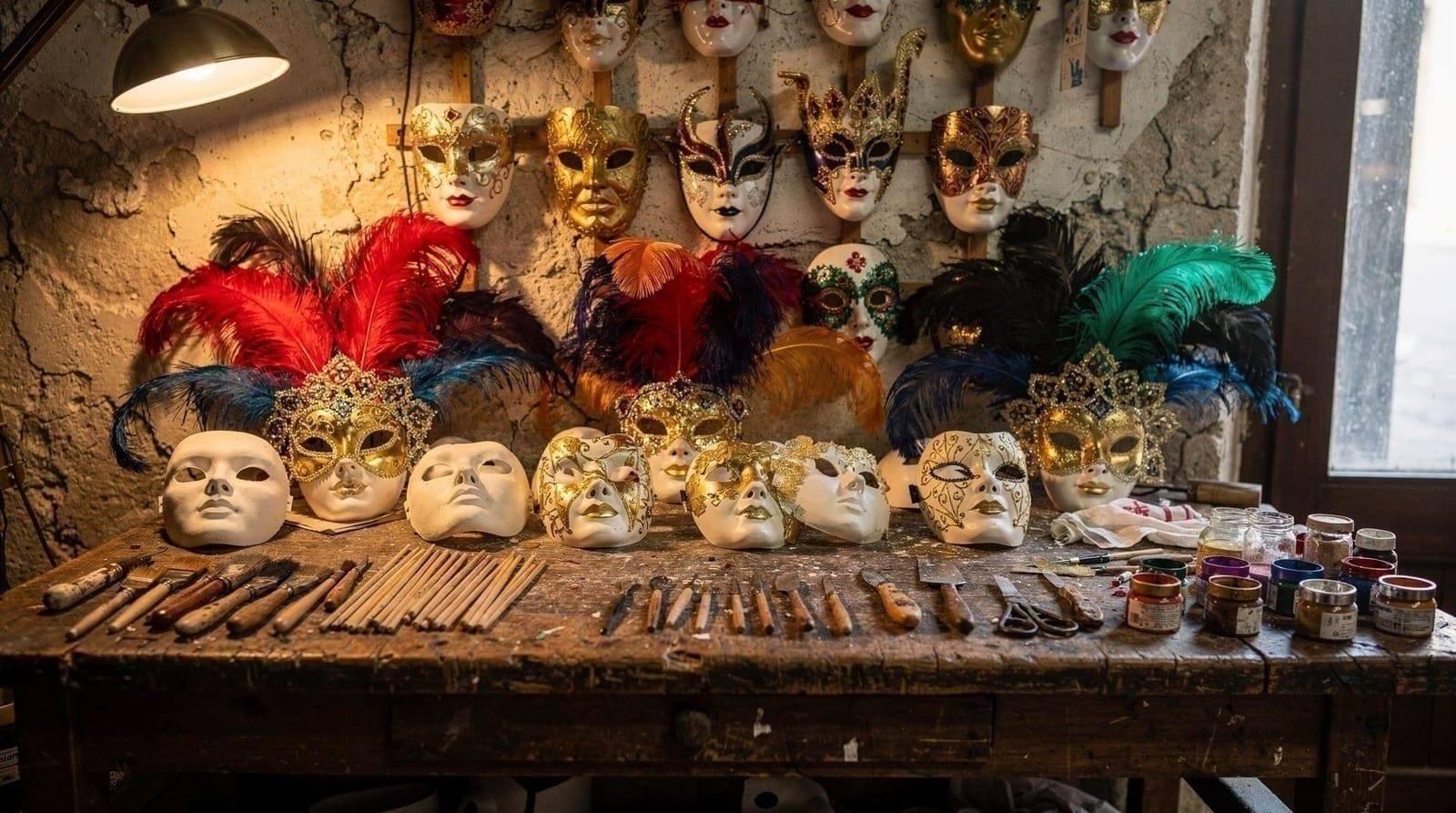
Artisans responded. Ca’ Macana, one of the most respected studios, was founded in the early 1980s and helped establish the modern standard for papier-mâché and leather mask-making. A new generation of mascareri (mask-makers) trained in techniques that combined historical reference with contemporary craft practice. The Venetian government eventually established a certification scheme to distinguish genuinely Venetian-made masks from cheaper imports.
Today, about 30–40 working mask-making studios operate in Venice. The best produce pieces that are genuine works of craft and command prices from €50 for a simple painted bauta to several thousand euros for elaborate theatrical commissions.
Where to see and buy genuine Venetian masks
The challenge in Venice is that 90% of the masks sold in shops near San Marco are manufactured outside Italy, often in China, from materials that would not survive the first Carnival season. The packaging may claim Venetian origin, but the tell-tale signs of non-artisan production are a perfectly uniform surface texture, machine-applied paint, and a plastic rather than papier-mâché or leather substrate.
Genuine Venetian masks have slight irregularities — the hand of the artisan is visible in the surface texture, the painted decoration has depth and variation, and the weight and flexibility are consistent with natural materials. Certified studios will often show you the production process.
Recommended studios with genuine artisan credentials:
- Ca’ Macana, Dorsoduro — one of the oldest operating studios, consistently recommended by craft historians. They also offer mask-painting workshops.
- Tragicomica, San Polo — exceptional theatrical masks, including full Commedia characters. Slightly off the tourist trail, which is part of the point.
- Il Canovaccio, near the Accademia — smaller, quieter, high-quality work.
Mask-making sits alongside glass and lace as one of Venice’s core artisan crafts — see the artisan crafts in Venice guide for the wider picture of where hand-skill traditions are still genuinely practised in the city.
The mask-making workshop guide explains how to join a session and paint your own mask under artisan guidance, which is a more active way to engage with the tradition.
Venetian mask decoration workshop with an artisan, Casanova-themed sessionGenuine artisan mask versus tourist souvenir: a comparison
Telling a genuine mask from a mass-produced import is easier once you know what to look for side by side.
| Signal | Genuine artisan mask | Mass-produced import |
|---|---|---|
| Material | Papier-mâché, leather or gesso-coated clay | Plastic or resin |
| Surface | Slight irregularities, visible hand-painting | Perfectly uniform, machine-applied paint |
| Weight | Light but substantial, natural material feel | Often noticeably lighter or plasticky |
| Price | From around €50 for a simple painted bauta | Often €10–20, sometimes marketed as “authentic” |
| Where sold | Certified studios (Ca’ Macana, Tragicomica, Il Canovaccio) | Souvenir stalls near major sights, especially San Marco |
If a mask shop near St Mark’s Square has a wall of identical, low-priced masks with a “made in Venice” sign but no visible workshop, that combination alone is a reliable sign it is not artisan-made — a genuine studio is usually happy to show or explain its production process.
The mascherari guild and the craft’s professional structure
In the medieval and Renaissance Republic, mask-making was a regulated guild trade. The mascherari (mask-makers) were a recognised professional guild with the right to produce and sell masks — which were, at the height of their use, as essential to Venetian social life as any clothing item.
The guild structure served multiple purposes: it maintained quality standards (shoddy masks that fell apart or deteriorated were not acceptable in a social context where the mask’s integrity was part of its function), it regulated prices, and it controlled who could enter the trade. Apprentices served years under master craftsmen before earning the right to produce independently.
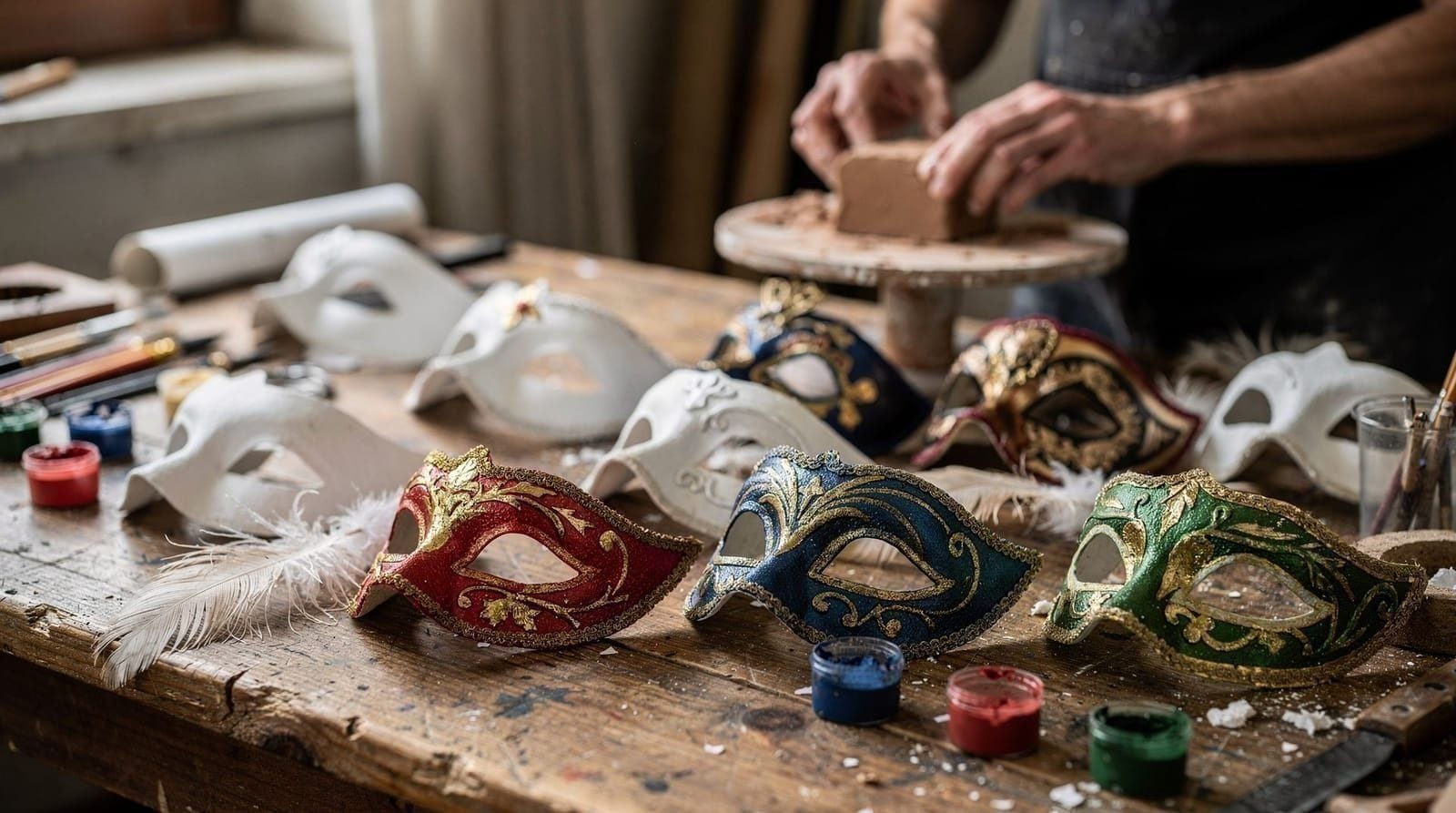
The materials of historical mask production were different from what is used today. The traditional Venetian mask was made from several layers of papier-mâché over a clay form, then painted with a gesso base and finished with pigments, lacquer, and sometimes gilded. The best historical masks had a quality of surface that modern mass-production cannot replicate — a slight hand of the artisan visible in the texture, a luminosity in the layered paint that only comes from the slow process of applying and drying multiple coats.
The mascherari as a guild dissolved after Napoleon’s suppression of the Republic. The revival of the craft from the 1970s onward involved learning from surviving historical masks (in museum collections) and reconstructing techniques that had been largely forgotten. Ca’ Macana and Tragicomica are among the studios where this reconstruction process produced genuinely skilled work.
Theatrical masks: the Commedia connection
The Commedia dell’arte — the Italian tradition of improvised masked comedy performed by travelling companies — was intimately connected to Venice throughout its history. La Serenissima’s opera and theatre culture was sophisticated and commercially important; the Commedia tradition fed into it and was fed by it in return.
The character masks of the Commedia — Arlecchino (Harlequin), Pantalone, il Dottore, Zanni — are distinct from the civic masks of Venetian social life. They are character masks with exaggerated, grotesque, or comic features: the large hooked nose of Pantalone, the idiotic blank grin of Arlecchino, the pompous academic nose of il Dottore. These masks communicate character immediately to an audience who has seen the same character before.
Pantalone is specifically a Venetian character — a greedy, suspicious, miserly merchant. His mask is a long hooked nose on a thin face, often with a beard. The comedy of Pantalone depended on Venetian audiences recognising the type: the paranoid merchant, afraid of being cheated even as he cheats others, is a comment on the commercial society Venice had built.
The best workshops that teach Commedia character mask construction — as distinct from the decorative Carnival masks — are small and specialist. Tragicomica in San Polo is the best-known; their theatrical character masks are works of genuine craft and are used by professional theatre companies.
Masks at the Correr Museum and Palazzo Mocenigo
The Museo Correr at the far end of Piazza San Marco holds the most significant collection of historical Venetian Carnival objects in the city, including 18th-century masks, costumes, and the social paraphernalia of the gambling houses. Entry to the Correr is included with the Museum Pass (Musei di Piazza San Marco). See the Correr Museum guide for more.
The Museo di Palazzo Mocenigo (near Santa Croce, roughly 10 minutes’ walk from Rialto) is less visited but more focused on Venetian fashion, costume, and social history. The permanent collection includes mask-related material in context, which gives a clearer sense of how masks were integrated into everyday aristocratic life.
For the full civic and political story behind why masks mattered so much to the Republic, see the Venetian Carnival history guide and the Doge history guide, both of which cover the wider institutional context that made anonymity such a valued civic tool. For visiting during the modern revival itself, the San Marco guide covers the square where most of the mask spectacle now takes place.
Frequently asked questions about Venetian mask history
When did Venetians start wearing masks?
The first documentary evidence of mask-wearing in Venice dates to 1268, when laws were passed regulating disguise. By the 13th century, mask-wearing was common enough to require specific legal restriction — which suggests the practice was already widespread.
What is the most iconic Venetian mask?
The bauta is the most distinctly Venetian form: a white face mask with a projecting lower section, worn with a tricorn hat and a black silk cloak. The medico della peste (plague doctor) is the most immediately recognisable globally, though the bauta has deeper historical roots in Venetian civic culture.
What happened to Venetian mask tradition after 1797?
Napoleon’s conquest of Venice in 1797 led to the abolition of the Serenissima and the suppression of Carnival. Mask-wearing was effectively banned. The tradition survived only in folklore until the 1970s, when a revival began.
What is the moretta mask?
The moretta was a black velvet oval mask worn exclusively by women, held in place by a button clenched between the teeth — making speech impossible. In 18th-century Venice, wearing the moretta was understood as a specific social signal.
Where can I see authentic antique Venetian masks in Venice?
The Museo Correr in Piazza San Marco has a collection of historical Carnival objects including masks. The Museo di Palazzo Mocenigo focuses on Venetian fashion and includes mask-related exhibits. For contemporary artisan work, Ca’ Macana in Dorsoduro and Tragicomica in San Polo are among the most respected studios.
Can I take a genuine Venetian mask home on a flight?
Yes — papier-mâché and leather masks are lightweight and travel well in checked or carry-on luggage if padded with clothing or bubble wrap; many studios will wrap larger pieces for transport. Fragile decorative elements (feathers, delicate gilding) are the main things to protect, not the base material itself.
Is it worth paying more for a certified artisan mask over a cheap souvenir?
Yes if the mask matters to you as more than a passing photo prop — a genuine artisan piece is a durable, hand-finished object that holds up over years, while a souvenir-stall mask is often flimsy and fades or cracks quickly. For a one-off photo, the difference matters less; for something you will display or wear again, the artisan piece is the better investment.