Mask-making workshop in Venice: what to expect and how to book
Venice: Carnival mask workshop
Can tourists make their own Venetian mask in Venice?
Yes. Venice has a handful of workshops where you paint and decorate a pre-formed papier-mâché mask using traditional pigments and techniques. Sessions last 1–2 hours and cost €30–€90 depending on the complexity of the mask and whether a tutor guides you throughout.
The tradition behind Venice’s masks
Venetian masks carry more history per square centimetre than almost any object in the city. Their roots go back to the 13th century, when Venice’s powerful merchant class discovered that anonymity had a social utility: wearing a mask, you could gamble, conduct business across class lines, and attend the theatre without your identity being known. The mask was, paradoxically, a great social equaliser.
By the height of Carnival in the 18th century, mask-wearing season extended from December to Fat Tuesday (Martedì Grasso), and in some years even longer. Specific mask types became associated with specific behaviours. The law eventually had to specify when you could and could not wear them. The tradition nearly vanished after Napoleon’s conquest of Venice in 1797 — masks were suppressed along with Carnival itself. The revival began slowly in the 1970s and accelerated through the 1980s, when mask-making was repositioned as an artisan craft worthy of preservation.
Today, learning to decorate a traditional mask is one of the few workshop experiences in Venice that genuinely connects you to that long history.
| Where | Dorsoduro, San Polo, and studios around San Marco |
| Cost | around €30–90/person depending on quality and length |
| Time needed | 60–90 minutes for most decorating workshops |
| Getting there | walkable within each sestiere; check studio address on booking |
| Best time | book weeks ahead during Carnival (31 Jan–17 Feb 2026) |
Types of Venetian mask and what makes each distinctive
Understanding the different mask types helps you choose intelligently in a workshop — and explains why some workshops are more culturally interesting than others.
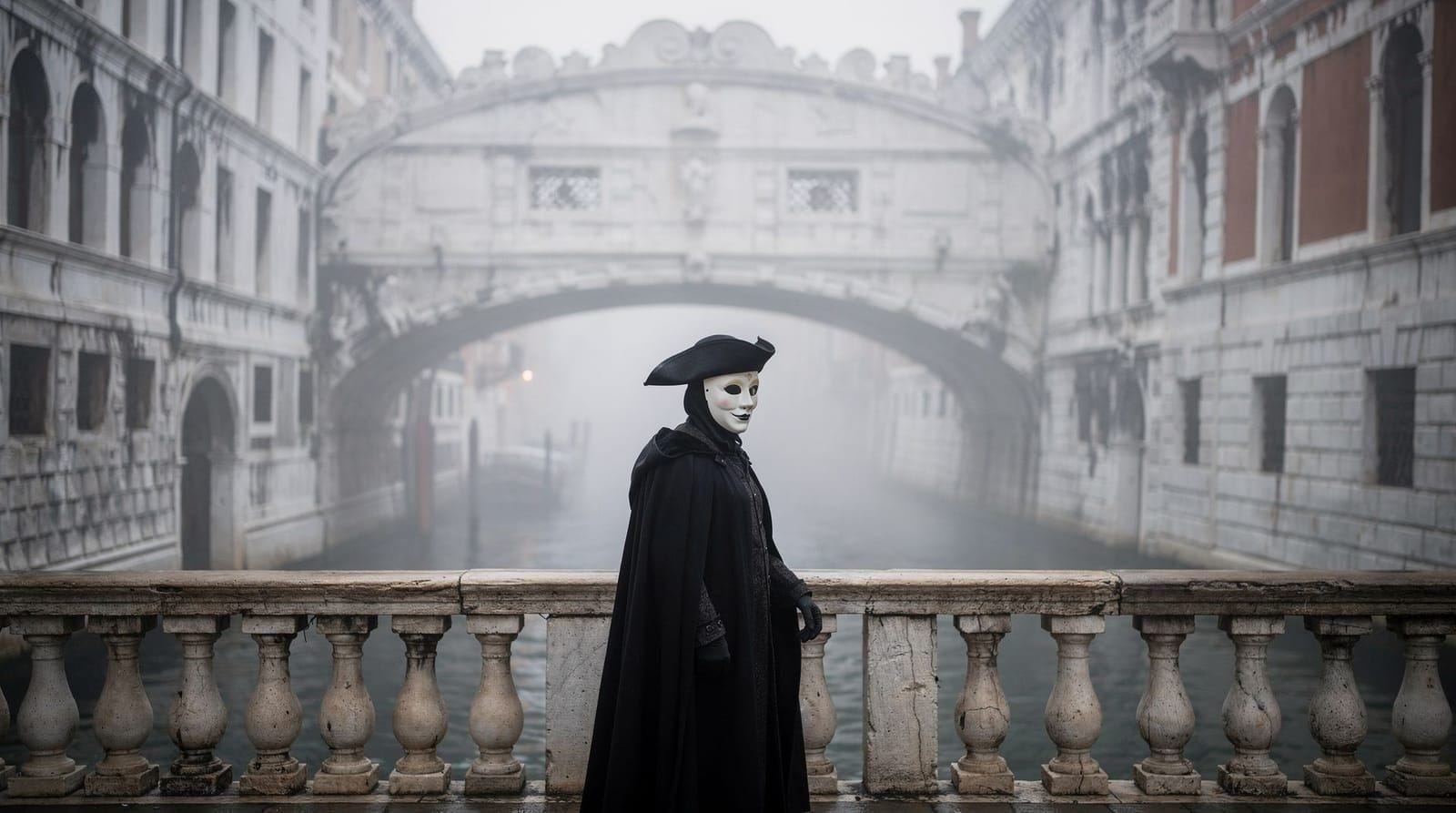
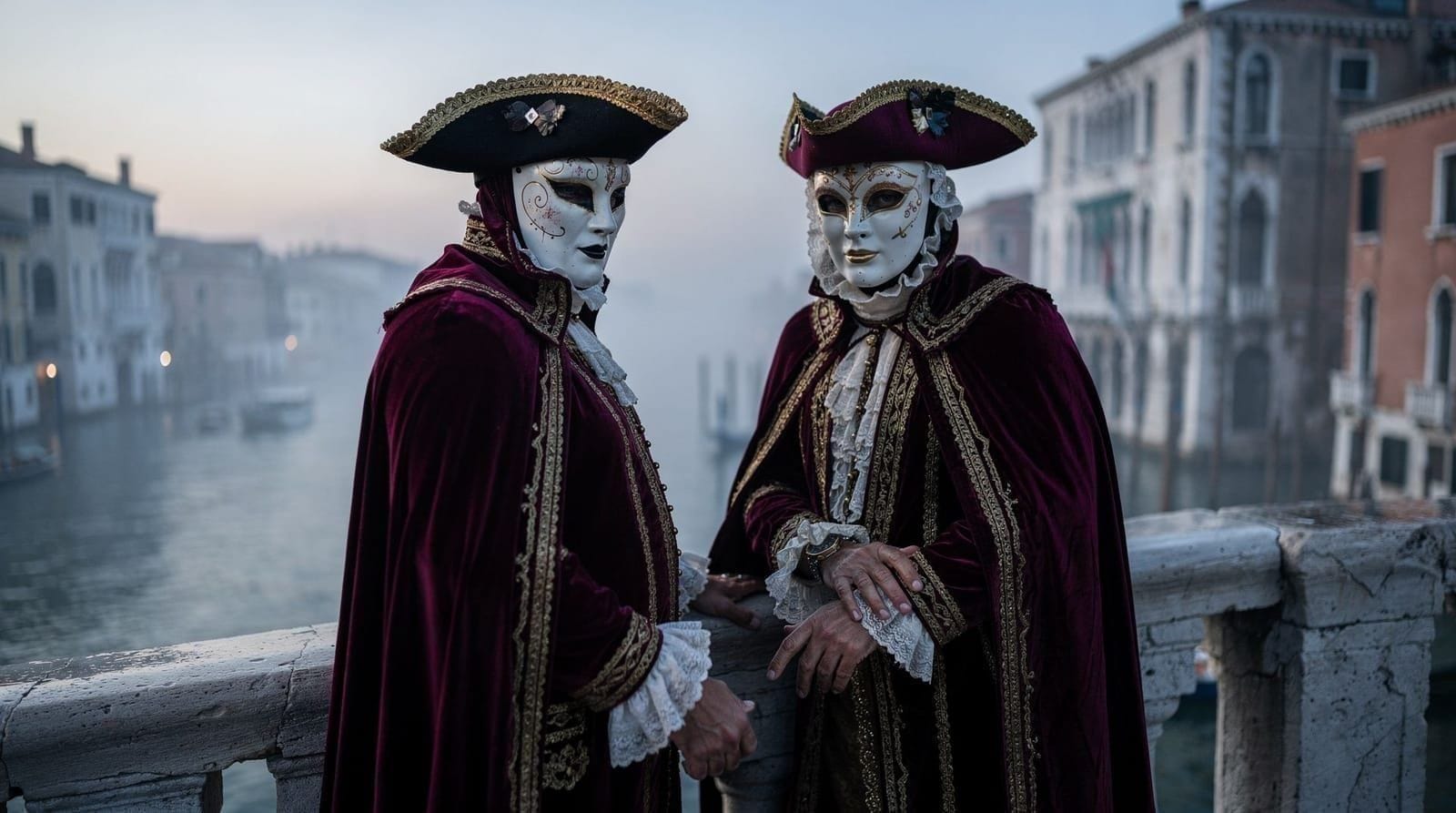
Bauta — the most iconic Venetian form. A white face mask with a projecting chin and no mouth covering, worn with a tricorn hat and black cloak (tabarro). The protruding lower section allowed the wearer to eat and drink without removing the mask, maintaining anonymity throughout an evening. The bauta is inseparable from the image of Venetian Carnival.
Colombina — a half-mask covering only the upper face, held in place by the wearer’s hand or tied at the back. Associated with the Commedia dell’arte character Colombina. More practical for extended wear than a full face mask.
Moretta — an oval, usually black velvet mask worn exclusively by women. It had no straps; it was held in place by a button clenched between the teeth, which rendered the wearer mute. The moretta was an explicit signal of erotic availability in 18th-century Venice. Most workshops will not explain this.
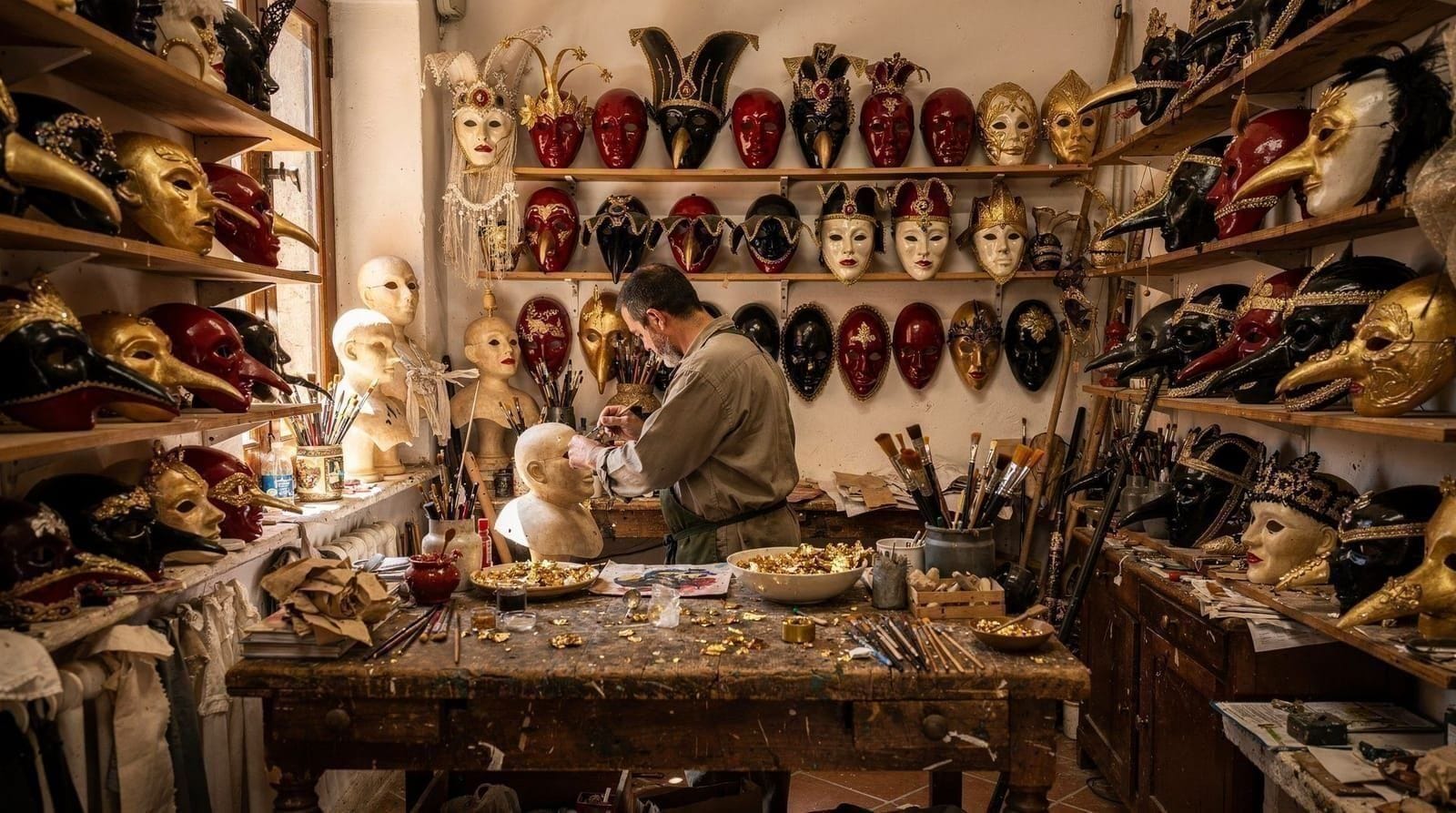
Medico della Peste (Plague Doctor) — the long-beaked mask filled with herbs, worn by physicians during plague epidemics. Now one of the most visually arresting forms in Carnival parades, though its origins are grimly practical. These are popular in workshops precisely because the silhouette is so dramatic.
Volto — a plain full-face mask, the most neutral form. The blank, pale volto is the mask most commonly associated with Venice in popular culture.
Pantalone, Arlecchino, other Commedia characters — character masks with exaggerated features, connected to the theatrical tradition rather than the civic one.
What happens in a mask-making workshop
Most workshops aimed at visitors work with pre-formed papier-mâché or leather base masks. The artisan stage — building the underlying mask by layering paper and glue over a clay form — takes days and is not part of a 90-minute session.
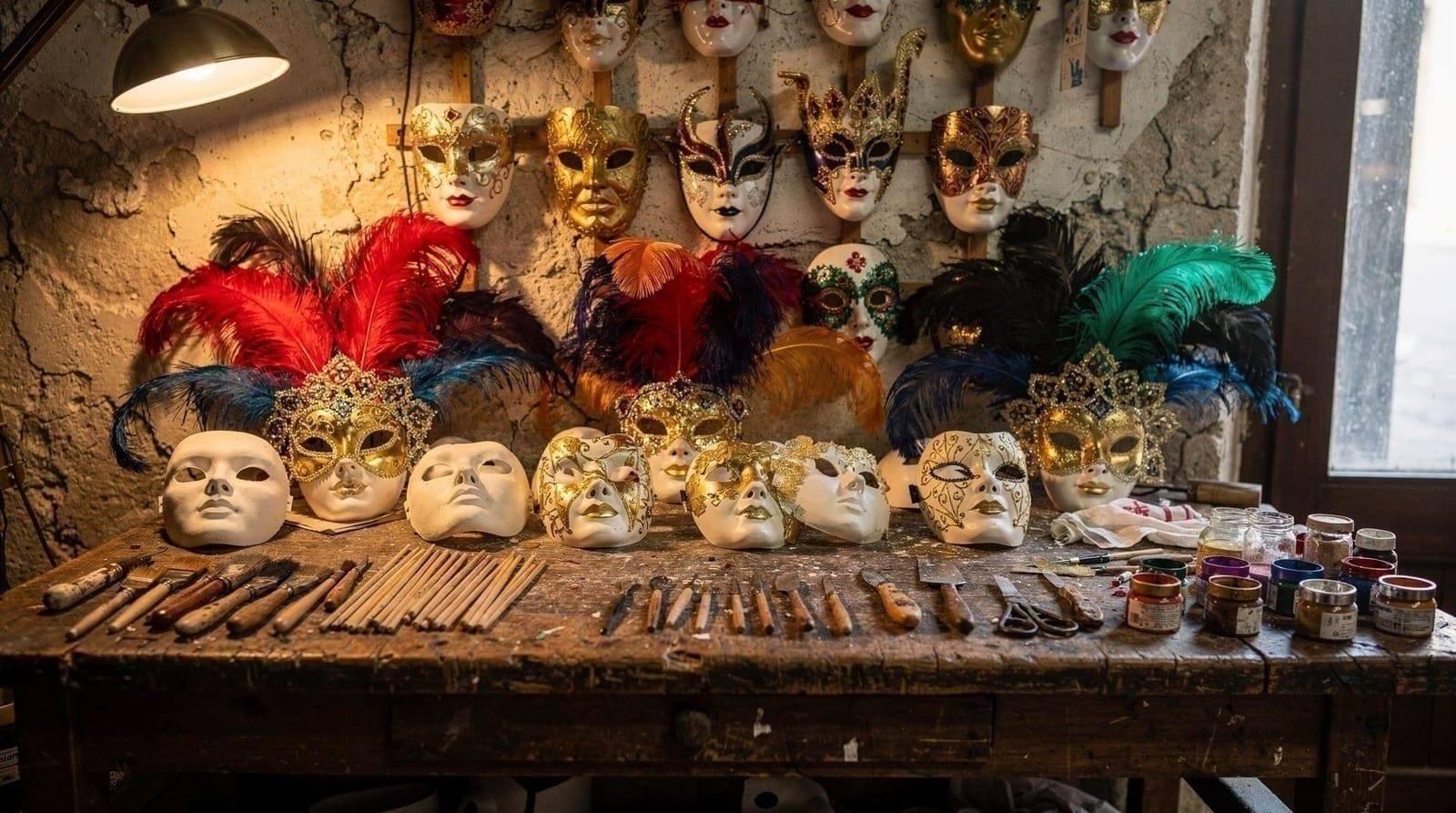
In a typical workshop, you arrive to find a selection of base forms waiting on a worktable: your choice of volto, bauta, colombina, or sometimes a small plague-doctor form. The instructor will walk you through the historical context (the good ones spend 15–20 minutes on this before touching a paintbrush), then demonstrate the painting technique.
You work with acrylic paints, gold and silver leaf, decorative laces, ribbons, feathers, and sometimes rhinestones or sequins. The instructor helps you plan a colour scheme and guides your application. By the end, you have a wearable, decorated mask to take home — packed flat in a protective bag.
The Venice Carnival mask workshop is one of the most established options, with instructors who provide genuine historical context alongside the practical work. Sessions run in small groups, and the quality of the base masks provided is noticeably higher than at some tourist-facing competitors.
For a more focused, one-to-one decorating experience where you paint your own design onto a blank mask form, the paint your own Venetian mask workshop is straightforward and well-suited to travellers who want flexibility over the design rather than structured guidance.
If you want to understand both the history and the technique at greater depth — and take home a mask made using more traditional methods — the traditional mask-making and decorating workshop spends more time on the craft context and uses higher-quality materials throughout. It runs about two hours and costs more, but participants tend to rate the quality of instruction significantly above shorter alternatives.
For anyone who wants to leave with something they actually made, a mask-making workshop with an instructor covers the papier-mâché base and the painting in one session, and the mask travels home flat.
Where to find genuine mask artisans in Venice
The streets around San Marco are densely packed with mask shops, but most of them sell Chinese-manufactured plastic or thin papier-mâché pieces with no connection to the Venetian craft tradition. If you are buying rather than making, look for shops with the Artigiano a Venezia certificate, which indicates genuine local production.
The Dorsoduro and San Polo sestieri have a higher concentration of working artisans. Ca’ Macana in Dorsoduro (near the Accademia) is one of the oldest continuously operating mask workshops in Venice, and they do teach classes. Tragicomica in San Polo is another studio with genuine craft credentials.
The artisan crafts guide for Venice covers the broader landscape of what you can buy or make that is genuinely Venetian in origin.
How Venetian mask-making has changed since the 1970s revival
The revival of mask-making as an artisan craft in Venice began in the early 1970s, driven by the same cultural impulse that revived Carnival itself. The masks produced in the first years of the revival were not necessarily historically accurate — they were creative interpretations of the tradition rather than reconstructions. Over subsequent decades, the better studios developed their research and their technique, consulting historical museum collections and working with costume historians to understand what 18th-century masks actually looked like.
Today the range is wide. At one end, there are studios that take the history seriously and produce work that could plausibly have been made in 1780 — the right pigments, the right lacquer finish, the right proportions. At the other end, there are tourist workshops that sell a quick experience without much regard for historical authenticity. Neither is dishonest about what it is, and the tourist workshop has its own legitimate place in the ecosystem — it is entertaining, accessible, and produces a souvenir.
The markers of higher-quality workshop instruction are: a longer time spent on historical context before any painting begins; better materials (thicker base forms, real artist-quality pigments rather than craft store acrylics); and an instructor who can explain why specific design choices relate to historical Venetian tradition rather than modern decoration convention.
Pairing a mask workshop with Carnival
If you are visiting during Carnival — which runs January 31 to February 17 in 2026 — workshops book out weeks in advance. Reserve your session before leaving home. The experience of making a mask and then wearing it in the actual Piazza San Marco crowds during Carnival is genuinely memorable, and it gives you a different relationship with the costumes and masks around you.
For the full Carnival context, read the Venetian Carnival history guide and the Carnival 2026 planning guide.
Outside Carnival season, a mask workshop is one of the more unusual things to do in Venice — less predictable than another museum visit, and something that produces a genuinely personal souvenir. The shops sell thousands of identical masks; yours will be the only one painted by you.
The materials used in a mask-making workshop
The quality of the base mask form varies significantly between operators. The cheapest workshops use thin, lightweight papier-mâché of minimal structural integrity; the best use thicker, higher-density forms that feel solid when held and take paint without buckling. Ask before you book whether you can see the base mask quality — the difference between a €30 and €90 workshop often comes down to this.
Paints: Most workshops use acrylic paints, which dry quickly, mix cleanly, and have good colour retention when dry. Some specialist workshops use specific pigments that more closely approximate historical Venetian mask finishes — a pearlescent base, layered glazes, and finish varnish. The result of a more labour-intensive process looks noticeably different from a simple acrylic application.
Gold and silver leaf: Applied over a size (adhesive), gold and silver leaf gives the mask the high-shine metallic quality associated with Venetian Carnival dress. Proper leaf application is a technique in itself — too much adhesive and the leaf tears; too little and it will not adhere. A good workshop teaches you this step rather than doing it for you.
Feathers and decorations: The finishing decorations — feathers, ribbons, lace trim, sequins — are added last and are the most personalised element. Venice’s mask tradition does not have rigid rules about decoration; the historical masks were as elaborate as the wearer could afford or imagine. Your choices here are genuinely creative.
The range of workshop quality in Venice
Venice has several hundred establishments that describe themselves as mask workshops or offer mask-painting experiences. The quality range is enormous, from a five-minute paint-your-mask at a market stall to a two-hour guided workshop with genuine historical instruction.
At the lower end, you receive a cheap base mask, a set of primary colour acrylics, and minimal guidance. The result will look like what it is. At the better end, you receive a quality base form, proper pigments and materials, instruction on technique and historical context, and a finished piece that genuinely represents the artisan tradition.
The price difference is usually €30–€50 between the two extremes. For an activity that produces a physical souvenir of Venice that you will potentially keep for years, the higher-quality workshop is almost always worth the extra cost.
Workshop tiers compared
| Tier | Price | What you get |
|---|---|---|
| Market-stall paint-your-mask | Around €20–30 | Thin base form, basic acrylics, minimal guidance |
| Standard tourist workshop | Around €30–50 | Decent base form, guided colour scheme, 60–90 min |
| Guided artisan workshop | Around €70–130 | Quality base, historical context, gold leaf technique taught |
| Studio-made collector piece | €200+ | Made by a master artisan, not hand-painted by you |
What to take home: the mask as souvenir and the mask as art object
The mask you make in a workshop is a genuine souvenir in the original sense — something that helps you remember, connected to a specific experience. But there is a range between the informal painting-session mask and the serious art object produced by a master artisan, and it is worth understanding the difference before deciding where to spend your mask budget.
A workshop mask — painted by you, with instructed guidance — has personal value that no shop-bought piece can match. Its imperfections are yours. The design choices you made are visible in it. It is, honestly, the most meaningful mask you can acquire.
A workshop-quality artisan mask — painted by a skilled maskmaker in a studio, from a well-crafted base form — is a higher-quality object with more visual consistency and better surface quality. Prices range from €40–€150 depending on complexity and studio reputation.
The museum-quality artisan mask — produced by one of Venice’s most skilled craftspeople using historical techniques, signed and certified — is an investment object. Ca’ Macana’s best theatrical pieces start at €200 and run substantially higher for elaborate historical reconstructions. These are genuinely collectable.
For most visitors, the workshop mask is the right choice. For serious collectors or those who want the finest available, the specialist studios are the appropriate destination.
Combining a workshop with a neighbourhood walk
Most mask workshops are located in Dorsoduro, San Polo, or the area around San Marco. After a morning session, the natural continuation is a walk through whichever sestiere the workshop is in.
From Dorsoduro, you are close to the Accademia gallery, the Peggy Guggenheim, and the Punta della Dogana on the waterfront. The Dorsoduro guide covers what to do in the neighbourhood around a half-day activity.
From San Polo, you are minutes from the Rialto market, the Frari church, and the Scuola Grande di San Rocco — one of the most visually spectacular buildings in Venice. See the San Polo and Rialto guide.
If your workshop is near San Marco, the San Marco destination page covers what else fills a half-day around the square once you have your finished mask in hand.
Families and other craft activities
Mask-making pairs naturally with other hands-on Venice experiences if you want to build a full day of workshops rather than a single session. Murano’s glass tradition offers a comparable craft encounter — see the Murano glassblowing workshop guide — and a Venetian cooking class makes a good pairing for the evening after an afternoon mask session. Families travelling with children should also check the Venice with kids guide for how a mask workshop fits alongside other child-friendly activities in a single day, and how to structure the Venice 3-day itinerary around one or two workshop sessions without overloading the schedule.
Frequently asked questions about mask-making workshops in Venice
How long does a mask-making workshop in Venice take?
Most painting and decorating workshops run 60–90 minutes. Full mask-making from scratch (working directly with papier-mâché or leather) is rarer and takes a full half-day. The majority of tourist workshops focus on the decorating stage.
How much does a mask-making workshop cost in Venice?
Basic paint-your-own-mask workshops start at around €30–€50. Guided workshops with an artisan instructor, including a better-quality mask form and more materials, run €70–€130 per person. Carnival-themed classes at specialist studios cost up to €150.
What type of mask will I make in a workshop?
Most workshops provide a classic bauta, colombina (half-mask), or a simple oval volto form. You paint and decorate it with acrylics, gold leaf, feathers, and ribbons. A few studios let you choose your base form from a small selection.
Do I need artistic skill to join a mask-making workshop?
No. The instructors guide you through the design process and provide stencils or templates if you want them. Most participants have no prior artistic experience and still produce something they are genuinely proud to take home.
Can children take part in mask-making workshops?
Yes. Mask-making workshops are one of the most family-friendly activities in Venice. Most studios welcome children aged 5 and up. The paints used are generally non-toxic acrylics. Check with the specific operator if you have a very young child.
Are there mask workshops in Venice outside Carnival season?
Yes — mask workshops run year-round. The Carnival association with masks is historical, but artisan studios and tourist workshops operate every month. Booking is easier outside peak season (February, July, August).
Top experiences
Bookable activities with verified prices and instant confirmation on GetYourGuide.