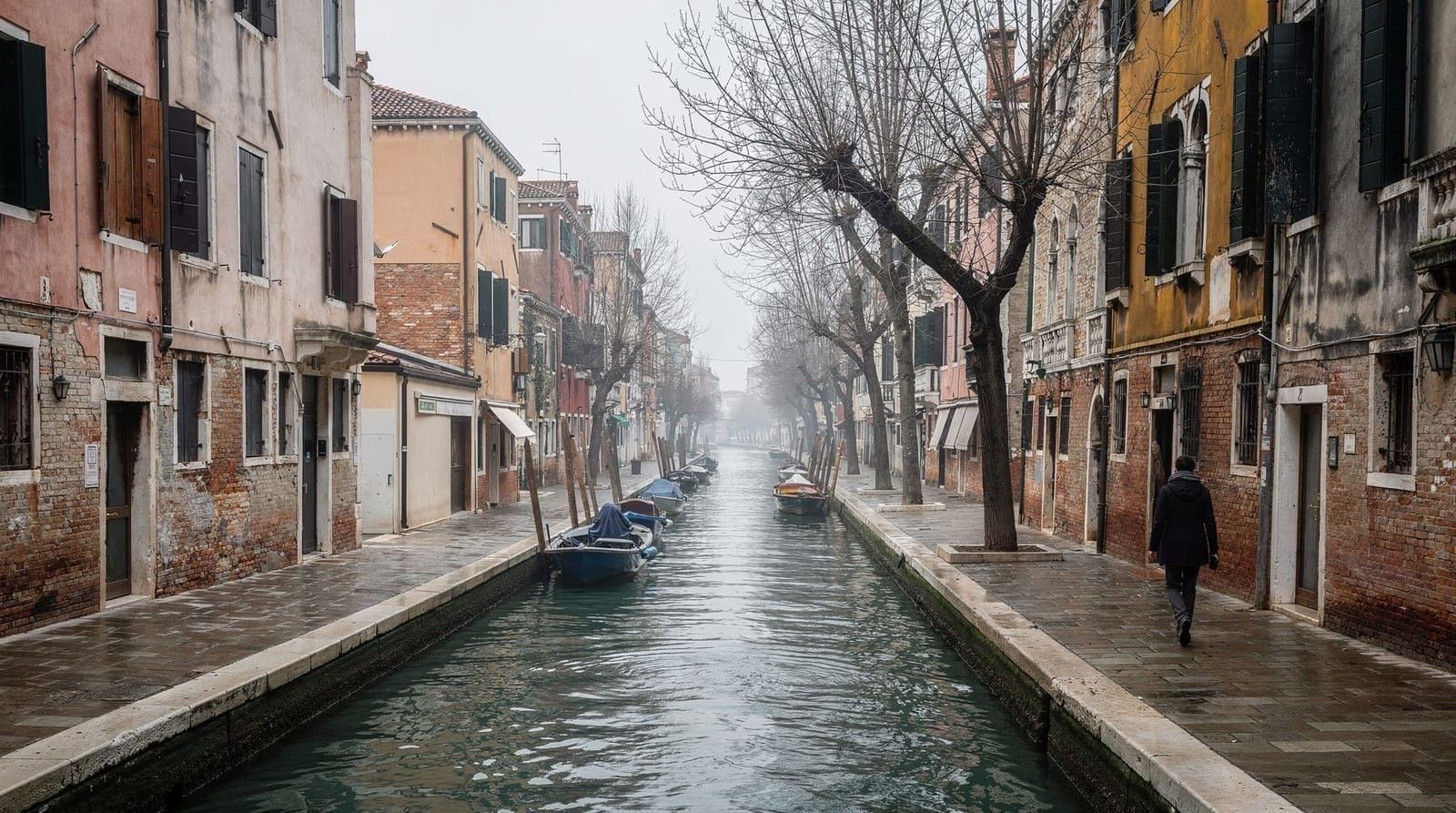
The day Venice flooded under our feet — an acqua alta diary
| When it happens | Mostly October-March, peaking November-December |
| Typical event | 100-120cm, lasts a few hours around high tide |
| Cost to prepare | €10-20 for waterproof overshoes |
| MOSE barrier | Deployed for forecasts above ~130cm, not every tide |
| Best move | Shift plans toward higher ground (Dorsoduro, Castello) |
The sirens started at six in the morning
I heard the first tone at six-fifteen. A long, rising wail from somewhere across the rooftops. Then a second one. By the third I was already looking at my phone and pulling up the MOSE alert app, which was showing 105cm forecast by eight o’clock. The hostel breakfast room filled up with people comparing boots.
This was not the photogenic disaster you sometimes see on news sites — no desks floating past soaked shopfronts, no cathedrals knee-deep in brown water. That kind of extreme flooding, the 140cm-plus events that made international headlines before MOSE came online, has become genuinely rare. But 105cm is still enough to make parts of Venice interesting.
Here’s what that day actually looked like.
How acqua alta works (the quick version)
The tides in the northern Adriatic are relatively small — maybe 50 to 70cm swing on a normal day. The problem is that when a strong southerly wind (the sirocco) pushes water up the Adriatic from the south at the same time as a high tide, the lagoon has nowhere to put the surplus and it backs up into the streets.
The vulnerable areas are the lowest-lying — primarily San Marco, parts of Rialto, and a few stretches of Cannaregio. The highest ground in Venice is remarkably dry even during a significant event. Most of the city sits above the typical flood line.
Since 2020, the MOSE barrier system has been operating at the lagoon inlets. It raises a row of metal flaps across the three passages connecting the lagoon to the sea, blocking the tidal surge before it reaches the city. The system has dramatically reduced the frequency of serious events, but it’s not deployed for every tide — only for forecasts above 130cm, roughly speaking. Moderate events like our 105cm morning still happen.
You can check the real-time forecast at the Centro Maree website or their app. The city also sends SMS alerts if you register, and the warning sirens are in every quarter: one tone means a forecast of 110cm, two tones 120cm, three tones 130cm, four tones 140cm. We had two tones on our morning — so moderate, not dramatic.
What 105cm looks like from the inside
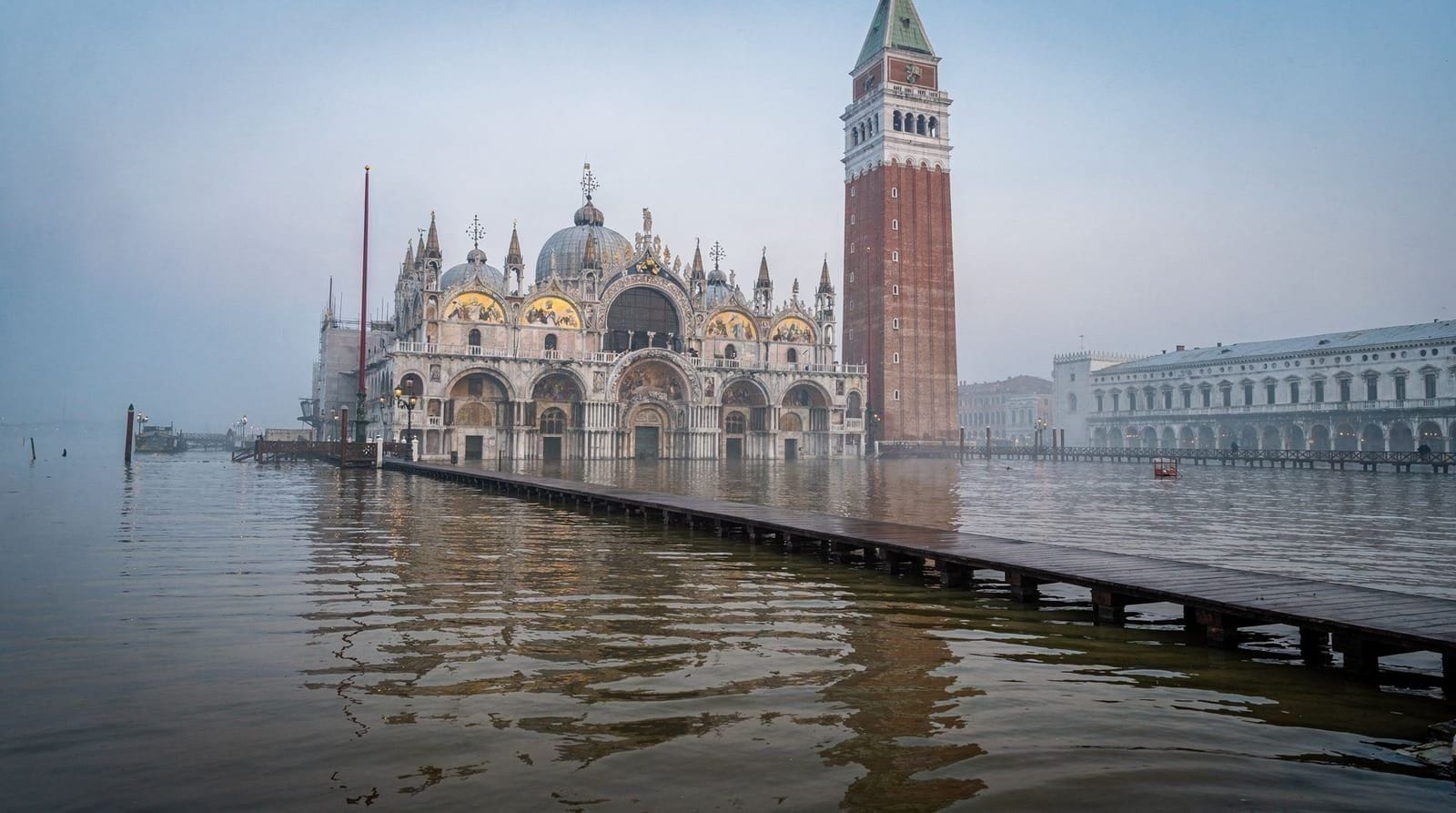
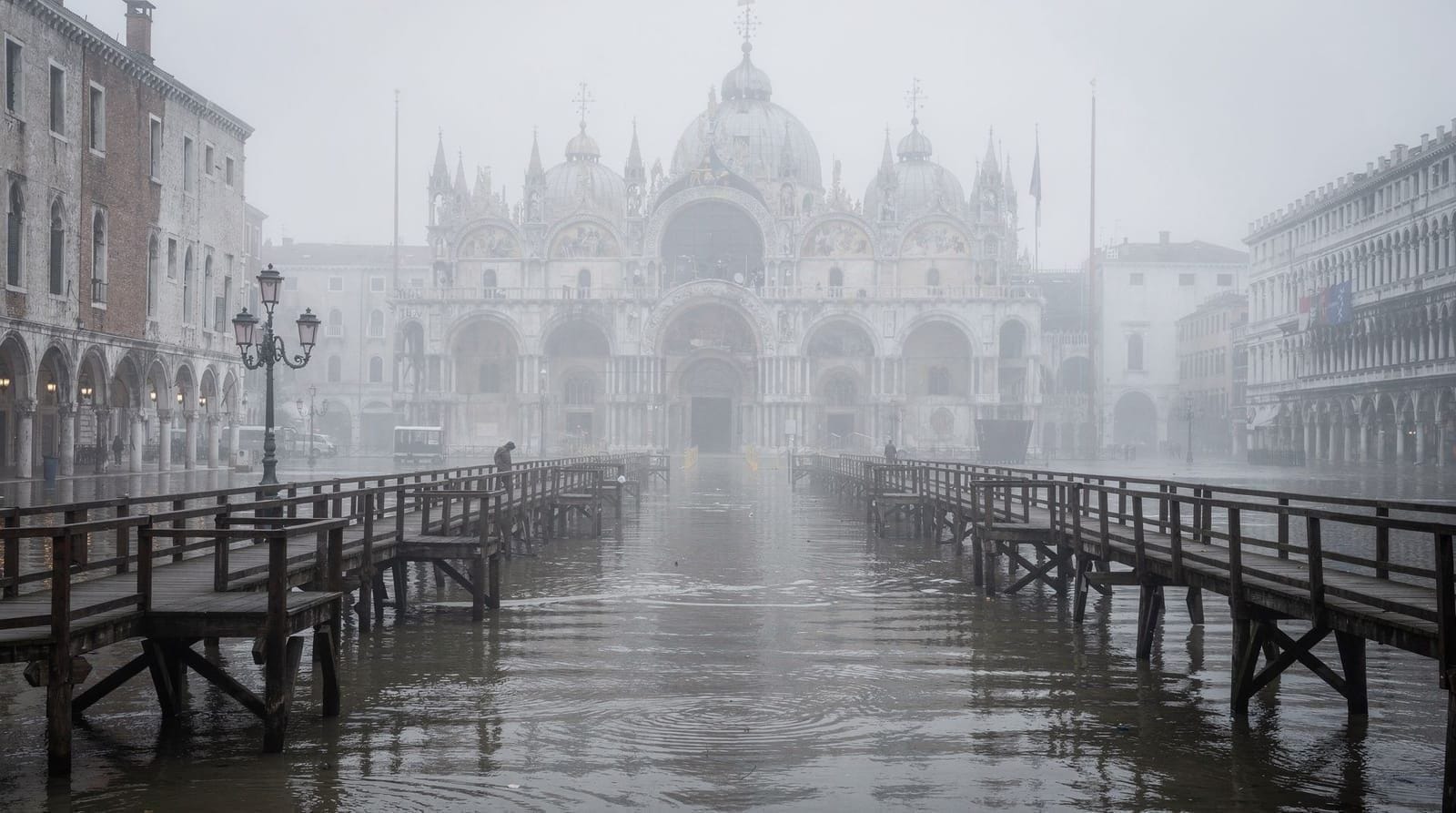
By eight o’clock the water was starting to creep across the lowest point of Campo San Marco — the northwest corner by the Procuratie. It was about 15cm deep there. The passerelle (the elevated metal walkways the city stores in stacks around low-lying areas) had been rolled out automatically overnight and stretched across the square in neat rows.
We watched a group of tourists, clearly unprepared, attempting to wade across in trainers. A local woman in rubber boots walked past them briskly with a shopping bag and the expression of someone who has been through this approximately five hundred times.
The iconic images you see of Venice flooding — chairs floating, waiters in waders serving espresso — are still partially real, but more theatrical than catastrophic. The restaurants near San Marco do keep rubber boots behind the bar. The staff are genuinely unbothered. One barman we spoke to at Caffè Florian said he’d been through sixty or seventy acqua alta events in his career and the worst part was the mopping up.
What struck me most was how quickly it passed. By ten-thirty the forecast peak had come and gone, the water was already receding, and by noon the square was merely damp. The passerelle were still out — they’re left until the afternoon, just in case — but the emergency was effectively over.
What we did (and what we recommend)
Our plan for the morning had been Doge’s Palace. The museum stays open during acqua alta — the entrance is elevated and the main halls are unaffected — but the ground floor gift shop had about three centimetres of water moving through it when we arrived, and a member of staff with a squeegee was already working the problem. We had our tickets, we went in, we spent two hours looking at extraordinary things. The flooding was entirely irrelevant inside.
Doge’s Palace secret itineraries — book ahead regardless of seasonAfter the palace we walked along the elevated walkway through San Marco, crossed the Ponte della Paglia above a canal that was visibly fuller than usual, and found a bacaro in Castello that was completely unaffected — higher ground, dry floor, excellent cicchetti, slightly bewildered by the tourists demanding to photograph their “flooded” tables. (The tables were dry. The tourists were disappointed.)
The best advice for an acqua alta day is to shift your plans toward the higher parts of the city. Dorsoduro — particularly the Zattere and the area around the Accademia — rarely floods meaningfully. Castello east of San Marco sits higher. The Jewish Ghetto in Cannaregio is at the north edge of the city and tends to escape the worst.
Gear that actually matters
Rubber boots or waterproof overshoes. This is non-negotiable if you’re visiting in October, November, or December. A standard pair of rubber overshoes folds flat into a bag and takes up roughly the space of a paperback book. When you need them, you need them properly.
Boots also mean you can walk normally instead of doing that mincing hop over wet patches that everyone else is doing. There is a certain satisfaction in striding through 10cm of water in good boots while people around you are desperately looking for the dry route.
The acqua alta guide has more detail on gear, forecasting, and the MOSE system if you want to go deeper.
The emotional reality
There’s something genuinely affecting about watching a city manage flooding as a routine part of life. Venice has been doing this for twelve hundred years. The residents have an extraordinary equanimity about it — the boots come out, the passerelle go up, the shops put their stock on higher shelves, and by lunchtime everyone’s carrying on.
What I found unexpectedly moving was the relationship between the city and the water. At around nine-thirty, with the flood at near its peak, a man was sitting on the passerelle near the Basilica, completely still, watching the reflections in the flooded piazza. He wasn’t a tourist — he had a shopping bag, he was dressed for the office. He was just watching his city do what his city does.
It’s one of the more beautiful things I’ve seen in a place full of beautiful things.
What I wish I’d known before
The acqua alta alarms come at irregular intervals — first, second, third tones — and unless you’ve read up on the system, the meaning of each is not obvious. The city posts interpretation guides at landing stages and the algorithm for the number of tones versus flood height is straightforward once you know it.
I didn’t know it. I spent twenty minutes trying to work out whether one tone meant “water coming” or “water gone” while standing in socks at the door of the hostel. Download the iMARE Venice app or the Venezia Unica app before you arrive — they give real-time forecasts and notifications.
Also: acqua alta is not the same as a rainy day. The flooding comes from the tidal lagoon below the city, not from above. You can have acqua alta on a perfectly clear sunny day. Conversely, heavy rain without a concurrent tidal surge produces wet streets and full gutters but not the dramatic water-in-the-piazza flooding. The two are separate phenomena.
The acqua alta guide has the technical explanation of why this happens and the MOSE barrier system’s role in managing it. Understanding the mechanics makes the event less alarming and more interesting when you’re standing in it.
Should acqua alta change your plans?
Only slightly. Don’t book a trip expecting to avoid it — November and December in Venice will likely include at least one event. But a moderate acqua alta (under 110cm) is honestly a spectacle rather than a disruption, and with decent boots it becomes one of those experiences that people who visited in August never get.
The winter Venice guide goes into this in more depth, including what the MOSE schedule means for the more dramatic events. And if you’re doing a longer stay, our 4-day Venice itinerary includes a morning that can flex around weather events without ruining the structure.
The only thing I’d say is this: if you leave Venice having walked through acqua alta, you’ve seen something more honest than any postcard. The city is beautiful when it floods. It’s also slightly surreal and very wet. Both of these are true simultaneously, and that’s very Venice.
Acqua alta by month
| Months | Frequency | What to expect |
|---|---|---|
| October | Occasional | First mild events, rarely above 100cm |
| November-December | Most frequent | Several events likely, moderate to occasional high ones |
| January-February | Frequent | Similar risk to November, colder |
| March | Tapering off | Lower odds, still worth packing boots |
| April-September | Rare | Not part of trip planning in practice |
What we’d do differently next time
Looking back, the single change we would make is booking accommodation slightly higher up rather than near San Marco — a room in Cannaregio or the northern edge of Castello means you are rarely more than a short walk from dry ground, whatever the forecast. We would also pack the overshoes on any November or December trip as a matter of course rather than a maybe, the way you’d pack an umbrella for a rainy destination. Neither change would have made the day less memorable — it remains one of our favourite Venice mornings — but both would have made it less stressful in the first confused hour before we understood the siren system.
FAQ
Does acqua alta happen every day in winter? No. It’s an occasional event tied to tides and wind, not a daily occurrence — you might have zero, one, or several during a week’s stay between October and March.
Will acqua alta ruin my Venice trip? Unlikely. Most events last a few hours around high tide and the city has infrastructure — passerelle walkways, elevated entrances — built around managing it. A little planning (boots, flexible morning plans) turns it into an experience rather than a disruption.