Jewish Ghetto Venice guide: history, synagogues, and how to visit
Venice: Jewish Ghetto walking tour with synagogue visits
Can you visit the Venice Jewish Ghetto independently or do you need a guided tour?
Campo del Ghetto Nuovo (the main square) and the Holocaust memorial are always free to visit independently. To see the synagogue interiors, you need a guided tour through the Jewish Museum — tours run hourly in English, cost around €15, and must be booked in advance in summer.
The world’s first ghetto: 500 years of history in a small campo
On 29 March 1516, the Venetian Senate decreed that all Jews living in the Republic of Venice must relocate to a small, enclosed island in the Cannaregio sestiere. The island was sealed at night; the gates were locked. During the day, Jews were permitted to move through the city for trade, but were required to wear identifying badges (a yellow O or red hat depending on the period) and to return to the island by the evening curfew.
The place was called the Gheto, after the copper foundry (gheto = foundry in Venetian dialect) that had previously occupied the site. The word spread across Europe and eventually into every language: today, 500 years later, every “ghetto” in every city carries this Venetian etymological weight.
This guide covers the history of the Venice Jewish Ghetto, what to see inside, how to arrange the synagogue tours, and what the Ghetto is like to visit today.
| Where | Cannaregio, a 10-minute walk from the train station |
| Cost | Museum around €12; synagogue tour around €15 (incl. museum) |
| Time needed | 30–45 min for the campo and museum; 2–2.5 hours with the synagogue tour |
| Getting there | On foot from Ponte delle Guglie |
| Booking | Book ahead in June–August; tours sell out |
The history of the Venice Ghetto
The Republic’s pragmatic tolerance
The Venetian Republic was not motivated by idealism in establishing the Ghetto — it was motivated by commercial pragmatism. Venice needed Jewish moneylenders and merchants for certain financial functions that Christian law (which prohibited lending at interest) would not permit. The Ghetto system offered the Jewish community a guaranteed, legally defined space in exchange for financial services and the payment of significant taxes.
The arrangement was, by the standards of most of Europe in 1516, relatively protective. Jews in the Ghetto had legal residence rights, functioning courts, synagogues, and communal organisations. They were not subject to random expulsion (as they were in Spain, England, France, and many German territories). The price was confinement, high rents from the Venetian landlords who owned the buildings, and the humiliating external markers.
As the Ghetto population grew through the 16th and 17th centuries — with refugees arriving from Spain, Portugal, Germany, and the Ottoman Empire — the buildings were extended upward to accommodate them. The Ghetto buildings are the tallest residential structures in Venice: 6–8 storeys with remarkably low ceilings (around 2 metres per floor) to maximise the number of habitable floors within the permitted height.
Three distinct communities
The Venice Ghetto developed three distinct Jewish communities, each with its own synagogue (scola):
Ashkenazi Jews (from Central and Eastern Europe): the oldest and most established community. Their synagogue, the Scola Grande Tedesca (1528), is the oldest in the Ghetto.
Sephardic Jews (from Spain and Portugal, expelled in 1492 and 1497): arrived later, often wealthier, with a different religious tradition. The Scola Spagnola (Spanish Synagogue) is the largest and most elaborate in the Ghetto.
Levantine Jews (from the eastern Mediterranean): merchants primarily, their community spanning Venice and the Ottoman territories. The Scola Levantina has a richly decorated wooden interior.
Each community maintained its own synagogue, cemetery (on the Lido), and communal organisations. The physical proximity — all within a small island — meant constant interaction despite the liturgical and cultural differences.
| Community | Synagogue | Character |
|---|---|---|
| Ashkenazi | Scola Grande Tedesca (1528) | Oldest, most established |
| Sephardic | Scola Spagnola | Largest, most baroque |
| Levantine | Scola Levantina | Richly carved wooden bimah |
The Ghetto under the French and Austrians
In 1797, Napoleon’s forces occupied Venice, ended the Republic, and demolished the Ghetto gates — a moment of liberation followed quickly by new forms of oppression under subsequent Austrian rule. Jews received full civil rights in the unified Kingdom of Italy in 1866; the physical Ghetto walls and gates had long since been removed.
The community remained in the Ghetto — partly by choice, partly by economic inertia — through the 19th century and into the 20th. By the 1930s, it was a shrinking but functioning community of several hundred families.
1943 and the deportations
In September 1943, German forces occupied Venice following the Italian armistice. The deportation of Venice’s Jewish population began almost immediately. Between December 1943 and August 1944, approximately 200 Venetian Jews were deported to concentration camps, principally Auschwitz-Birkenau. The majority were killed; very few returned.
The Holocaust memorial panels by sculptor Arbit Blatas (installed in 1980 on the north wall of Campo del Ghetto Nuovo) depict the deportation in relief. They are modest in scale — easy to walk past without noticing — but among the most affecting public memorials in Venice.
Campo del Ghetto Nuovo: what to see
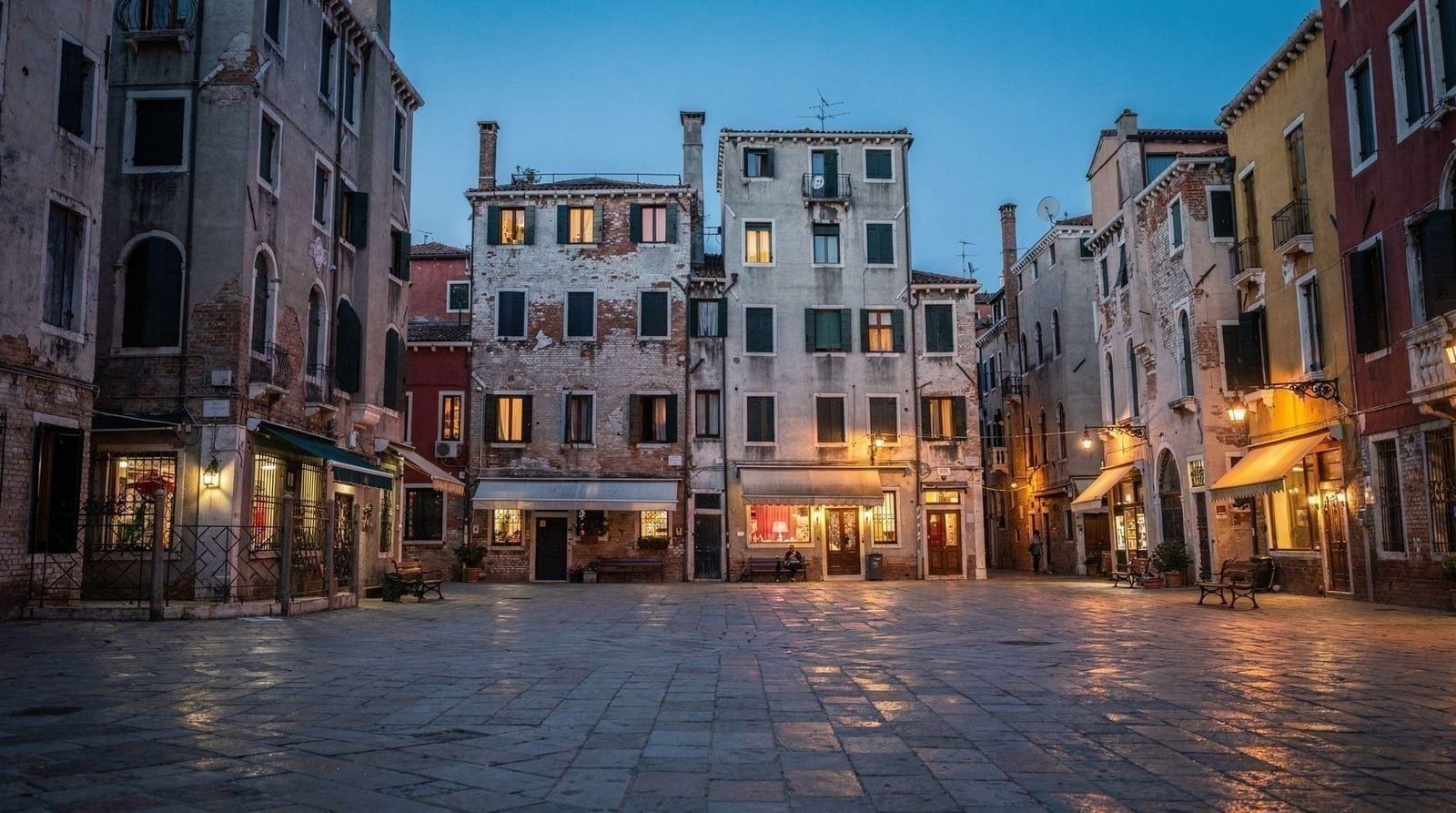
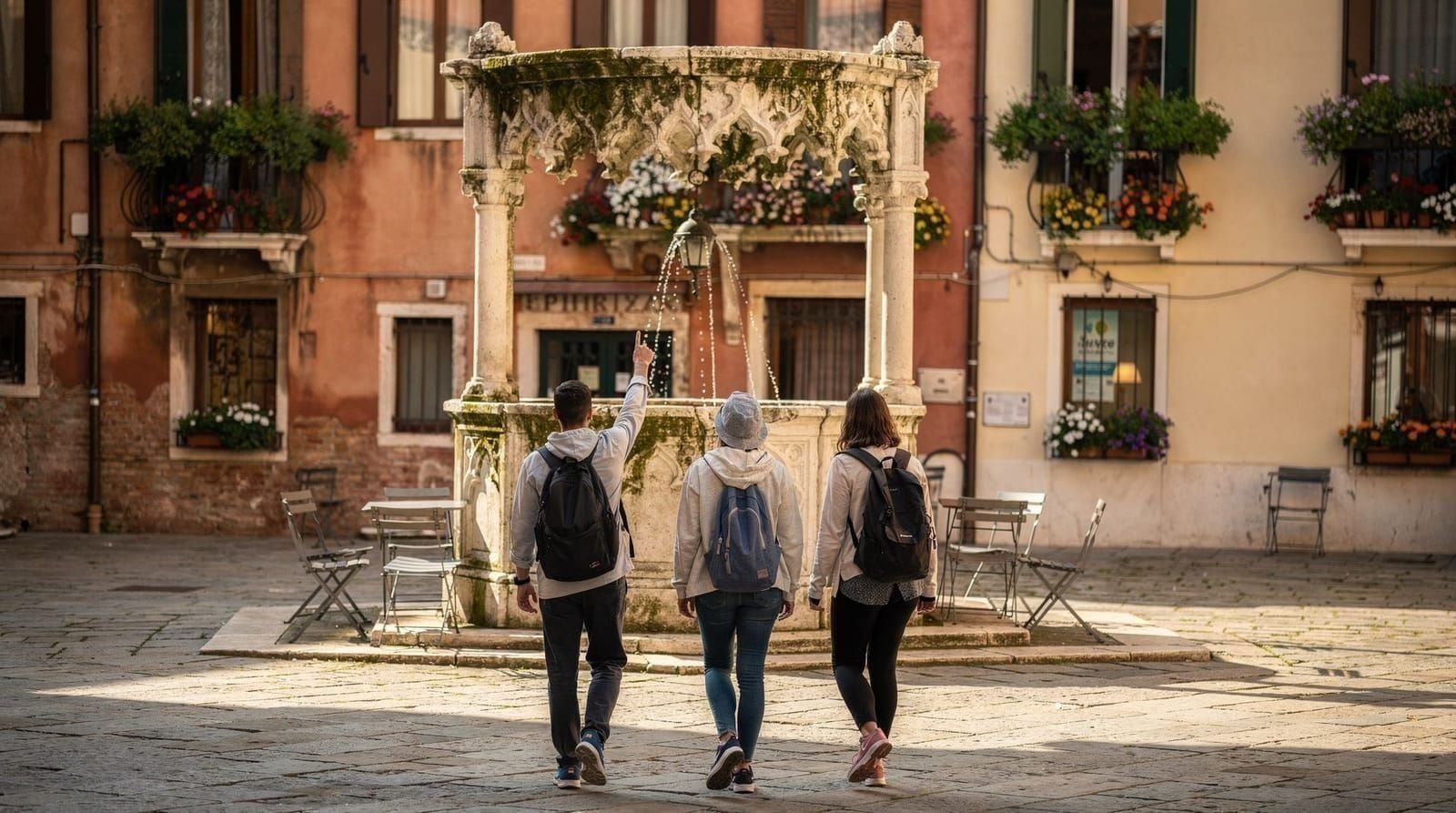
Campo del Ghetto Nuovo is the main campo of the Ghetto — a roughly square space enclosed by the tall, weathered buildings of the Jewish community. It has a bench-lined perimeter, two wells (now sealed), the entrance to the Museo Ebraico, and the Holocaust memorial on the north wall.
The campo changes character through the day. Before 10am, it is nearly empty. During the day, guided tour groups pass through frequently. By evening, when the museum closes and the tours end, it returns to a quieter state.
The tall buildings: The most immediate visual experience is the scale of the buildings — much taller than anything else in Venice, with a compressed, canyon-like quality. Look up at the facades; count the floors. The stairwells are narrow and the floors low; the buildings were essentially tenements extended vertically under pressure.
The memorial panels: On the north wall — slightly recessed from the main facade, easy to miss. Take five minutes. The panels in bronze depict the rounded deportees; the inscriptions are in Italian, Hebrew, and English.
The Museo Ebraico and synagogue tours
Museo Ebraico di Venezia (Campo del Ghetto Nuovo 2902): The Jewish Museum of Venice covers the history of the Venetian Jewish community from the 16th century to the present, with liturgical objects, textiles, manuscripts, and photographs. Entry is around €12 for the museum alone.
Synagogue tours (€15 including museum entry): The guided tour of the synagogue interiors is the main reason to pay. The tour covers three of the five synagogues on a rotating basis depending on the day (the most commonly visited are the Scola Tedesca, Scola Canton, and Scola Levantina). English-language tours run hourly during museum opening hours.
The synagogue interiors are extraordinary — not for their size (all are small, accessed via steep stairs in the upper floors of the Ghetto buildings) but for their condition and detail. The Scola Levantina has a carved wooden bimah (prayer platform) of remarkable quality. The Scola Spagnola (opened on different days) is the largest and most baroque in character. Photographs are allowed inside on the tour.
Booking in advance: Essential in July and August; advisable in June and September. The tours are small (15–20 people maximum) and sell out. Book via the museum website or through GetYourGuide.
Venice: Jewish Ghetto walking tour with synagogue visitsFor a longer guided walk covering the Ghetto in broader historical context:
Venice: ghetto highlights and Cannaregio walking tourThe synagogues can only be entered with a guide, on a fixed rotation decided on the day: a guided tour of the Jewish Ghetto and its synagogue is the only way inside, and turning up alone gets you the square and nothing else.
Ghetto Vecchio and Ghetto Nuovissimo
The original 1516 Ghetto (Ghetto Nuovo, “New Ghetto” — confusingly, the oldest part) was expanded in 1541 with the adjacent Ghetto Vecchio (“Old Ghetto”) for the Levantine and Sephardic communities, and then further in 1633 with the Ghetto Nuovissimo (“Newest Ghetto”). All three sections are connected via gated passageways.
Ghetto Vecchio (reached from Campo del Ghetto Nuovo via an underpass) has the Scola Levantina, Scola Spagnola, and the Luzzo synagogue. It is a narrow, dark alley with a distinctly different atmosphere from the main campo — quieter, more contemplative. The Scola Spagnola facade (visible from the street) is the most overtly architectural of the Ghetto synagogues.
Dining and shopping in and around the Ghetto
Gam Gam Osteria (Rio Cannaregio, near the Ghetto entrance): Established kosher restaurant in a canalside setting, serving Israeli and Middle Eastern dishes alongside traditional Venetian options. Booking recommended for dinner.
Ba’Ghetto (Campo del Ghetto Nuovo and Calle del Ghetto Vecchio): Two locations, serving kosher and non-kosher dishes. Known for Sephardic and Israeli food (falafel, hummus, shakshuka) as well as pasta.
Pasticceria Volpe (near the museum): Traditional Jewish-Venetian bakery, in operation for generations. Sells busolai (ring biscuits), zaleti (cornmeal cookies with raisins), and other traditional pastries. Closed Saturday.
The Cannaregio guide covers the broader neighbourhood eating options including the bacari of Fondamenta della Misericordia, a 5-minute walk from the Ghetto.
The Ghetto as part of a Cannaregio itinerary
The Ghetto is best combined with a broader Cannaregio exploration. A morning route:
- Arrive at the Guglie bridge (10 minutes from the train station)
- Campo del Ghetto Nuovo — walk the perimeter, view the memorial
- Jewish Museum and synagogue tour (1.5–2 hours)
- Ghetto Vecchio for the Scola Spagnola exterior
- Walk north to Fondamenta della Misericordia for cicchetti (11am–12pm or 6–8pm)
- Continue to Madonna dell’Orto church (optional)
For the full neighbourhood context, see the Cannaregio guide.
The Ghetto for children and school groups
The Jewish Museum has materials aimed at children and families — exhibits designed for younger visitors, and the synagogue tour is often appropriate for children from age 8 or so (the scale of the buildings and the history of confinement are concrete and comprehensible). The Holocaust memorial is straightforward enough for older children to understand with explanation.
Many school groups visit the Ghetto — if you arrive between 9:30 and 11am on a school day, you may find the campo and museum somewhat crowded with Italian school groups. The Venice with kids guide includes the Ghetto as an appropriate educational stop.
Visiting respectfully
The Ghetto is a functioning neighbourhood and a site of serious historical weight, not a themed attraction. Keep voices down near the Holocaust memorial, avoid treating the campo purely as a photo backdrop during quieter hours, and dress modestly if joining a synagogue tour (shoulders covered is customary, though not strictly enforced for visitors). Security is visibly present at the museum entrance, a reminder that this remains an active Jewish community, not only a historical site.
Frequently asked questions about the Jewish Ghetto
Is the Venice Ghetto the oldest ghetto in the world?
Yes — established in 1516, it predates all other documented ghettos. The word itself originates here and was subsequently applied to Jewish quarters in Rome (1555), Frankfurt (Judengasse, earlier in origin but formalised similarly), and eventually to segregated urban areas of all types in the modern era.
Can I visit the Ghetto on a Saturday?
The campo is always accessible. The Jewish Museum is closed on Saturday (Shabbat) and on Jewish holidays. If you want to visit the museum and take the synagogue tour, plan for Sunday through Friday.
Are there still Jewish residents in the Ghetto?
Yes — a small permanent Jewish community lives in the Ghetto area, alongside a broader Venetian Jewish community scattered through the city. The Ghetto is not exclusively Jewish in its current residential makeup; it is a functioning mixed residential neighbourhood. The Jewish institutions (museum, synagogues, bakery, restaurants) remain active.
How long does the Jewish Museum visit take?
The museum alone takes about 30–45 minutes. The museum plus synagogue tour (1.5 hours for the full tour) brings the total to 2–2.5 hours at a comfortable pace.
What is the difference between the Ghetto Nuovo and the Ghetto Vecchio?
Confusingly, the Ghetto Nuovo (“New Ghetto”) is the oldest and most central section, established first in 1516. The Ghetto Vecchio (“Old Ghetto”) was added in 1541, using a pre-existing alley that was already called the Ghetto Vecchio before 1516. The names refer to the pre-existing foundry area, not to the chronological order of Ghetto construction.
How does the Jewish Ghetto compare to other Cannaregio sights?
The Ghetto is one of several strong reasons to spend real time in Cannaregio rather than treating it as a walk-through corridor to the Rialto. Combined with the bacari of Fondamenta della Misericordia and the quieter northern fondamente toward the lagoon, it makes a self-contained half-day. See the Cannaregio guide and the hidden Venice tour for how it fits a broader neighbourhood exploration.
Is the Jewish Ghetto worth visiting if I only have one day in Venice?
If your day is genuinely limited to the essentials — St. Mark’s, the Doge’s Palace, the Rialto — the Ghetto is a reasonable thing to skip. But it requires only about an hour for the campo and memorial without the full synagogue tour, and it sits directly on a natural walking route between the train station and the rest of Cannaregio, so it costs little extra time to include even briefly. See first time in Venice for how it fits a tight itinerary.
Top experiences
Bookable activities with verified prices and instant confirmation on GetYourGuide.