Giudecca
The quiet island across the Giudecca Canal — Il Redentore church, skyline views of Venice, peaceful streets, and the city's most famous luxury hotel.
Basilica San Giorgio Maggiore tour with water transport
Quick facts
- Best for
- Peace, skyline photography, Redentore church, Cipriani hotel
- Vaporetto stops
- Palanca, Redentore, Zitelle, Sant'Eufemia (line 2/4.1/4.2)
- Time needed
- 2–3 hours; add time if watching the Redentore fireworks
- Don't miss
- View of Venice skyline from the Zattere-facing side, Redentore interior
- Redentore festival
- Third weekend of July (18–19 July 2026)
Venice’s overlooked island across the canal
Giudecca is one of the most misunderstood places in Venice. A long, thin island (about 1.5 km end to end) separated from Dorsoduro by the 300-metre-wide Giudecca Canal, it is technically part of the Dorsoduro sestiere but feels entirely distinct — quieter, more residential, less photographed, and offering the best continuous view of Venice’s southern skyline that exists.
Most visitors see Giudecca from the Zattere waterfront on the Dorsoduro side, gazing across at the Redentore church and the converted Molino Stucky flour mill. Far fewer cross over. The vaporetto takes three minutes. The island on the other side is one of the more genuinely peaceful places in Venice, and it earns a half-day if you have the time.
| Where | Across the Giudecca Canal from Dorsoduro, 3 minutes by vaporetto from Zattere |
| Cost | Free to walk; Il Redentore around €3–4 with Chorus Pass |
| Time needed | Half a day (2–3 hours); a full afternoon if combining with San Giorgio Maggiore |
| Getting there | Vaporetto line 2 (Zattere–Palanca) or lines 4.1/4.2 for the full island |
| Best time | Weekday mornings for quiet streets; late July for the Redentore festival |
Il Redentore
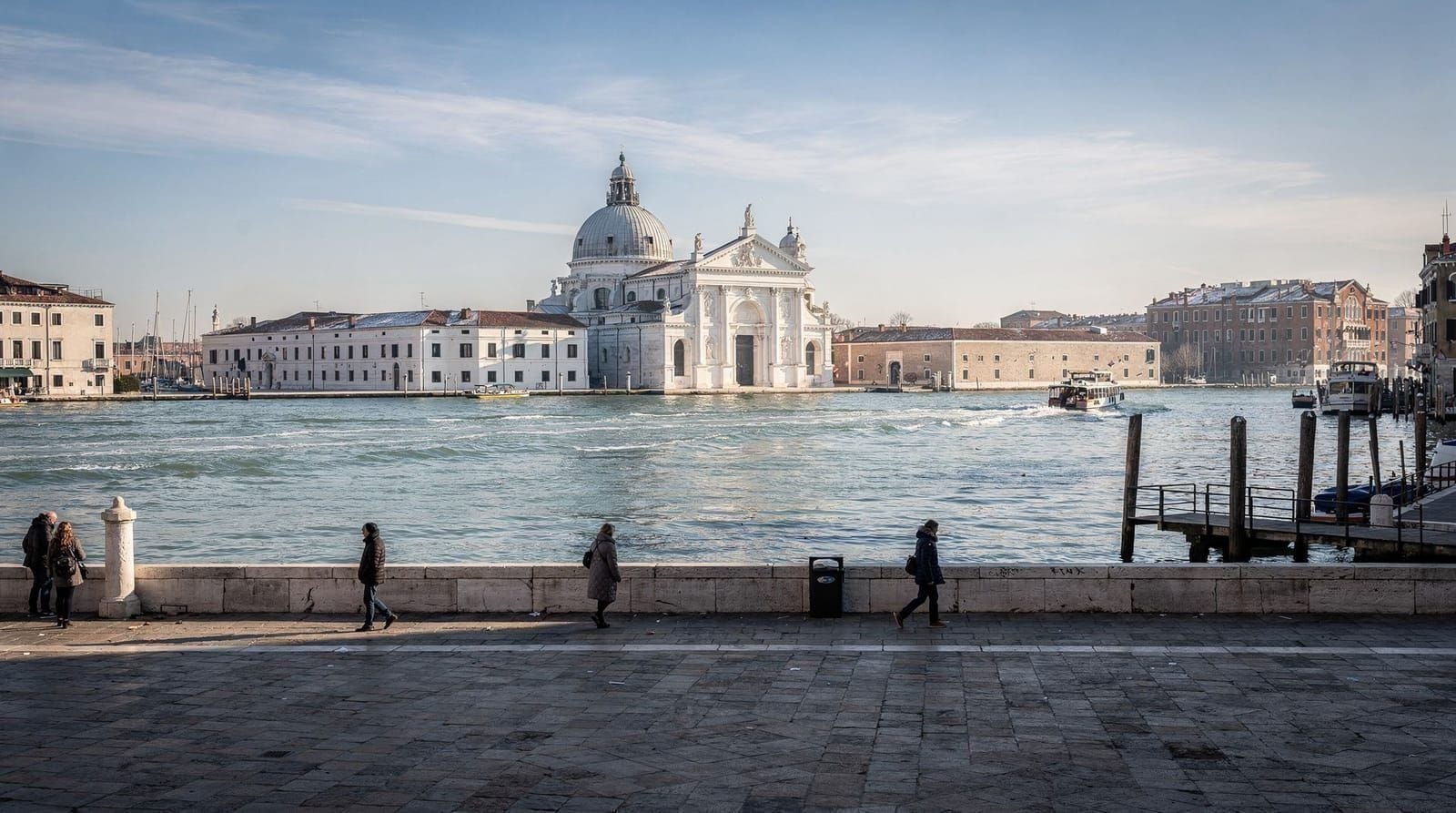
The church of Il Redentore (the Redeemer) is Giudecca’s defining landmark and one of Andrea Palladio’s last and finest works, completed in 1592. It was built as a votive offering to God for Venice’s deliverance from the plague of 1575–1577, which killed about 50,000 people — a third of the city’s population. The Venetian Senate voted to build it in 1577, and Palladio’s design — a classical temple facade on a broad flight of steps, the white dome visible from all across the Bacino — was a deliberate statement of renewal and power.
The interior is cool, calm, and classically proportioned, with an altarpiece of the Baptism of Christ attributed to Veronese in the sacristy, and Palma il Giovane’s Deposition above the high altar. Entry is around €3 with the Chorus Pass. Allow 30–45 minutes. Almost always quiet.
Redentore festival (2026: 18–19 July): On the third Saturday night of July, Venice celebrates the Redentore with a massive fireworks display over the Bacino di San Marco, and a pontoon bridge of boats is temporarily constructed across the Giudecca Canal connecting Dorsoduro to the church. The Zattere fills with boats and spectators; the fireworks start around 11:30pm. One of Venice’s most spectacular annual events — see the full Redentore festival guide.
San Giorgio Maggiore — across the canal from Giudecca
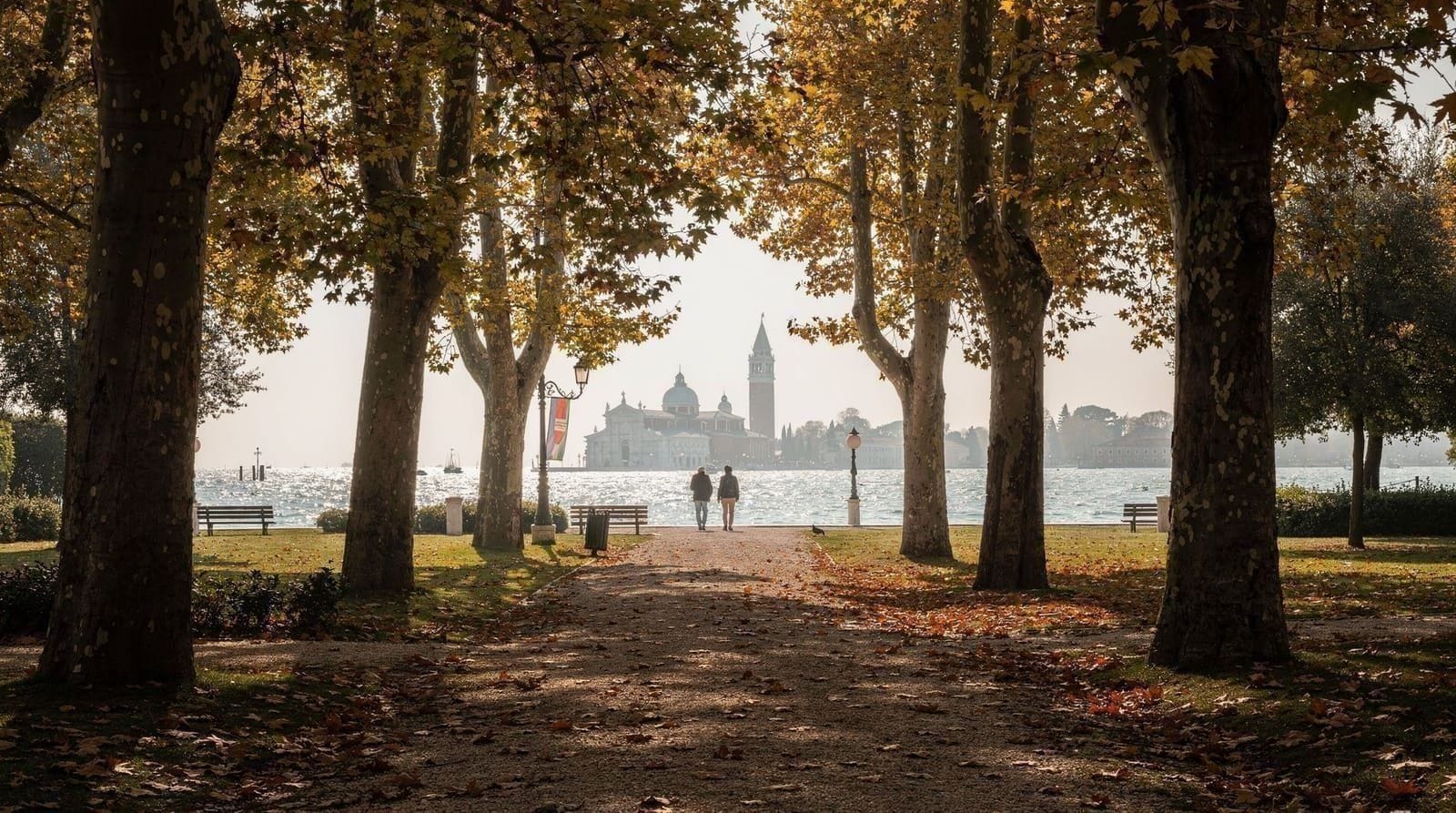
Strictly speaking, San Giorgio Maggiore is a separate island from Giudecca — a small, round island facing the Bacino di San Marco to the north. But its white Palladian church is so visually intertwined with the Giudecca skyline that it belongs in any visit to this part of the lagoon. The campanile of San Giorgio Maggiore, accessible by lift, offers arguably the best 360-degree view in Venice — looking north you see the entire city plan; south you see Giudecca; east takes in the Lido and the Adriatic.
Basilica San Giorgio Maggiore tour with water transportThe Fondazione Giorgio Cini on San Giorgio Maggiore — a major arts and cultural foundation in the former monastery — opens parts of the complex for guided tours on weekends. The library, cloisters, and Teatro Verde are extraordinary.
The skyline view from Giudecca
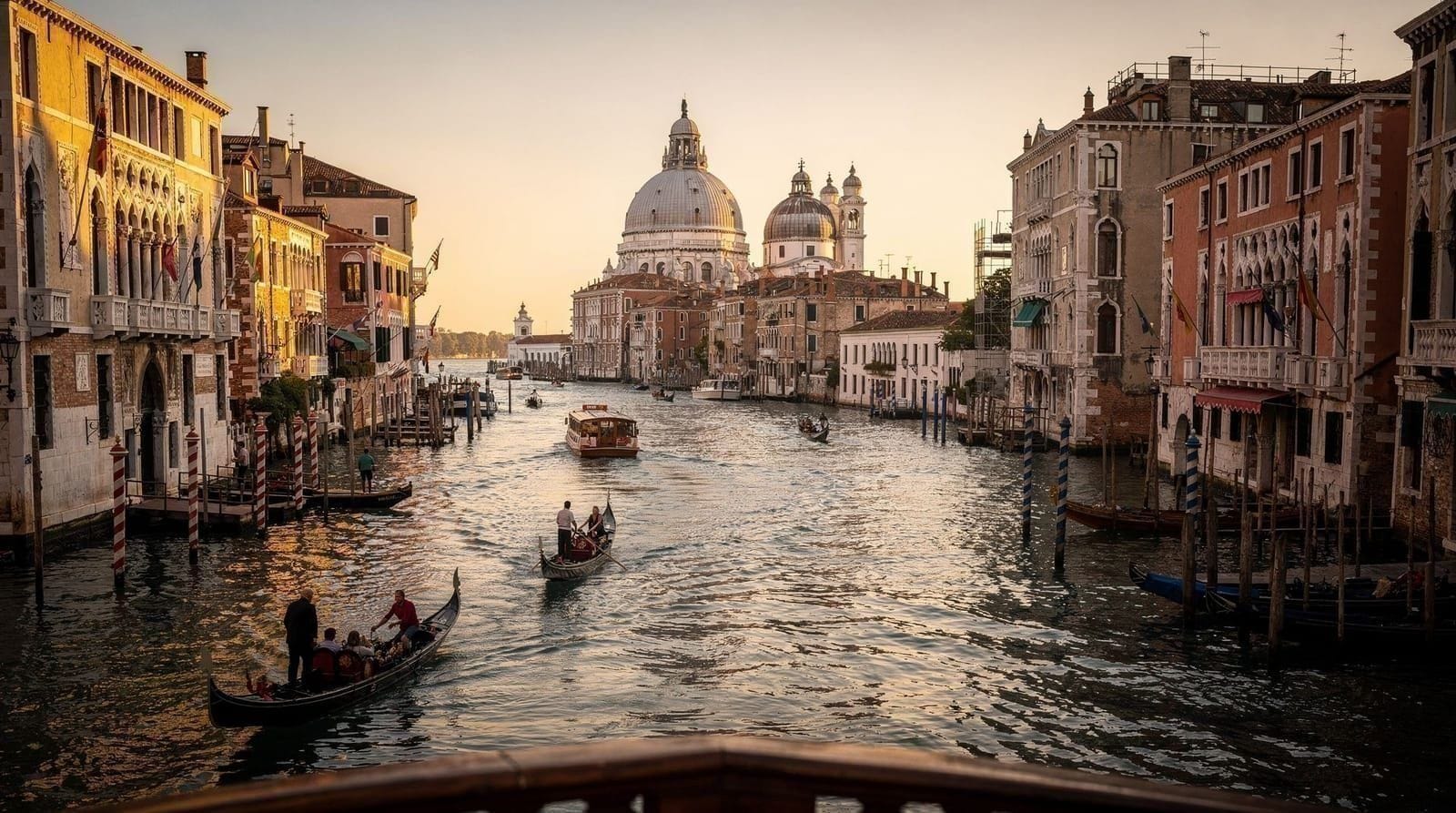
The north-facing waterfront of Giudecca (the side facing back toward Dorsoduro and Venice) provides a view of the Venice skyline that is completely different from any you get inside the city. You see the Salute dome, the Campanile, the Doge’s Palace roof, the distant towers of the north lagoon — stretched across the water in a panorama that is best at sunrise or in the late afternoon when the light comes from the west.
Photographers refer to this as one of the key golden hour Venice locations. The view from the Fondamenta San Biagio on the north shore of Giudecca is the standard spot.
For a boat-based version of this view, a sunset cruise around the lagoon gives you the Venice skyline from multiple angles.
Venice: sunset cruise by typical Venetian boatSee the best photo spots guide for specific locations and times.
The Molino Stucky and the Hilton
The Molino Stucky is Giudecca’s most distinctive non-Venetian building — a massive neo-Gothic flour mill built by Swiss entrepreneur Giovanni Stucky in 1884, designed to look as medieval as possible. For much of the 20th century it was abandoned and deteriorating; in 2007 it reopened as the Hilton Molino Stucky Venice. The building now occupies almost the entire western end of Giudecca and has a rooftop pool with extraordinary views of Venice, visible to non-guests from the vaporetto.
The hotel’s Skyline bar on the roof is accessible to non-guests (minimum spend applies). A cocktail here at sunset — around €20–25 — with the Venice skyline spread out in front of you is a legitimate splurge. Book a reservation, especially in summer.
Other churches and buildings on Giudecca
Giudecca is long enough to have several distinct clusters of buildings. Beyond the Redentore, walking west along the main Fondamenta:
Le Zitelle (Santa Maria della Presentazione): A Palladian church at the eastern end of Giudecca near the Zitelle vaporetto stop, built 1579–1586 as an institution for young women at risk of poverty. The facade is austere; the church has been converted for use as a conference venue attached to the adjacent Belmond Cipriani hotel. The exterior and setting (facing the Bacino toward San Marco) are worth seeing.
Ex-Junghans factory: A converted early 20th-century watchmaking factory midway along the island, now housing apartments, studios, a cinema (the Cinema Multisala Giorgione has a Giudecca outpost here), and a series of artist residencies. One of Venice’s better examples of post-industrial adaptive reuse.
Palladio in context: Walking between the Zitelle and the Redentore on foot gives a clear sense of the scale of Palladio’s vision — two churches anchoring the two ends of a water facade that was meant to be read from the Bacino di San Marco as a single compositional statement. The intervening buildings (later, less distinguished) interrupt the sequence, but the idea is still legible from the water.
Giudecca and the Venice Biennale
During Biennale years (art in odd years, architecture in even years), Giudecca hosts several collateral exhibitions in the former factory buildings and convent spaces along the island. Many of these are free. The Spazio Punch in the ex-Junghans complex and the Spazio Insula near the Palanca stop are recurring Biennale venues. In a Biennale year, adding a walk through Giudecca to a Castello/Arsenale Biennale day makes sense logistically — cross from Zattere to Giudecca, walk the island, and cross back from the western end toward Piazzale Roma.
See the Biennale guide for the full overview of collateral venues across the city.
Swimming and the lagoon near Giudecca
The Giudecca Canal is one of Venice’s main shipping channels and is not suitable for swimming. But Giudecca is positioned close to the Venice Lido — the barrier island with public beaches about 20 minutes by vaporetto from San Zaccaria. In summer (June–September), the Lido beaches are the most accessible swimming option from central Venice. See the Lido guide.
The Belmond Cipriani pool (mentioned above) and the Hilton Molino Stucky rooftop pool are the two hotel options for non-beach swimming on or near Giudecca. Both require advance booking; day passes are limited.
Local life on Giudecca
Giudecca is a genuinely working-class Venetian neighbourhood that was largely overlooked by the tourist economy until the Hilton arrived. It has several small restaurants and bacari along the main Fondamenta Sant’Eufemia, a few small grocery shops, a boatyard, and social housing alongside the luxury Belmond Cipriani hotel (one of Europe’s most expensive; non-guests can take the private launch for dinner or a swim at the pool).
Eating on Giudecca: The restaurants along Fondamenta Sant’Eufemia are honest and inexpensive by Venice standards — mostly aimed at locals and working boatyard staff. Harry’s Dolci (near Palanca stop) is the less famous sibling of Harry’s Bar in San Marco, with an outdoor terrace and slightly more reasonable prices. Trattoria Altanella (Calle delle Erbe) is Giudecca’s most established traditional restaurant; main courses €18–26.
Walking the full length of Giudecca
The full length of the island from east (Zitelle stop) to west (Sacca Fisola stop) is about 1.4 km on foot — roughly 20 minutes at a comfortable pace without stops. Walking this route gives you the complete range of Giudecca’s character: the Belmond Cipriani grounds and the quiet Zitelle church at the east, the Redentore church midway, the increasingly residential and then industrial-residential west end, and the converted Molino Stucky mill at the far end.
The north-facing waterfront of the entire island is a public Fondamenta. The south side has some residential calli but is less walkable as a continuous route. The narrow Calle del Forno and Calle della Croce run through the interior of the island — short distances that give a sense of a residential Venice without any tourist infrastructure whatsoever.
Giudecca in the history of Venice
Giudecca’s history is distinct from the main island sestieri. The name may derive from Giudei (Jews), suggesting an early Jewish settlement before the Ghetto was established in Cannaregio in 1516; alternatively from “giudicati” (judged), referring to noble families exiled here. In the 15th and 16th centuries it was Venice’s pleasure district — aristocratic villas and orchards occupied its quieter streets. By the 18th century, religious institutions (the Zitelle and Redentore congregations) dominated. In the 19th and 20th centuries, it industrialised — the Junghans clock factory, textile works, and the Stucky mill. Today it is in a transitional phase: residential, slowly being absorbed into the luxury tourism economy (Cipriani, Hilton), but still with a working-class majority.
This history makes Giudecca one of the more layered places in Venice for the visitor interested in how the city changes over time. The Venice history overview guide places Giudecca in the broader arc.
Getting to Giudecca
From the Zattere waterfront in Dorsoduro, vaporetto line 2 crosses the Giudecca Canal in about 3 minutes to the Palanca stop. Lines 4.1 and 4.2 serve the full length of the island from Zitelle (east) through Redentore, Sant’Eufemia, Palanca to Sacca Fisola (west end). A single vaporetto ticket costs €9.50 — or use your 24/48/72-hour pass.
During the Redentore festival weekend (third Saturday of July), the pontoon bridge crossing is pedestrian-only and free.
Giudecca in itineraries
The Venice couples 3-day itinerary includes a Giudecca afternoon on day two — crossing at Zattere, walking the full length of the island to Redentore, having dinner at Altanella, then crossing back to Dorsoduro for the evening. The Venice photography itinerary uses the Giudecca north shore as a key early-morning shooting location for the Venice skyline.
Artisan workshops and small studios
Away from the Molino Stucky end, Giudecca has a handful of working artisan studios that get almost no tourist traffic — glassworkers, textile printers, and a couple of small ceramics workshops occupying ground-floor spaces along the interior calli. None of these are set up as tourist attractions with fixed hours, so the approach is to walk and look through open doors rather than plan a specific stop. This is closer to the artisan crafts of Venice than the tourist-facing glass demonstrations on Murano, and it rewards an unhurried pace more than a checklist.
Comparing Giudecca to Venice’s other quiet islands
Giudecca is often mentioned alongside Sant’Erasmo and the smaller lagoon islands as an escape from the crowds, but the comparison only goes so far — Giudecca is a 10-minute vaporetto ride from San Marco, while the outer lagoon islands take 40 minutes to over an hour.
| Island | Distance from San Marco | Character | Best for |
|---|---|---|---|
| Giudecca | 10 min (vaporetto) | Residential, one luxury hotel, skyline views | A quiet half-day without leaving the centre |
| San Giorgio Maggiore | 5 min (vaporetto) | Single church and bell tower, small and self-contained | The best panoramic view of Venice |
| Lido di Venezia | 15–20 min (vaporetto) | Beach resort, Art Nouveau architecture, cars | A beach day or cycling |
| Murano | 30–40 min (vaporetto) | Working glass island, more tourist infrastructure | Glassblowing demonstrations and shopping |
Of these, Giudecca is the closest genuinely residential alternative to the main sestieri — it feels like Venice minus the crowds, rather than a separate excursion.
A realistic half-day plan
Start on the Zattere in Dorsoduro around mid-morning, take vaporetto line 2 to the Palanca stop (three minutes), and walk east toward the Redentore church, stopping to look back at the skyline as you go. Visit the church interior (30–45 minutes), then continue east to the Zitelle stop and the grounds of the Belmond Cipriani. Double back and walk west past Palanca toward the ex-Junghans complex and the Molino Stucky, finishing with a drink at the Skyline bar or a simple meal at one of the trattorie on Fondamenta Sant’Eufemia before crossing back to Dorsoduro or on to San Giorgio Maggiore if time allows. Budget three to four hours for the full loop with stops.
Frequently asked questions about Giudecca
Is Giudecca worth visiting?
For visitors who have already covered the main sestieri and want something quieter, yes. For a first-day visitor with only 2 days in Venice, Giudecca is lower priority than the Accademia, the Ghetto, or the lagoon islands. It makes most sense as a half-afternoon excursion from Dorsoduro.
How do you get to Giudecca?
By vaporetto from the Zattere waterfront in Dorsoduro (line 2 or 4.1/4.2). The crossing takes 3 minutes. You can also take the vaporetto from Piazzale Roma or from San Marco — lines 2 and 4.2 both stop at Giudecca stops.
When is the Redentore festival?
The third Saturday of July — 18–19 July 2026. Fireworks over the Bacino di San Marco start around 11:30pm Saturday. The pontoon bridge connecting Dorsoduro to the Redentore church opens from Saturday morning and closes Sunday evening. Plan accommodation well in advance if visiting during this weekend.
Can I visit the Belmond Hotel Cipriani on Giudecca?
The Cipriani is one of the world’s most expensive hotels (rooms from €1,000+ per night). Day passes to the pool are available in summer at around €100–150 per person. The hotel’s restaurants are open to non-guests. A private launch operates from San Marco jetty.
Where is the best view of Venice from Giudecca?
From the north-facing waterfront (Fondamenta San Biagio or the area near the Redentore church steps), looking back toward Dorsoduro, the Salute dome, and the Venice skyline. Early morning and late afternoon give the best light. The view from the Hilton Molino Stucky rooftop bar is higher and more panoramic.
Is Giudecca or San Giorgio Maggiore better for a short visit?
If you only have an hour, San Giorgio Maggiore wins — it is a shorter crossing and its bell tower gives the single best panoramic view in Venice. Giudecca needs at least two hours to be worthwhile, since its appeal is the walk along the Fondamenta and the residential streets, not one standout viewpoint.
Can you eat well on Giudecca without spending a lot?
Yes. The trattorie along Fondamenta Sant’Eufemia are aimed at locals and boatyard workers rather than tourists, with main courses generally cheaper than equivalent restaurants in San Marco or near the Rialto. Trattoria Altanella and the simpler bacari nearby are the standard honest options; the Cipriani and Hilton restaurants sit at the opposite, luxury end of the price range.
Top experiences
Bookable activities with verified prices and instant confirmation on GetYourGuide.