Venice Biennale guide: art, architecture, and how to visit
Venice: city center historical guided walking tour
When is the Venice Biennale and how does it work?
The Venice Biennale alternates between the International Art Exhibition (odd years) and the International Architecture Exhibition (even years). The 2026 edition is the Architecture Biennale, running May 10 to November 23, 2026. Exhibitions are spread across two main venues — the Giardini and the Arsenale — plus dozens of collateral events and national pavilions across the city.
| Where | Giardini and Arsenale, Castello sestiere |
| 2026 edition | Architecture Biennale, May 10–November 23 |
| Cost | around €25 full pass (both venues) |
| Time needed | Half a day minimum; two full days to see both venues thoroughly |
| Getting there | Vaporetto line 1 to Giardini or Arsenale |
What the Biennale actually is
The Venice Biennale is the oldest and most prestigious international exhibition of contemporary art and architecture in the world. It was founded in 1895, initially as an art exhibition intended to bring Venetian civic pride into line with other European capitals’ investment in the arts. The first edition attracted 200,000 visitors. It has been evolving — and sometimes controversially lurching — ever since.
The Biennale is not one thing. It is an institution (the Fondazione La Biennale di Venezia) that runs multiple disciplines: a visual arts exhibition, an architecture exhibition, a film festival (the Mostra Internazionale d’Arte Cinematografica, one of the oldest film festivals in the world), a dance festival, a music festival, and a theatre festival. The exhibitions that most visitors mean when they say “the Biennale” are the International Art Exhibition (held in odd years) and the International Architecture Exhibition (held in even years).
In 2026, you are visiting an Architecture year.
The 2026 Architecture Biennale
The International Architecture Exhibition 2026 runs from May 10 to November 23. The theme and curator for each edition are announced in the year preceding the exhibition; the curator sets an intellectual direction that national pavilions may respond to or depart from as they choose.
Architecture Biennales since 2010 have ranged from the provocative (Rem Koolhaas’s 2014 “Fundamentals,” which examined the elements of architecture) to the humanist (Hashim Sarkis’s 2021 “How Will We Live Together?,” postponed from 2020 due to the pandemic). They are generally considered harder for non-architecture specialists to access immediately, but they reward time and engagement. The national pavilions tend to be more directly engaging than the curated thematic exhibition, which can veer toward academic installation.
The two main venues: Giardini and Arsenale
Giardini della Biennale
The Giardini are the original home of the Biennale, a public garden on the southern tip of the Castello sestiere. They contain 29 permanent national pavilions built at various points throughout the 20th century, many of which are architecturally significant in their own right.
The most important are: the Finnish pavilion (Alvar Aalto, 1956), the British pavilion (modified by various architects over the decades), the German pavilion (rebuilt in a form associated with Nazi classicism that has generated critical debate ever since), the Venezuelan pavilion (Carlo Scarpa, 1954 — one of the masterpieces of 20th-century Venetian architecture), and the central Italian pavilion, which houses the curated international exhibition. The Giardini cover about 11 hectares and can be walked through in 2–3 hours at a minimum. Allow more time if you want to engage with the exhibitions rather than just pass through.
Getting there: From the centre of Venice, take vaporetto line 1 or 4.1 to Giardini stop (Castello). Walking from Piazza San Marco takes about 20–25 minutes.
Arsenale
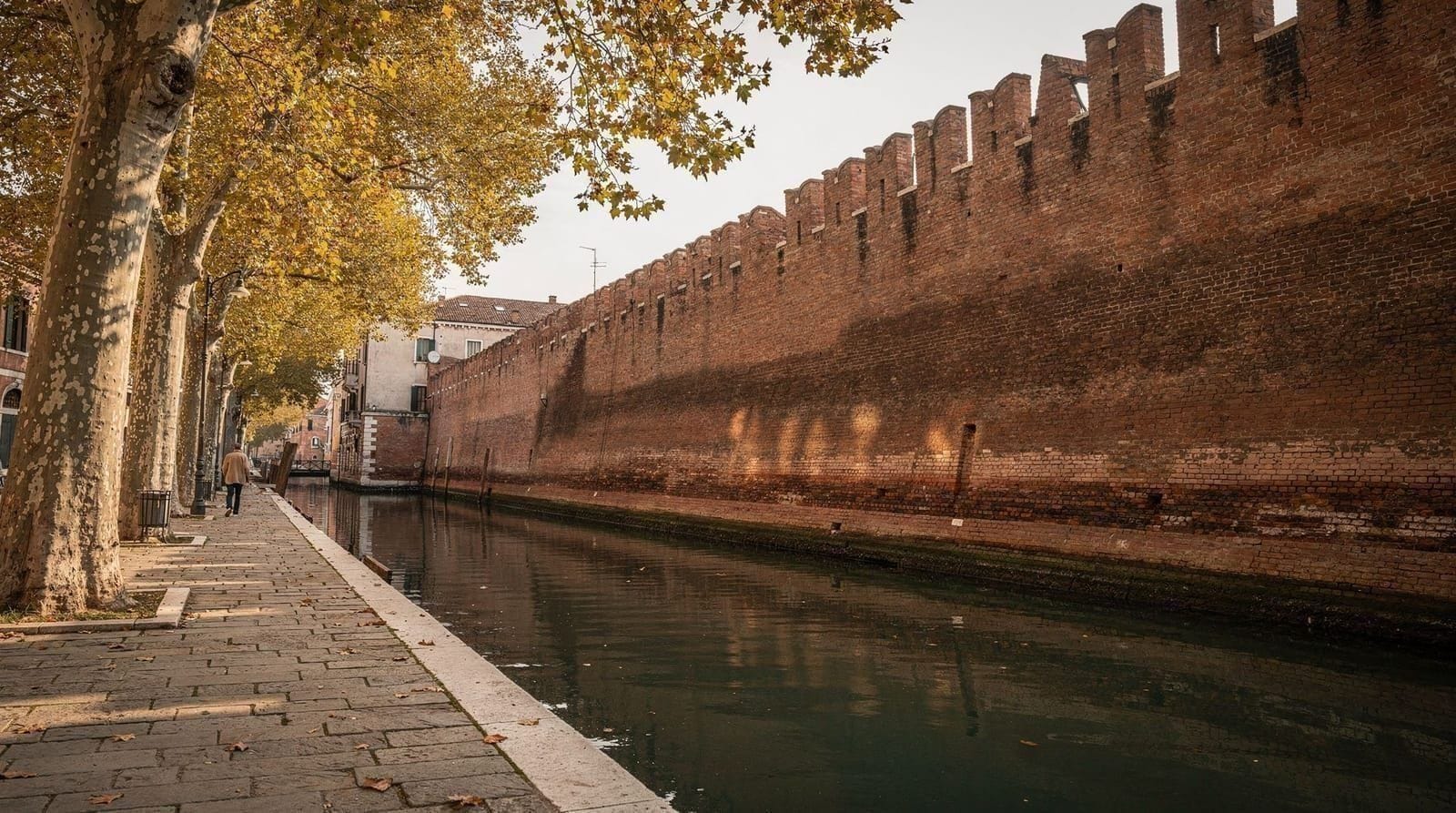
The Arsenale is the former Venetian naval shipyard — one of the largest and most important military-industrial complexes of medieval Europe. At its peak in the 16th century, the Arsenale employed 16,000 workers (Arsenalotti) and could produce a fully equipped warship in a day. The word “arsenal” is derived from the Arabic dar al-sina’a (house of industry) via Venetian dialect.
The Biennale uses the Arsenale’s vast covered sheds (the Corderie, where ropes were made, runs 300 metres long) as exhibition space. The Arsenale’s industrial scale and visual drama make it one of the most extraordinary spaces for contemporary installation anywhere in the world. Exhibitions here often use the architecture as part of their meaning.
Getting there: The Arsenale entrance (Campo della Tana) is a 5-minute walk from the Giardini, or accessible from Vaporetto stop Arsenale (line 1).
The national pavilions and how they work
Each country with a permanent or temporary pavilion appoints a commissioner — usually a government culture ministry or arts council — who selects an artist or team of artists (for the Art Biennale) or an architectural team (for the Architecture Biennale) to represent the nation. The selection process is itself a form of cultural politics: which artists or architects get to represent a country at the world’s most prestigious exhibition is never a neutral decision.
The pavilions vary enormously in quality from edition to edition. A country that produces a brilliant installation in one edition may mount a mediocre one five years later. The pavilions with the strongest reputations for consistency include those of Germany, the United States, Brazil, Japan, and the Nordic countries — but surprises come from unexpected directions.
The Golden Lion awards — the Biennale’s prizes — are given for the best national pavilions and for individual artists or architects within the curated exhibitions. Past recipients include Bruce Nauman, Cindy Sherman, Gerhard Richter, and numerous less internationally recognised figures who gained significant attention through their recognition.
Collateral events: the Biennale beyond the Giardini
Perhaps a third of the interesting content during a Biennale year is outside the Giardini and Arsenale, in the form of officially recognised “collateral events.” These are exhibitions and projects organised by national governments, cultural foundations, and institutions in spaces around Venice, often in historic buildings that are otherwise closed to the public.
In recent editions, collateral events have taken place in churches, convents, palazzi, and industrial spaces across every sestiere. Many are free. They are listed on the official Biennale website (labiennale.org) and require independent navigation around the city.
The Palazzo Grassi and Punta della Dogana — François Pinault’s private contemporary art museums on the Grand Canal and at the tip of Dorsoduro — often mount major exhibitions timed to coincide with the Biennale period. These are commercially operated, separately ticketed, and always worth checking. See the Punta della Dogana guide and the Dorsoduro guide for context.
Getting to the Giardini and Arsenale from the centre
Both Biennale venues are in the Castello sestiere, the eastern end of Venice. Navigation from the main tourist areas is straightforward by vaporetto or on foot.
By vaporetto: Line 1 from the Rialto or San Marco area stops at Giardini (the Biennale stop for the Giardini pavilions) and then at Arsenale (a short walk from the main Arsenale entrance on Campo della Tana). The journey from San Marco takes approximately 10–15 minutes.
On foot: From Piazza San Marco, walk east along the Riva degli Schiavoni toward the Arsenale — the Arsenale’s imposing gate (with its lion sculptures) is visible from the waterfront. From the Arsenale, it is approximately 10 minutes’ walk south through Castello to the Giardini.
Combined route: Many visitors start at the Giardini (arriving by vaporetto at the Giardini stop), walk through the pavilions, exit at the far end, and walk north to the Arsenale entrance. This loop takes 2–4 hours for the pavilions alone and can continue with the Corderie exhibition inside the Arsenale for another 2–3 hours. The walk between the two venues is pleasant through the Castello neighbourhood.
Eating near the venues: The Castello sestiere near the Giardini is one of Venice’s less tourist-heavy areas for lunch. Via Garibaldi (the wide street near the Giardini stop) has several straightforward trattorie serving the local neighbourhood at reasonable prices. Avoid the restaurants immediately adjacent to the Biennale entrances, which price for captive audiences.
Practical logistics for Biennale visitors
Tickets: Purchase online at labiennale.org. A full pass covering both Giardini and Arsenale costs €25 (standard). Reduced price €22 (students, over-65). Children under 12 enter free. The passes are valid for the entire period of the Biennale, not just a single day.
What to wear: The Giardini involve significant outdoor walking. The Arsenale is covered but vast. Comfortable shoes are essential. In summer (July–August), the Arsenale’s indoor spaces can be hot; carry water.
When to go: Opening week (May 10–17 for 2026) is the most vibrant but also the most crowded. Weekend afternoons in June and September are heavy. Weekday visits in July and August are significantly quieter. The final weeks of October before the November 23 closing also tend to be less crowded.
How much time to allow: To see both venues thoroughly — engaging seriously with the exhibitions rather than just walking through — plan two full days. The Arsenale alone rewards 3–4 hours. The Giardini with all 29 pavilions, viewed properly, takes another full day.
The history of the Venice Biennale
The Biennale was founded in 1895 by the mayor of Venice, Riccardo Selvatico, as part of the silver wedding anniversary celebrations of King Umberto I and Queen Margherita of Savoy. The first edition attracted approximately 200,000 visitors and included works by artists from 14 countries. The permanent pavilion system developed gradually: the Belgian pavilion was the first national pavilion constructed (1907), followed by the Hungarian, British, and German pavilions over the next decades.
The Biennale’s history includes some uncomfortable moments. The German pavilion was used in 1934 to promote Nazi art as part of the regime’s propaganda effort. The Biennale continued during much of the Second World War before suspending in 1942. It resumed in 1948 and has been held in each subsequent odd year without interruption.
The shift in what the Biennale signified happened gradually through the 1960s and 1970s, when it became increasingly associated with avant-garde and conceptual art rather than academic and traditional work. The 1968 Biennale was particularly significant: student protests disrupted the opening, and the political context of 1968 — Paris, Prague, student movements across Europe — inflected what was shown and how it was received.
The Golden Lion award, the Biennale’s highest prize, has been given since 1986 for national pavilions and individual artists. The history of its recipients is a compressed survey of 40 years of art world history: it has been given to Hans Haacke, Bruce Nauman, Cindy Sherman, Gerhard Richter, and many less internationally recognised figures who gained significant profile through the recognition.
Architecture Biennale vs Art Biennale: what actually differs
The practical experience of the Architecture and Art Biennales is significantly different. At the Art Biennale, the emphasis is on objects, installations, and performances; national pavilions typically present solo artists or small groups; the atmosphere is gallery-like, with clearly delineated works in clearly delineated spaces.
At the Architecture Biennale, the emphasis shifts to environments, ideas, and processes. Pavilions often present research, models, urban proposals, and immersive environments that do not function as traditional art objects. The experience is more intellectually demanding and rewards some preparation — reading the curator’s stated theme before visiting helps you engage with what you are seeing rather than simply consuming it as visual spectacle.
For visitors with a general interest in both art and design, the Architecture Biennale tends to be slightly less immediately accessible but often more intellectually stimulating. For visitors primarily interested in contemporary art, the Art Biennale (2025 was the most recent edition; 2027 will be the next) is more rewarding.
| Art Biennale (odd years) | Architecture Biennale (even years, incl. 2026) | |
|---|---|---|
| Focus | Objects, installations, performance | Environments, ideas, urban proposals |
| Feel | Gallery-like, object-centred | More conceptual, research-driven |
| Accessibility | Generally more immediate | Rewards preparation and reading the theme |
| Next after 2026 | 2027 Art Biennale | 2028 Architecture Biennale |
Combining the Biennale with the rest of Venice
Because the Giardini and Arsenale sit at the eastern end of Castello, a Biennale visit pairs naturally with the rest of that sestiere rather than requiring a separate trip. Before or after your Biennale morning, the Castello guide covers the quieter residential streets, the Naval History Museum near the Arsenale gate, and the long Riva degli Schiavoni waterfront walk back toward San Marco.
If you are staying multiple days, spreading the Biennale across two shorter visits — one for the Giardini, one for the Arsenale, ideally on different days — is more sustainable than a single marathon day. A 3-day Venice itinerary has room for this if art and architecture are a priority rather than an add-on.
For visitors who want a guided introduction rather than navigating 29 pavilions independently, a general orientation walking tour of Venice on the day before your Biennale visit — such as the Venice city centre historical guided walking tour — gives useful context on the Republic’s history that the Biennale’s contemporary content is, in various ways, still responding to.
When collateral events matter most
In a year like 2026, Biennale-adjacent programming is not limited to the Giardini and Arsenale. Palazzo Grassi and Punta della Dogana typically time a major exhibition to the Biennale period, and smaller collateral events pop up in churches, convents, and palazzi across every sestiere — many free, many in buildings otherwise closed to the public. Checking labiennale.org’s collateral events list before your trip, rather than relying on discovering them by chance, meaningfully expands what a Biennale visit can include beyond the two ticketed venues.
Connecting the Biennale to Venice’s broader art scene
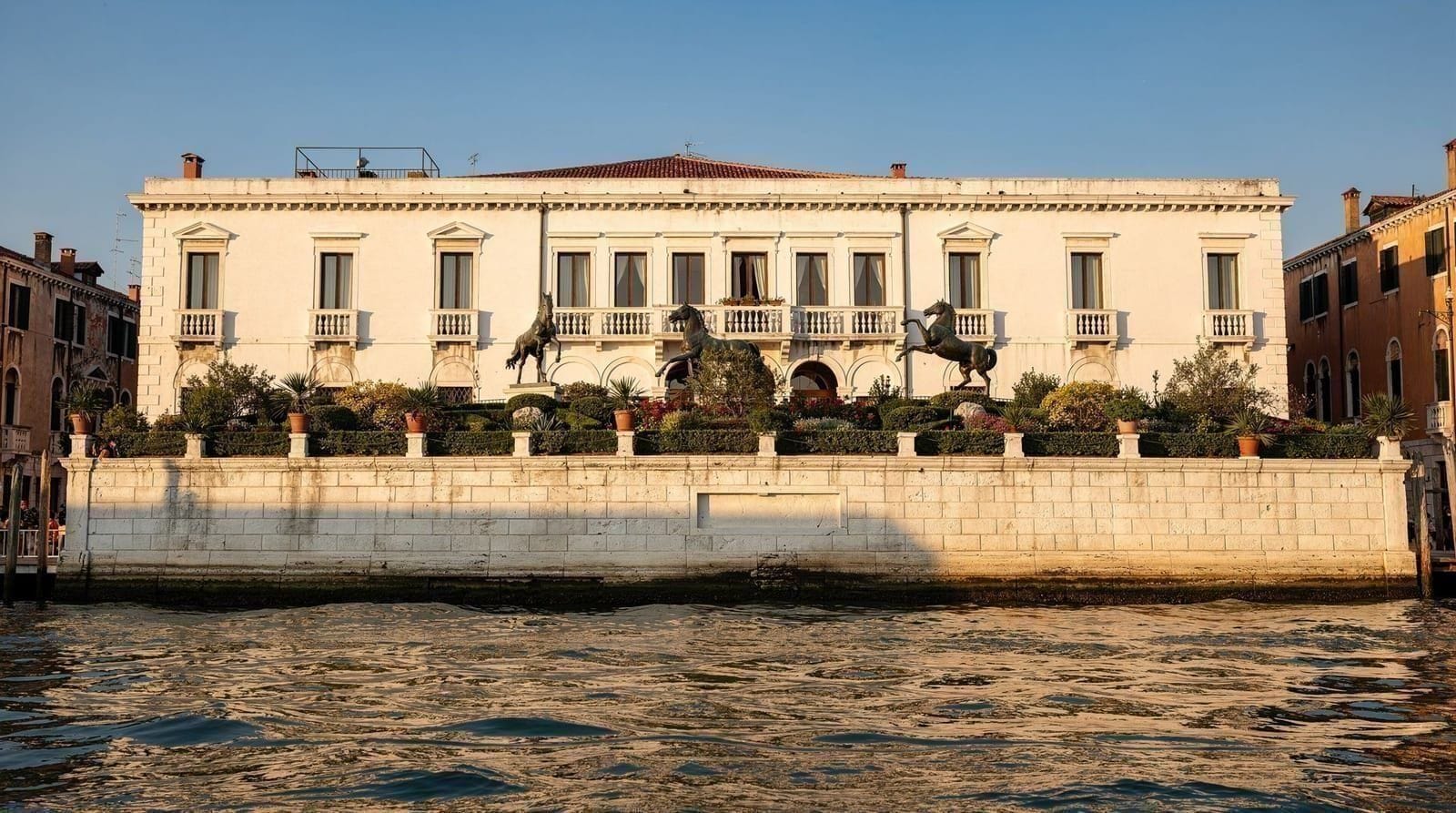
The Biennale is only one layer of Venice’s contemporary art ecosystem. The Peggy Guggenheim Collection on the Grand Canal in Dorsoduro is one of the finest collections of 20th-century art in Europe, with work by Picasso, Dalí, Kandinsky, Pollock, and Ernst, among many others. It is worth a half-day at any time of year but especially during Biennale periods when Venice’s cultural gravity is at its highest. See the Peggy Guggenheim guide.
The Gallerie dell’Accademia — Venice’s primary historical art museum, with an extraordinary collection of Venetian painting from the 14th to the 18th centuries — provides the temporal context for the Biennale’s contemporary work. Understanding what Carpaccio, Bellini, Titian, Tintoretto, and Veronese were doing in Venice before anyone imagined contemporary art gives the Biennale’s interventions in this city more meaning. See the Accademia gallery guide.
Frequently asked questions about the Venice Biennale
What is the difference between the Art Biennale and the Architecture Biennale?
The International Art Exhibition (odd years) presents contemporary art from national pavilions and a curated international exhibition. The International Architecture Exhibition (even years) focuses on architecture and urbanism. Both use the same venues — the Giardini and the Arsenale.
How much do Biennale tickets cost?
A standard full-price ticket for both Giardini and Arsenale costs €25. Reduced tickets cost €22. A two-day ticket costs €30. Book online in advance during peak months.
How many days do you need for the Biennale?
To see the Giardini and Arsenale thoroughly, allow at minimum 6–8 hours — more realistically, two days. A serious visitor can spend three to four days including collateral events.
What are the national pavilions at the Giardini?
The Giardini contain 29 permanent national pavilions, including architecturally significant buildings by Alvar Aalto (Finland), Carlo Scarpa (Venezuela), and others. Each country fills its pavilion with a national representation.
Are there free events at the Biennale?
Some collateral events — exhibitions mounted by national governments or cultural institutions around Venice — are free. A full list appears on the Biennale website each year.
When is the best time to visit the Venice Biennale?
May (opening weeks) and September–October are the busiest periods. For thinner crowds, visit in July or August, or in the final weeks of October before closing.
Can I visit the Biennale on the same day as St Mark’s Square and the Doge’s Palace?
Technically yes by vaporetto, but it is not recommended. Both the Biennale venues and the San Marco monuments deserve unhurried time; combining them in one day means rushing both. If your schedule is tight, prioritise one and add the other on a later day — see how many days in Venice for planning a realistic pace.
Is the Biennale suitable for visitors with only a general interest in art?
Yes, particularly the Art Biennale years — the work is often visually striking even without deep context. The Architecture Biennale (2026) rewards a little preparation, but the Arsenale’s industrial setting alone is worth the visit for anyone interested in Venetian history, independent of the exhibitions inside it.