Torcello: the quiet island that was once bigger than Venice
| Where | Northern lagoon, via Burano, about 45-50 min from Venice |
| Cost | Vaporetto fare or pass; cathedral entry a few euros |
| Time needed | 2-4 hours |
| Getting there | Line 12 from Fondamente Nove to Burano, then connecting boat |
| Best time | November-February for near-total quiet |
The island that history left behind
Before Venice was Venice — before the palazzi and the Doge’s Palace and the commercial empire that dominated Mediterranean trade for three centuries — there was Torcello. The island that now has perhaps a hundred and fifty permanent residents was, for most of the first millennium AD, the most important settlement in the northern Adriatic. Refugees from the Roman cities of the mainland, fleeing successive waves of invasion, built here on the flat grassy mud of the lagoon and made it extraordinary.
At its peak in the tenth and eleventh centuries, Torcello may have had twenty thousand inhabitants. It had its own bishop, its own legal structure, its own merchant class. The cathedral at the centre of the island — Santa Maria Assunta, built in 639 AD and rebuilt in 1008 — is one of the oldest standing buildings in the entire Venice region. The Basilica of San Marco in Venice, for comparison, was begun in 832 AD. Torcello came first.
Then the lagoon channels shifted, the island’s port silted up, malaria came, and over several centuries the population simply drifted away. They left behind their cathedral, their campanile, their archaeological museum, and an enormous silence.
What it is like to be there now
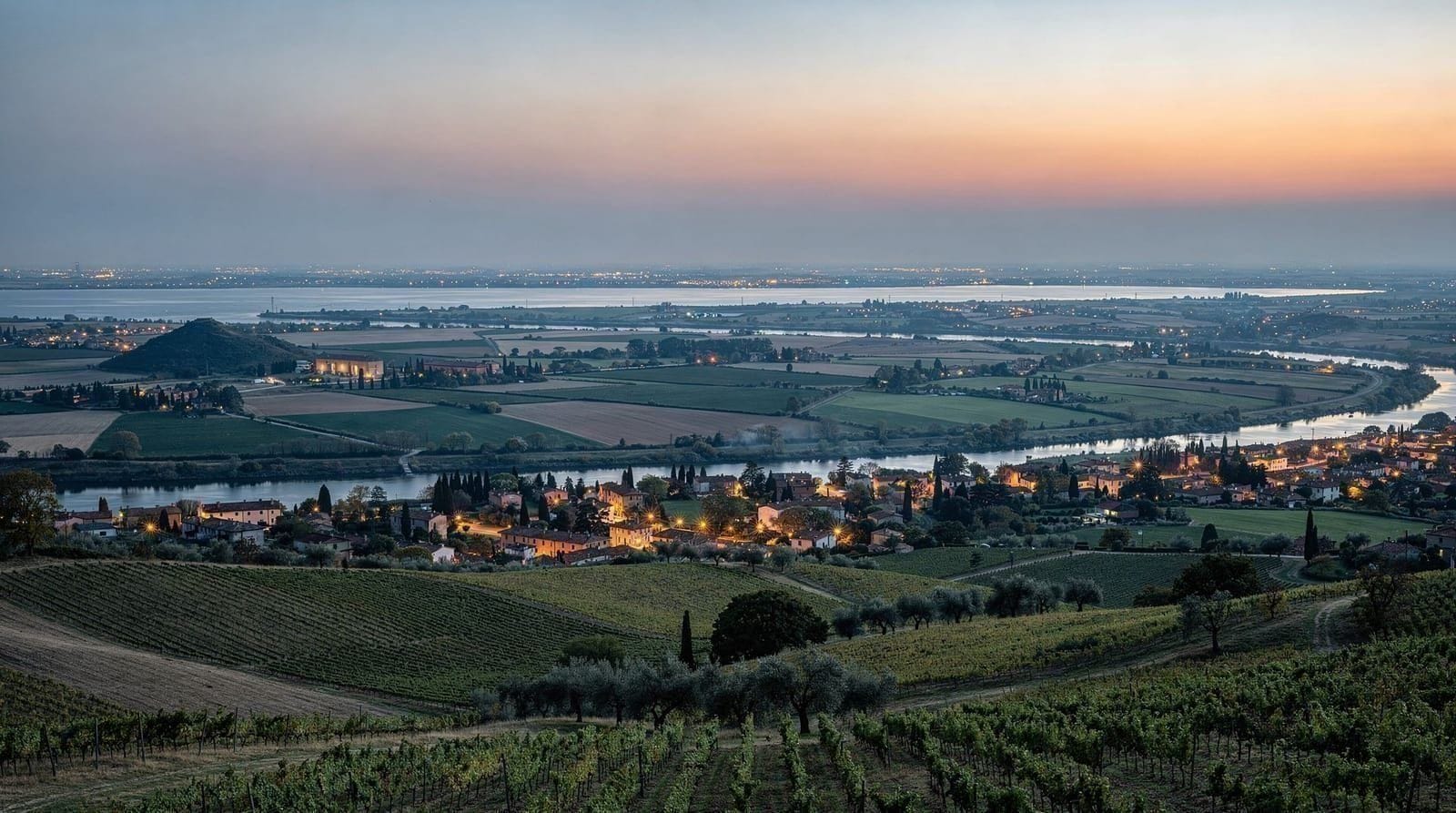
We visited in November, which I recommend unreservedly. There may have been thirty tourists on the island at any point during our four-hour visit. The path from the vaporetto stop to the cathedral runs alongside a narrow canal and passes through a flat agricultural landscape — bare vines, low walls, the occasional farmhouse — that looks almost nothing like any other part of the Venice lagoon. It is profoundly quiet. The only sounds for long stretches are the distant water and the wind in the reeds.
The cathedral itself is something quite different from the Byzantine splendour of San Marco. It is older, plainer from outside, and inside reveals a mosaic that runs across the entire west wall: the Last Judgement, laid in the eleventh and twelfth centuries, with gold ground and figures that are somehow more affecting for their archaic stiffness. The Madonna stands alone in the apse above, tall and isolated, one of the defining images of Byzantine art in northern Italy.
The neighbouring Church of Santa Fosca, built in the eleventh century, is a smaller circular structure with an exterior arcade that is one of the most quietly beautiful pieces of architecture I have seen anywhere.
The museum and the Attila’s chair
The Museo di Torcello, occupying two buildings near the cathedral, contains Roman and early medieval fragments recovered from the island and surrounding lagoon: mosaic floors from submerged buildings, stone reliefs, small objects from what was a substantial city. It is small but serious, and the material is genuinely interesting for anyone drawn to the idea of the lagoon’s earlier history.
The stone chair in the campo in front of the cathedral is known locally as Attila’s Throne. It almost certainly had nothing to do with Attila — it is probably a magistrate’s seat from the early medieval period — but the name has stuck for centuries and tells you something about how this island remembers its own extraordinary past.
Getting there
The vaporetto route to Torcello runs via Burano: take line 12 from Fondamente Nove in Cannaregio to Burano, then the connecting service to Torcello. Total journey from Venice is about 45-50 minutes each way. From Burano it is a short boat ride — eight or ten minutes.
If you are doing the standard three-island day trip (Murano, Burano, Torcello), the lagoon islands day trip guide and the how to visit Murano and Burano guide cover the full logistics. You can also book an organised tour that covers all three: the guided Murano, Burano and Torcello tour is the most structured option, with a local guide who provides historical context at each stop.
In terms of timing within the day: Torcello at midday or early afternoon, when the morning day-trippers have mostly left and the late afternoon ones have not yet arrived, is the quietest. November through February you will have the island almost to yourself at any hour.
What to eat and drink
There are very few options on Torcello. The Locanda Cipriani is the famous one — opened in 1934, once frequented by Hemingway, and still operating at significant expense. A meal there is an experience rather than just lunch, and the garden in warmer months is extraordinary. The prices are high by any measure: expect €80-120 per person for a full lunch.
The Osteria al Ponte del Diavolo, near the landing stage, is more modest and the food is honest lagoon cooking — risotto di gò (the local goby fish), pasta with cuttlefish, seasonal vegetables from the island’s remaining farms. We ate here both times we visited and were satisfied rather than amazed, but it is genuinely local and the setting — a small canal bridge, bare trees in November — is atmospheric.
There is a bar near the vaporetto stop with basic food and acceptable coffee if you want to save the main meal for Burano, which has better options at mid-range prices.
How long to spend here
Four hours is enough and not too much: cathedral, Santa Fosca, the museum, the campo and the Attila’s chair, lunch or a drink, a slow walk back along the canal. If you are combining with Burano and Murano, two hours on Torcello is the minimum to do the cathedral justice.
Do not rush the cathedral. The interior rewards time. The Torcello guide suggests going slowly through the mosaics — the figure of Satan in the Last Judgement, at the lower left, surrounded by souls, is a medieval image of hell that is genuinely haunting once you find it.
What Torcello looks like in different seasons
I have visited Torcello twice: once in November and once in early June. They were almost entirely different experiences, and both were excellent.
In November, the island is stripped back and austere. The vines are bare, the grass yellowed, the sky a flat northern grey. The birds on the lagoon are more visible without summer foliage; coots and cormorants are everywhere on the approach from Burano, and the sound of them carries across the water. The cathedral, with almost no other visitors, becomes something genuinely private — you can sit in front of the Last Judgement mosaic for twenty minutes without anyone else entering.
In June, the island is almost lush: the vines are leafed, the fields green, the light softer and coming from a higher angle. There are more visitors, though not many even in early summer. The garden at the Locanda Cipriani was open and had the particular quality of a very old and slightly faded luxury that I find more appealing than the polished version. The lagoon approach smelled of salt and warm mud in a way that felt fundamental to the place.
The winter visit is quieter; the summer visit is warmer and more welcoming. Both times I left feeling that this island rewards patience in a way that most of the more visited parts of the Venice lagoon do not.
Burano as a companion
Almost everyone who visits Torcello goes via Burano, and Burano is where most of the day-tripper time is concentrated — the coloured houses, the photographs, the lace shops. The combination of the two islands makes a logical day: Burano for colour and lunch, Torcello for the cathedral and silence.
What I would suggest, having done the combination both ways: go to Torcello first, in the morning, before the day-trippers from Burano arrive. The last boat from Burano to Torcello is around 17h in summer and earlier in winter — check the schedule. Coming from Burano in the early morning, before the first tourist boats from Venice have reached Burano, gives you Torcello almost entirely to yourself.
The Burano guide has detailed photography tips for the famous coloured houses; the vaporetto to islands guide covers the schedule from Venice.
Photography notes
Torcello photographs differently from Burano and Murano. There is no colour scheme to exploit, no glass to catch the light. What it offers photographically is texture and stillness: the mosaic, the stone in the cathedral interior, the reeds at the edge of the canal approach, the flat lagoon in any weather.
The cathedral interior requires a steady hand in low light — no flash is permitted and the mosaics need careful exposure to render both the dark figures and the gold ground without losing either. A wide-angle lens captures the whole west wall in one frame; a longer lens picks out the individual faces in the narrative panels. We found mid-morning the best light for the interior, when the sun has risen enough to come through the side windows but is not yet creating harsh contrast.
The path from the vaporetto stop to the cathedral is worth photographing at the right season: bare vines in November, full leaf in June, and at both times a quality of extreme quietness that is hard to convey in a photograph but worth attempting. The Burano photography guide covers the adjacent island; Torcello requires a different approach but the lagoon light principles are the same.
The bigger picture
Torcello is what makes the Venice lagoon more than a backdrop for a famous city. It is a reminder that the lagoon had its own history before the palazzi, that the city as we know it was built partly from the materials and population of places that no longer exist in recognisable form, and that the lagoon itself — the water, the mud, the changing channels — was the decisive force in who survived and who didn’t.
Standing in the campo on a November afternoon with the cathedral behind you and the flat lagoon visible between the buildings, it is possible to understand Venice in a different way: not as an improbable accident but as the last survivor of a denser, more complex world that the water gradually reclaimed. That understanding is worth the forty-five-minute boat ride.
Torcello versus Murano and Burano
| Torcello | Murano | Burano | |
|---|---|---|---|
| Draw | History, mosaics, silence | Glass craft | Colour, photography |
| Population | ~150 | ~5,000 | ~2,700 |
| Visitor numbers | Lowest of the three | Moderate | Highest of the three |
| Minimum time | 2 hours | 2-3 hours | 2 hours |
How Torcello rewards a slow visitor
Nearly everything on Torcello improves with unhurried time. The walk from the landing stage alone — fifteen minutes past bare vines and low farm walls — sets a pace that the cathedral, the museum, and Attila’s chair all reward if you keep it up. Visitors who arrive with a return boat already timed for forty minutes later tend to see the mosaic and leave; visitors who give themselves two hours notice details the rushed group misses entirely — the individual faces in the Last Judgement’s narrative panels, the light shifting on the gold ground through the morning, the specific quality of silence that only a handful of other visitors makes possible. If your Venice trip allows it, this is one island where less planning and more time genuinely changes the experience.
FAQ
Is Torcello worth visiting if I’ve already seen Murano and Burano? Yes — it offers something neither island does: near-total quiet and mosaics older than St Mark’s Basilica. It’s a short extension from Burano rather than a separate trip.
How much time do I need on Torcello? Two hours covers the cathedral, Santa Fosca, and the campo. Four hours lets you add the museum, a slow lunch, and time to simply sit with the mosaics without rushing.