San Polo
Venice's market district — the Rialto bridge, the city's oldest market, the Frari church, and the best cicchetti bars within walking distance of each
Venice: Rialto market food and wine lunchtime tour
Quick facts
- Best for
- Rialto market, cicchetti culture, Gothic church, local shopping
- Vaporetto stops
- Rialto Mercato, San Silvestro, San Tomà
- Time needed
- 2–3 hours; 4 hours with the Frari and Scuola Grande
- Don't miss
- Rialto fish market on a Tuesday or Friday morning, the Frari's Titian altarpiece
- Market hours
- Rialto market Tuesday–Saturday, 7:30am–1pm
Venice’s market quarter and the Rialto
San Polo is Venice’s smallest sestiere but punches above its size. It is built around two centres of gravity: the Rialto bridge and market at its northern edge, and the Gothic church of Santa Maria Gloriosa dei Frari (always just “the Frari”) at its western end. Between them is a dense network of calli lined with some of Venice’s best bakeries, bacari, and artisan workshops — fewer tourists, better prices, more life.
| Where | Between the Rialto bridge and the Frari, west of San Marco |
| Cost | Market free; Frari ~€5; Scuola Grande di San Rocco ~€10; cicchetti lunch €15–22 |
| Time needed | 2–3 hours; 4 hours with the Frari and Scuola Grande |
| Getting there | Vaporetto to Rialto Mercato, San Silvestro or San Tomà |
| Best time | Tuesday–Saturday, 7:30–10am for the market at its liveliest |
The Rialto was the commercial heart of the Venetian Republic for 1,000 years. The bridge itself is a 16th-century stone arch (the earlier wooden bridges collapsed twice); the markets below it have run continuously since at least the 11th century. This is where Venetians shop for fish, meat, and produce, and where the most concentrated cluster of honest cicchetti bars is found anywhere in the city.
The Rialto bridge
The Ponte di Rialto is one of the most photographed structures in Venice — a wide stone arch crossing the Grand Canal at its narrowest point, built 1588–1591 to designs by Antonio da Ponte after the previous wooden bridge collapsed. It has two rows of shops along its span and wide porticoed viewing areas on both sides.
The bridge is most beautiful from the water (take vaporetto line 1 and position yourself near the bow for the approach) or from the Fondamenta del Vin and Fondamenta del Carbon on either bank. Standing on the bridge itself is crowded during peak hours; go before 9am or after 7pm for a clearer view. Photography from the bridge offers good angles toward the Ca’ d’Oro to the north or the Ca’ Farsetti palaces to the south.
For the bridge’s history and the best viewing spots, see the Rialto bridge guide.
The Rialto market
The Rialto market runs along the Grand Canal bank west of the bridge and is divided into the Erberia (vegetable and fruit market) and the Pescheria (fish market). The Pescheria is the more distinctive — built in 1907 in a Gothic neo-medieval style, it occupies an open loggia right on the canal edge and sells the catch of the Adriatic: spider crabs, razor clams, lagoon-farmed clams (vongole), branzino, rombo, moeche (soft-shell crab in spring and autumn), and the extraordinary San Pietro (John Dory).
Markets run Tuesday through Saturday, 7:30am to roughly 1pm. Arrive before 10am; by noon the best of the fish is gone and the stalls are packing up. The vegetable market on the Erberia side stays open slightly later and sells seasonal Venetian produce: radicchio di Treviso, Sant’Erasmo artichokes, and lagoon violet artichokes (castraure) in spring.
The Rialto market is free to walk through. The best time for photography is early morning (7:30–9am) before the crowds and with the best light.
Venice: Rialto market food and wine lunchtime tourSee the full Rialto market guide.
Cicchetti and bacari around Rialto
The streets immediately around the Rialto market — particularly the Ruga degli Orefici, the Calle dei Boteri, and the Campo Bella Vienna area — are the most concentrated bacaro zone in Venice. The famous names:
All’Arco (Calle del’Arco, near the fish market): tiny, standing-only, cicchetti made fresh every morning from the market ingredients next door. Joins the baccalà mantecato, sarde in saòr, and seasonal toppings. The standard reference for what cicchetti should be. Open mornings only.
Cantina Do Mori (Calle Do Mori): Venice’s oldest bacaro, open since 1462 according to the sign. Copper pots hanging from the ceiling, no seats, excellent wine list for an ombra (small glass), and reliable cicchetti. Narrow and atmospheric.
Osteria ai Assassini: slightly less well-known than Do Mori, better for a longer stand with multiple rounds of wine and cicchetti.
Bancogiro (Ruga degli Orefici, overlooking the Grand Canal): more of a full restaurant but with an excellent aperitivo offer and good wine list; nice canal-side terrace for a more leisurely drink.
A proper cicchetti lunch — 4–6 pieces with two glasses of wine — costs €15–22 per person at these places. See the cicchetti guide and the best bacari guide for the full picture.
Santa Maria Gloriosa dei Frari
The Basilica of Santa Maria Gloriosa dei Frari (commonly “the Frari”) is Venice’s greatest Gothic church, built by the Franciscans in the 14th and 15th centuries. It competes with Santi Giovanni e Paolo in Castello for the title of Venice’s finest interior.
The church contains three works of particular importance:
Titian’s Assumption of the Virgin (1516–1518): The enormous altarpiece above the high altar, the artist’s first major commission, shows the Virgin ascending in a swirl of colour and movement that broke completely with the static Byzantine-derived painting that preceded it. It is still in its original position; the scale and the red-gold palette are striking even to visitors who know it only from reproductions.
Titian’s Pesaro Madonna (1519–1526): The left transept altarpiece, unusual for placing the Virgin asymmetrically. Titian is buried in the Frari; his tomb in the right aisle is a 19th-century monument.
Giovanni Bellini’s triptych (1488): In the sacristy, in its original gilded frame — a tender, intimate polyptych that contrasts beautifully with the drama of the main altarpieces.
Entry costs around €5 with the Chorus Pass (which covers 16 Venetian churches). Allow 45–60 minutes. The Frari is usually less crowded than San Marco’s churches despite being roughly equivalent in importance.
Scuola Grande di San Rocco
Opposite the Frari entrance, the Scuola Grande di San Rocco is a building almost entirely decorated by Tintoretto, who won the commission in 1564 and spent 23 years completing the cycle. The Sala dell’Albergo (upstairs) has the Crucifixion — a single vast canvas covering an entire wall — which Ruskin called “the most perfect picture in the world.” The ground floor hall, the upper hall, and the Sala dell’Albergo together form one of the great Mannerist decorative cycles anywhere.
Entry around €10. Handheld mirrors are provided to look at the ceiling canvases without straining your neck. Allow 45–60 minutes.
San Polo’s smaller churches and hidden campo
San Polo is compact but dense with details. Beyond the Frari and the Scuola Grande di San Rocco, the sestiere has several small churches and quiet squares that deserve attention.
San Giacomo di Rialto (San Giacometto): Claimed to be the oldest church in Venice (6th century, rebuilt 1071), it stands immediately beside the Rialto market — a small structure almost invisible between the market stalls. The motto carved on the clock tower — “Hoc circa templum sit ius mercantori aequum, pondus et mensura et jus servent” (Around this temple let merchants act justly, keeping correct weights and measures) — reflects the market’s centuries-long history as a place of commerce. Entry free.
San Polo church: The large Gothic church of San Polo itself (Campo San Polo, the sestiere’s main square) has 14 Stations of the Cross by Giandomenico Tiepolo (son of Giambattista) and a fine Last Supper by Tintoretto. Campo San Polo is the largest campo in Venice after Piazza San Marco — host to outdoor cinema in summer and a skating rink in winter.
Palazzo Mocenigo: A 17th-century patrician palace just off the Grand Canal, now the Museo di Palazzo Mocenigo, dedicated to Venetian textiles, perfume history, and noble life. Entry around €8. Lord Byron lived in Venice’s Mocenigo palaces on the Grand Canal — a different branch of the same family.
The San Polo and Santa Croce food loop
The most satisfying food-focused walk in Venice connects San Polo’s Rialto market with the bacari of Santa Croce, then south through the calli to the Frari area. The route: Rialto market (morning), All’Arco for cicchetti (11am), walk west through San Polo into Santa Croce toward Campo San Giacomo dell’Orio for a second round of cicchetti, then back east toward the Frari for an afternoon visit.
This route takes 4–5 hours at a comfortable pace and covers most of the best eating and cultural highlights of both sestieri. The cicchetti guide has recommended stops along the full route.
Getting around San Polo
San Polo is walkable from most other sestieri. The Rialto Mercato vaporetto stop puts you directly at the market (line 1 from San Marco takes about 15 minutes). The San Tomà stop serves the Frari and Scuola Grande di San Rocco. The neighbourhood is compact enough that walking from Rialto to the Frari takes about 10 minutes.
The best route for exploring on foot: approach from the Rialto bridge, walk through the market, then turn south through the calli to All’Arco for cicchetti, continue to the Frari for the main church, then Scuola Grande di San Rocco. Return via the calli to Rialto for the vaporetto back.
See the Venice orientation guide for San Polo’s position relative to other sestieri.
San Polo in itineraries
The Venice 1-day itinerary includes Rialto and the Frari as the afternoon component after a San Marco morning. The Venice on a budget itinerary uses the Rialto market as the main food-cost-saving strategy: buy your lunch from the market stalls (€5–8 for bread, cheese, and produce) rather than sitting at a restaurant.
San Polo for photographers and visual travellers
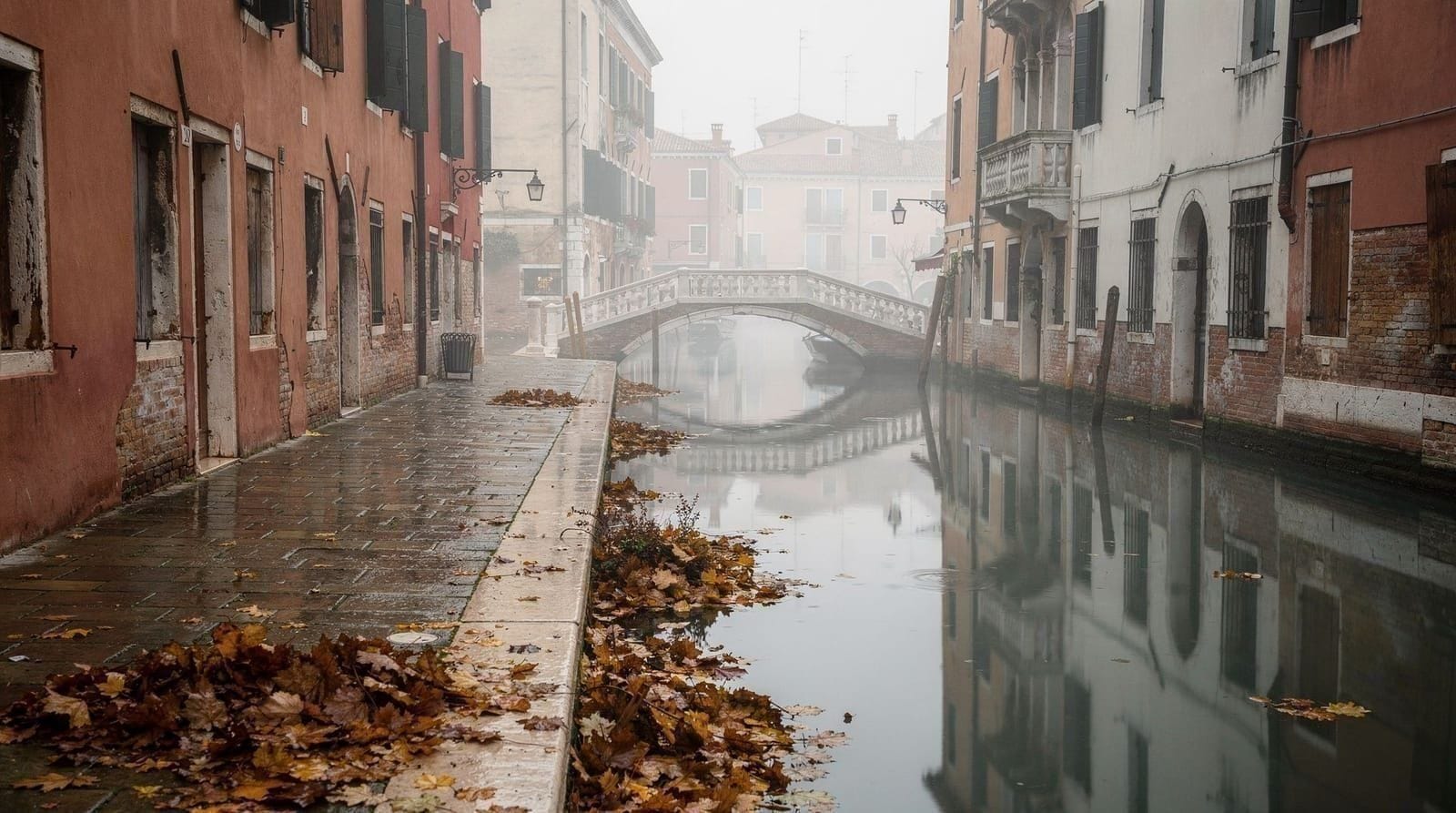
The Rialto market and bridge area is one of the most intensely photographed parts of Venice — and for good reason. But the standard tourist photographs (wide-angle of the bridge, posed shots in the market) are the ones most people take. The better photography happens in the side streets: the narrow calli between the market and the Frari, the canal reflections at Rio di San Polo on a still morning, the gondola workshops (squeri) on the edges of the sestiere.
Squero di San Trovaso (technically in Dorsoduro, on the border with San Polo) is one of Venice’s last working gondola boatyards — a small, chalet-style building from the 17th century where gondolas are built and repaired. Closed to visitors but visible from the canal; the best photo spots guide covers the viewing angles.
The Rialto fish market at 7:30–8:30am is outstanding for photography — colour, activity, reflected light from the canal, and the fish themselves. See the sunrise photography guide for early-morning lighting in the market area.
Venice in winter from San Polo
San Polo is one of the best sestieri for winter visits. The market runs year-round and is most atmospheric in autumn and winter when the light is lower and richer. The Frari and Scuola Grande di San Rocco are uncrowded. The bacari operate a full-day service with seasonal cicchetti — autumn brings moeche (soft-shell crab) and baccalà preparations that are San Polo’s cold-weather specialties.
For winter trip planning see the Venice in winter guide and the acqua alta guide for what to expect in the lower-lying parts of San Polo near the Rialto in a high-water event.
What’s in season at the Rialto market
Part of what makes repeat visits to the Rialto market worthwhile is that the stalls change with the calendar. Knowing roughly what’s in season helps set expectations for what you’ll actually see.
| Season | Look for |
|---|---|
| Spring (Mar–May) | Castraure (baby lagoon artichokes from Sant’Erasmo), moeche (soft-shell crab) |
| Summer (Jun–Aug) | Peak tourist crowds, standard Adriatic catch, fewer local specialties |
| Autumn (Sep–Nov) | Second moeche season, radicchio di Treviso, funghi porcini |
| Winter (Dec–Feb) | Quietest market visits, best baccalà and hearty cicchetti at the bacari |
Spring and autumn are the two windows when the market’s most distinctive Venetian specialties — moeche in particular — actually appear on the stalls.
Comparing San Polo’s classic bacari
The Rialto’s bacaro cluster is dense enough that first-time visitors often don’t know where to start. A rough guide to what distinguishes the best-known names:
| Bacaro | Style | Best for |
|---|---|---|
| All’Arco | Tiny, standing-only, market-fresh | The reference cicchetti experience, mornings only |
| Cantina Do Mori | Historic (since 1462), narrow | Atmosphere and an ombra of wine |
| Osteria ai Assassini | Slightly less crowded | A longer stand with multiple rounds |
| Bancogiro | Full restaurant with terrace | A sit-down aperitivo with a Grand Canal view |
None of these require a reservation for standing cicchetti; Bancogiro is the one worth booking ahead if you want a canal-side table.
Venice: Rialto market food tour with cicchetti tastingFrequently asked questions about San Polo
What time does the Rialto market open and close?
The market runs Tuesday to Saturday, opening around 7:30am. The fish market (Pescheria) closes around 12:30–1pm; the vegetable market (Erberia) slightly later. Nothing of interest happens at the market on Sundays and Mondays — the stalls are empty.
Is the Frari worth visiting?
Absolutely — the Titian Assumption alone makes it worth the €5 entry. The Frari is one of Venice’s top five interior experiences but significantly less crowded than the Doge’s Palace or the Accademia. Budget 45–60 minutes.
What is the difference between the Rialto market and a Rialto market food tour?
Independent visitors can walk through the Pescheria and Erberia for free and observe the market life. A food tour (typically 2.5–3 hours, €60–80 per person) adds context — what the fish species are, how the market operates seasonally, cicchetti tasting at three or four bacari, and wine pairing. Good value for visitors interested in food culture.
Can I buy food at the Rialto market?
The market sells wholesale to restaurants and direct retail to locals — you can buy vegetables, fruit, and fish directly from the stalls. However, Venetian fish requires a kitchen to prepare; the market is mostly a spectacle for visitors rather than a practical food source. The cheese, cured meat, and bread shops nearby are more accessible for self-catering.
Where should I have lunch in San Polo?
At a bacaro near the market, standing up. All’Arco is the classic recommendation: arrive between 11am and 1pm, order a few cicchetti from the counter, and drink a glass of local Soave or a spritz. Budget €15–20 per person. Sitting-down restaurants near Rialto are more expensive (€30–45 per person with wine) — fine, but not necessary for a good meal here.
What is moeche and when can I try it?
Moeche is soft-shell lagoon crab, harvested during two short annual moulting windows — roughly April to May and again in October — when the crabs are caught just after shedding their shells and are eaten whole, usually fried. It’s one of the Rialto market’s genuine seasonal specialties and appears on bacaro menus in San Polo during those windows only; outside them, don’t expect to find it.
Is San Polo walkable from San Marco or the train station?
Yes to both. From San Marco, it’s about a 15–20 minute walk across the Rialto bridge. From Venezia Santa Lucia station, San Polo is roughly 20–25 minutes on foot through Santa Croce, or a few minutes by vaporetto to San Silvestro or Rialto Mercato.
Top experiences
Bookable activities with verified prices and instant confirmation on GetYourGuide.