The Dolomites from Venice: what a day trip actually delivers
What “Dolomites from Venice” actually means
The Dolomites are approximately 170km from Venice as the crow flies. The drive takes two to two and a half hours depending on your target — Cortina d’Ampezzo, the most accessible focal point for a day trip, sits at 1224 metres altitude above the Boite valley, deep in the heart of the Tre Cime di Lavaredo area. The bus journey (organised day trips) takes about the same time.
This means that on a day trip, you’re spending roughly four to five hours in transit and four to five hours on the ground. Whether that ratio is acceptable depends on what you’re after.
We went in August. The mountains were clear. We had four and a half hours in the Cortina area. It was not enough to do the Dolomites justice. It was enough to understand why people come back.
| Where | Cortina d’Ampezzo, about 170km / 2–2.5 hours from Venice |
| Cost | Tour from around €100–130; cable car around €20 return |
| Time needed | Full day for a taste; 2+ nights for real hiking |
| Getting there | Organised bus tour or self-drive via A27/SS51 |
| Best time | June–September, mornings for clear views before afternoon storms |
Day trip vs staying over
| Day trip | 2+ nights | |
|---|---|---|
| Time in the mountains | 4–5 hours | full days, both mornings and evenings |
| Tre Cime dawn shot | not realistic | possible with an early trailhead start |
| Serious hiking | not enough time | yes, multi-hour or multi-day routes |
| Cost | tour from ~€100–130 | tour cost + €120–300+/night lodging |
| Best for | scenery on a tight schedule | hikers, photographers, a proper mountain stay |
What the journey north looks like
One thing the standard “Dolomites from Venice” tour marketing doesn’t emphasise is how good the journey itself is. The Veneto plain north of Venice — flat, agricultural, bisected by the Piave river — transitions gradually into the foothills around Belluno. The Piave valley narrows. The mountains come down closer. The SS51 follows the river north through progressively steeper terrain.
By the time you reach the Forra del Vajont (the gorge below the Vajont Dam, site of the catastrophic 1963 landslide), you’re genuinely in mountain territory. The road passes through a series of small towns — Longarone, Castellavazzo, Ospitale di Cadore — where the architecture shifts from Veneto brick to stone-and-render mountain vernacular. If you’re driving, these towns are worth a stop. If you’re on a guided tour, look out the window from here on.
What we saw
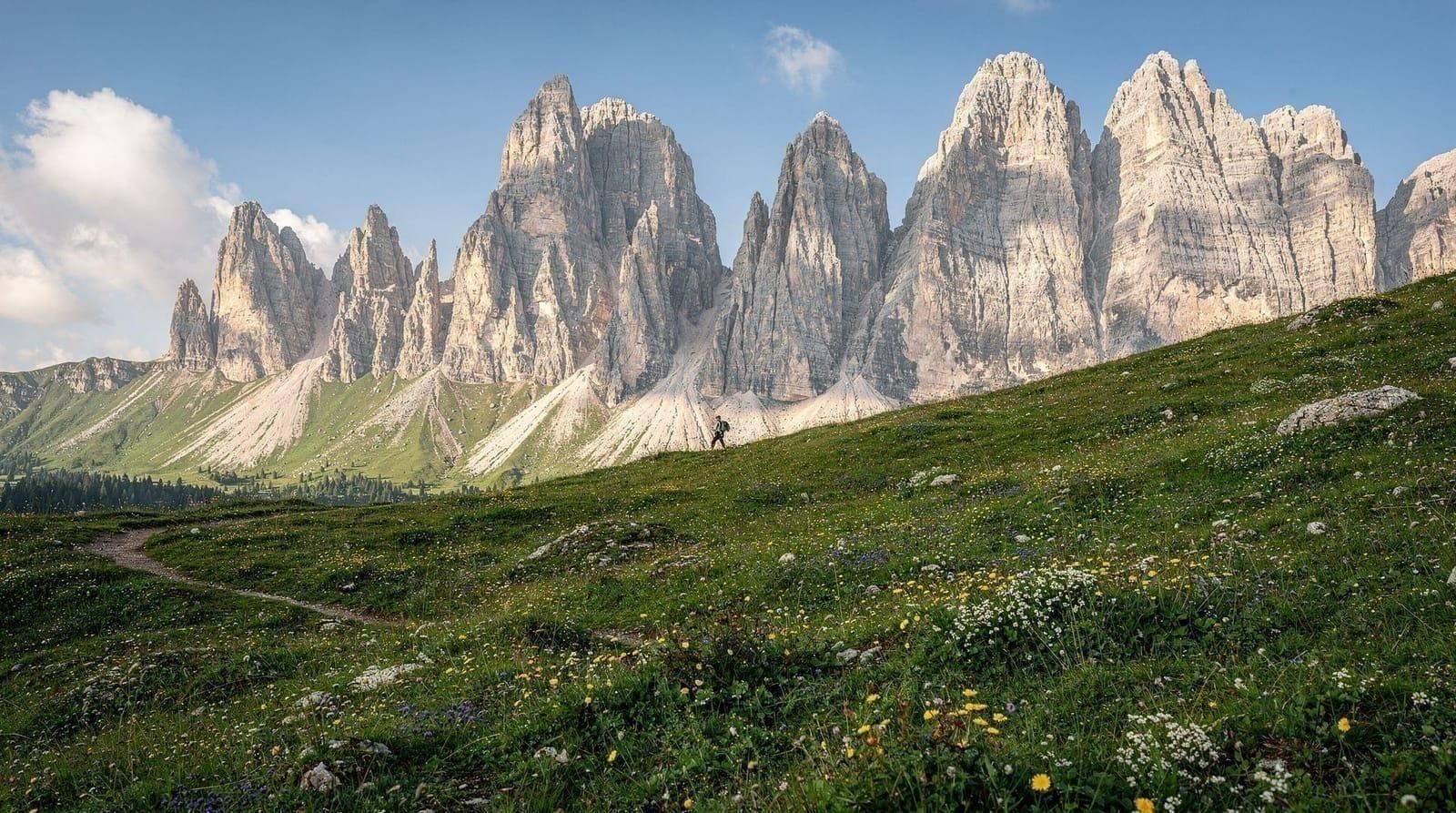
The approach to Cortina on the Alemagna road (SS51) is a gradual revelation. The Veneto plains give way to foothills, the foothills to lower mountains, and then the road enters the first of several valleys where the Dolomite rock formations begin to dominate. These are not ordinary mountains — the pale vertical limestone towers, cut by weather into forms that look more architectural than geological, give the range its UNESCO designation and its hold on the imagination.
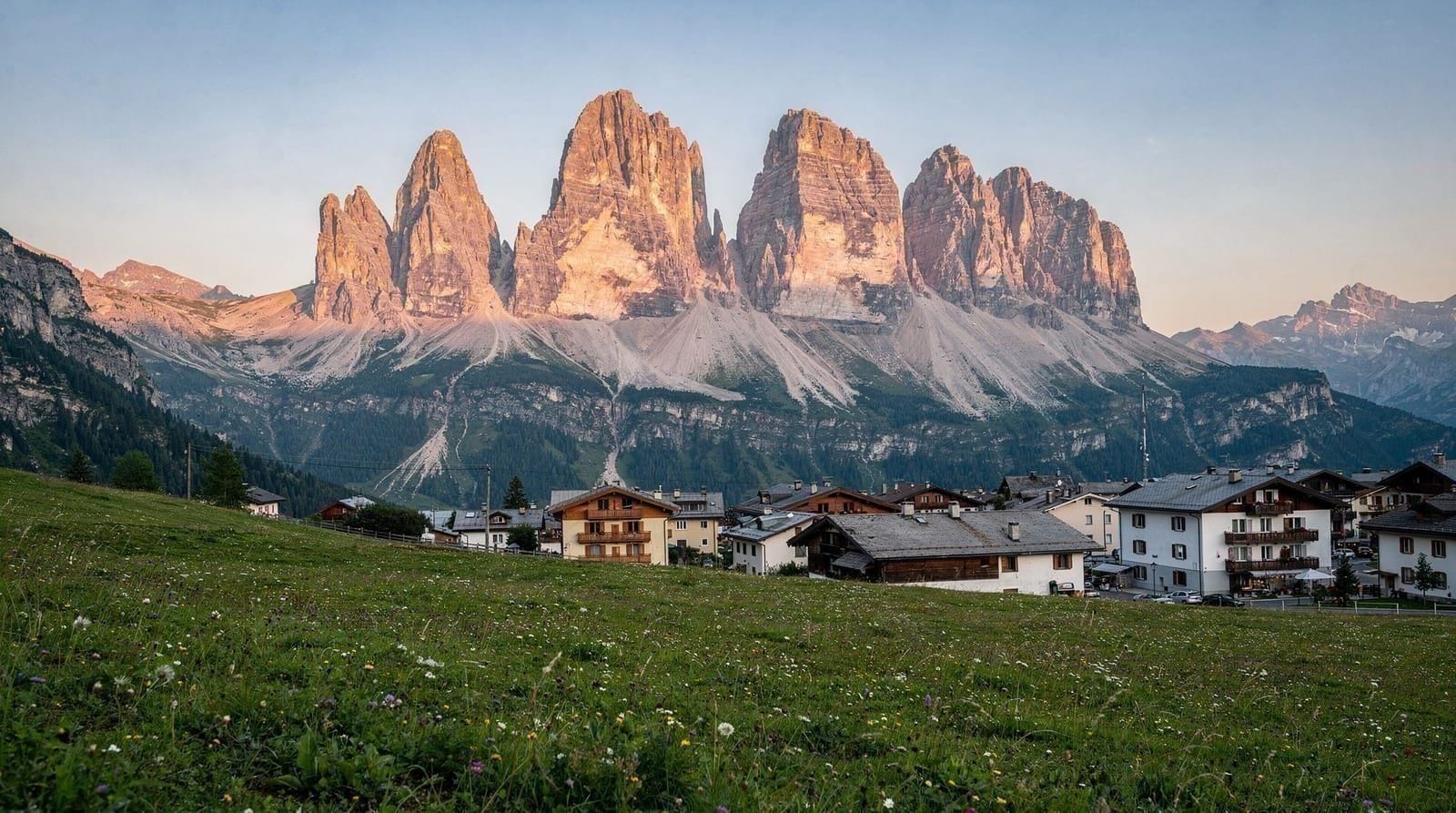
Cortina itself is a ski resort in winter and a hiking base in summer. It’s also expensive and slightly self-conscious — the town centre is full of designer outdoor gear shops and the hotel prices reflect the resort economy. But the setting is breathtaking in a literal sense: you stand in the main street and the Pomagagnon massif is above you to the north, the Cinque Torri rock towers visible to the south.
We took the cable car up to Ra Valles (€20 return), which gave us an hour on a plateau at 2470 metres looking at the full panorama. On a clear August day this is one of the great views in Europe. The scale of the rock formations only becomes clear from altitude — the towers and walls that look dramatic from below reveal their three-dimensionality when you’re at the same level.
We had lunch in the rifugio at the top — risotto with local cheese, €14, eaten on a terrace at 2470 metres with the Marmolada glacier visible to the south. This is not an available experience in Venice.
From Venice: Cortina and Dolomites mountains day tripWhat a day trip doesn’t give you
The Dolomites reward time. The iconic photographs — Tre Cime di Lavaredo at dawn, Lake Braies at seven in the morning, the Alpe di Siusi plateau — require either staying in the mountains or committing to very early starts. A day trip from Venice cannot reach Lake Braies until nine at the earliest, by which time the summer crowds have arrived.
The hiking is the main point of summer Dolomites, and meaningful hiking requires at least a full day in the hills — preferably two or three, with a night in a rifugio on the high route. The Alta Via 1, the classic Dolomites long-distance route, takes seven to ten days. None of this is compatible with a day trip.
For the classic Tre Cime circuit (three hours round trip, the most photographed walk in the Dolomites), you’d need to be at the trailhead by eight in the morning in high summer, which means leaving Venice at 5:30am. Possible, not comfortable.
What a day trip does give you
The mountain air — immediately noticeable after Venice’s summer humidity. The scale of the landscape. The specific feeling of standing in one of Europe’s most beautiful mountain ranges after a morning in one of Europe’s most beautiful cities. The cable car experience if you choose it. A lunch that isn’t cicchetti.
For visitors who are not experienced hikers and won’t be doing the multi-day routes anyway, a day trip delivers the main visual experience of the Dolomites at a fair exchange rate in time and money.
The Dolomites day trip guide makes this case more methodically, including which specific tours reach Tre Cime versus just Cortina.
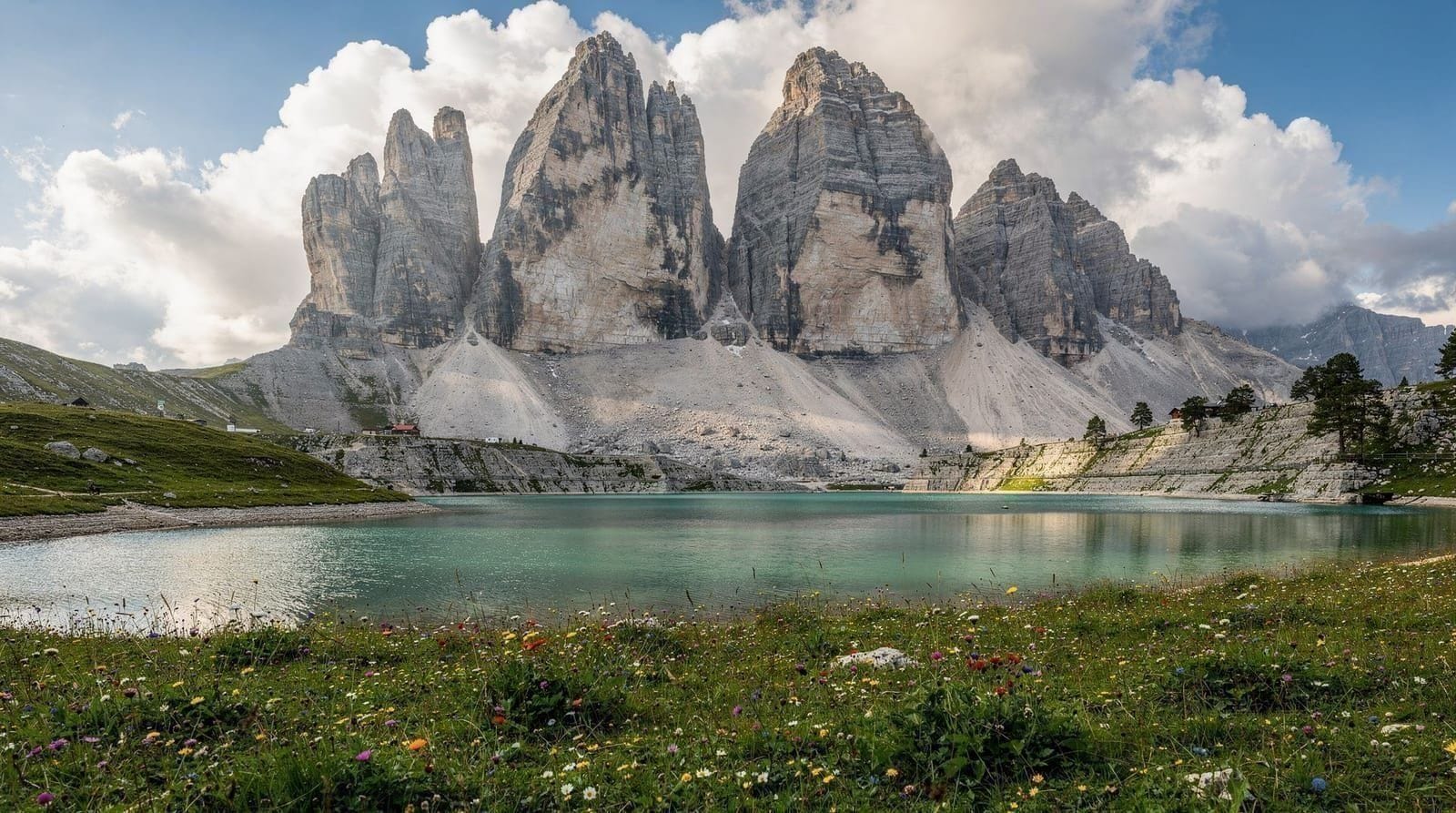
Lake Misurina is worth specifically mentioning: it’s a lake at 1754 metres altitude below the Tre Cime di Lavaredo massif, and it’s accessible by road. The reflection of the Sorapiss massif in the lake on a clear morning is one of the better-known Dolomites photographs. Some Dolomites day tours from Venice include Misurina specifically; ask before booking which stops are on the route.
From Venice: the best of the Dolomites mountains day tripWhat “Dolomites” actually covers on a day trip
This is worth clarifying because the Dolomites is a large range spanning three regions (Veneto, Trentino-Alto Adige/Südtirol, and Friuli-Venezia Giulia), and “Dolomites day trip from Venice” can mean quite different things depending on the operator.
Most tours from Venice go to the Cortina d’Ampezzo area (Bellunese Dolomites) — this is the closest point of the range to Venice, approximately 2h30 by road. Some tours go north toward the Tre Cime di Lavaredo specifically (an additional 45 minutes from Cortina on mountain roads). A few go to the Brenta Dolomites northwest of Trento, which is actually further from Venice and involves a different landscape character.
If the iconic Tre Cime di Lavaredo image — the three vertical pinnacles — is what you’re coming for, specifically book a tour that lists Tre Cime or Lake Misurina in its itinerary. Cortina by itself gives you mountains and the town, not the Tre Cime circuit.
The practical details
Day tours from Venice typically depart at 7 or 8am from Piazzale Roma or Venice Santa Lucia and return by 7 to 8pm. Some stop at Lake Misurina (stunning, accessible by road) before or after Cortina. A few go to Lake Braies (Lago di Braies) instead of, or alongside, Cortina.
If you’re driving, the route is A27 north from Venice to Belluno, then SS51 north to Cortina. Allow 2h30 in August (traffic is significant on the SS51 in summer). Alternatively, the A27 to Belluno and then the Dolomite road through Passo Falzarego is longer but more dramatic.
Self-driving gives you flexibility to stop at viewpoints and avoid the Cortina town centre, which on August weekends is genuinely congested. Guided tours handle the driving and parking, which in Cortina means not having to find a spot in a resort full of Ferraris from Milan.
From Venice: Dolomites, Lake Misurina, and Cortina day tripShould you stay overnight?
Yes, if you have the days. One night in Cortina or in a mountain rifugio transforms the experience — you get the early morning light on the rock, the cooler temperatures, and access to trailheads before the day-trip crowds arrive. Hotel prices in Cortina in summer range from €120 to €300+ per night depending on season and proximity to the lifts.
The Venice-Dolomites 5-day itinerary builds in two nights in the mountains, which we’d consider the minimum for a serious experience. Cortina d’Ampezzo as a destination page also has more on the town itself and what makes the area distinctive.
The weather variable
The Dolomites in August are not guaranteed to be clear. Summer afternoon thunderstorms are common, typically developing between noon and three. Most day trips leave the mountains by mid-afternoon, which means you’re usually back on the valley roads before the storms hit — but the morning window is the important one for views.
If you arrive at Cortina under cloud, the cable car up to the high plateau may be running but unrewarding. Check the forecast for the Cadore area (weather sites covering the Cortina d’Ampezzo valley are more specific than general Italy forecasts) before committing to the cable car.
The Cortina d’Ampezzo destination page has more on the seasonal calendar — when the roads are fully open, when the cable cars run, and what summer thunder means for day-trip planning.
Comparing it to the other big Venice day trips
Against the other major day trips from Venice, the Dolomites is the longest and most weather-dependent — a Padua or Verona day trip is a 25-to-90-minute train ride with a near-certain outcome regardless of conditions, while a Dolomites day is a 5-hour round trip in transit with an outcome that depends partly on whether the afternoon storms hold off. The best day trips ranked post places the Dolomites in tier three for exactly this reason: rewarding, but only with the right expectations and, ideally, more than one day. If mountain scenery is the priority but you don’t want the transit tax, Lake Garda is a shorter, more reliable alternative, though it’s a lake with mountains in the background rather than the Dolomites themselves.
Booking the right tour for what you actually want
Not all “Dolomites from Venice” listings deliver the same day. Some are a Cortina town visit with a cable car; others specifically route through Lake Misurina or toward Tre Cime, adding real driving time but a materially better view. Before booking, check the stated itinerary stops rather than the title alone — a tour titled simply “Dolomites day trip” that doesn’t name Misurina, Tre Cime, or a specific pass is probably a Cortina-only day. If you want the mountain photography rather than just the town, prioritise a tour that names the high points explicitly.
Our verdict
A single day trip to the Dolomites from Venice is worth doing if: it’s your only available day, you’re primarily going for the scenery rather than hiking, and you accept that you’re getting a taste rather than a meal.
It’s not worth it if you’re expecting the iconic Tre Cime dawn shot, serious hiking, or the silence of high-altitude mornings before the crowds arrive. Those require staying longer.
We came back to the Dolomites the following year for four days and understood what we’d been missing. The day trip was a trailer. The longer trip was the film. The Venice-Dolomites 5-day itinerary is the version that actually delivers what the promotional photography promises.